What is The Best Way to Train for a Beginning Runner?

I have been running for a little over a month. I seem to be in decent shape for a former smoker. I started with 2 miles per run, twice a week for the first 2 weeks. Then, I stepped it up to 3 miles per run, again twice a week for the next 2 weeks. This past Sunday, I even completed 4 miles with a friend. In each running session, I made sure to maintain a consistent pace, around a 10-1/2 minute mile. The 4-mile run took us about 42 minutes.
However, I signed up for what I believed to be a 5k three weeks from now. It actually turns out to be a 5 mile race and I am unsure if I can complete it. I'm unsure if I should focus on hill running, cross-training, or sprint training of some kind. I've always been an active person, playing sports or working construction jobs. I am 31 years old and quit smoking 7 months ago.
– Nick, Ohio
Answer by Dominique: Hello!
Thanks so much for your question regarding training for your upcoming 5 mile race. It's fantastic to see that you've embarked on the journey of running. From what I gather, you're progressing pretty well so far. Let me put your mind at ease, since you're already up to 4 miles, you can complete a 5 mile race. It will be fine.
In order to prepare best for this adventure, I have got the following breakdown for you:
1. Most of the Running Should be Easy
2. Benefits of Easy Running
3. Adding Some Faster Running
Most of the Running Should Be Easy

It might seem counter-intuitive at first, but incorporating lots of easy runs into your training routine is a terrific method for building endurance and achieving consistent results. Easy runs help to condition your body and build on your current base. Besides that, it's a great way to burn calories and increase your stamina - all without overstressing your body. It's also beneficial for promoting a steady and healthy heart rate. Plus, easy runs are typically more enjoyable and less stressful for your mind.
Check out the Easy Running Page for more information.
Benefits of Easy Running

As a beginner, your focus should be on increasing your distance and comprehensively enhancing endurance rather than speed. If you rush into extensive speedwork or rigorous hill runs too early, you could find yourself with increased injury risks.
Tortoise and the hare, my friend. Build that base, take it easy, then move on to the more advanced stuff.
Adding Some Faster Running

"Fartlek" is a Swedish term that means "speed play". It involves random bursts of speed during your normal run. Temporarily increasing your pace helps to push your boundaries and can really spice up your training routine.
Tempo running, on the other hand, is a run carried out at a "comfortably hard" pace. It trains your body to sustain speed over distance, which could be very handy for races.
Intervals can be good as well. It is a form of high-intensity interval training (HIIT). HIIT is often touted as the best way to train, but it can lead to exhaustion and stress. So, I am not saying do not do it. But, one interval session is more than enough per week. Balance is the key in running just like in life.
I hope this clarifies your doubts and helps you in your training. I hope the 5 mile race is not the end of the running journey. Best of luck with your race!
Kind Regards,
Dominique
Some Other Pages You May Like
About the author

Dominique de Rooij (Dom)
Advanced Running Coach certified by Athletics Australia with 20 years of writing about running and over a decade coaching runners — from first-timers to marathoners. Dom's beginner programs have guided thousands of runners and been praised above plans from Jeff Galloway, Hal Higdon, and Runner's World. Now over 50, Dom still loves trail running, parkrun, and the coffee after.
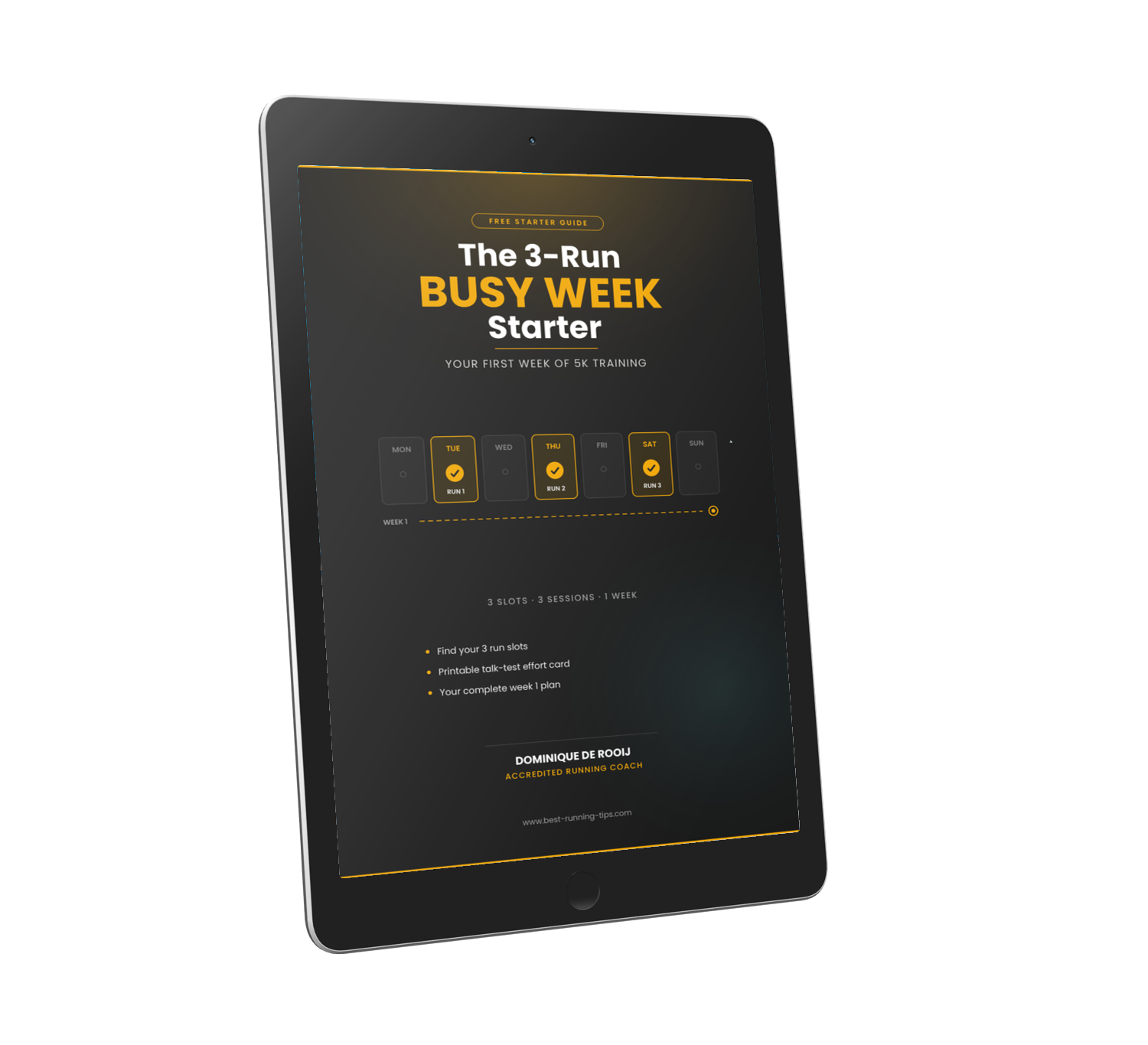
Free beginner guide • From Coach Dom
Start Running This Week, Even If Your Week Is Already Full
Most beginners don't quit for lack of motivation. They quit because their plan doesn't fit their life. The 3-Run Busy Week Starter plans your first week around the week you actually have.
- Find 3 run slots you can actually keep
- The talk test: the simple way to stop running too fast
- Your complete week 1 plan: 3 run/walk sessions, about 20 minutes each
You'll get the guide plus a short email every few days to help you through week 1. Unsubscribe any time. Privacy policy.
What's New?
-
Personalized Running Coaching - BRT | Run Smarter, Race Better
 Get a personalized running program built around your current fitness, goals, and schedule - not a generic app template. Choose from BRT Silver, Gold, or Platinum coaching with Dom, accredited running…
 -
Sample 4-Day Marathon Training Week: Base to Taper
A full 4-day-a-week marathon training schedule, phase by phase - base, build, peak, and taper - with named workouts and weekly mileage. -
Marathon Taper for a 10-12 Week Training Cycle
How to taper correctly on a compressed 10-12 week marathon plan - the right taper length, why standard advice doesn't fit, and the week-by-week structure.