BMI Calculator - Work Out Your Body Mass Index (Quetelet Index)
Let's face it — the Body Mass Index is a blunt tool. I use it on this page because it's widely recognised and genuinely useful as a starting point. Quetelet, the man who invented it, identified a reasonably reliable relationship between your weight and your height. That's the maths behind the number you're about to calculate.
I want to give you a little extra information about the Body Mass Index.
More than you'll usually find. So please keep reading after you've tried the calculator.
I'm also adding some useful links that show you how running can reduce your BMI.

So now you know your BMI — but what counts as high and what counts as low?
These are the standard adult categories (WHO) I'd point you to:
| BMI < 18.5 :: |
Underweight |
| BMI 18.5 to 24.9 :: |
Normal weight |
| BMI 25 to 29.9 :: |
Overweight |
| BMI 30 and over :: |
Obese |
 The Body
Mass Index gives you an indicator
of overweight.
And with that, an indicator of your risk of developing heart and/or artery diseases.
Insurance companies use the BMI, for example.
Is it a good indicator of cardiovascular problems?
Read these comments about the Body Mass Index first — then judge for yourself.
BMI depends on both height and weight. Children's bodies change shape as they grow, so adult cut-offs don't apply to them. Children's BMI has to be compared with age- and sex-specific growth charts.
When you get older, the opposite happens — older people maintain roughly the same weight, but they lose a little height. So for elderly people, BMI loses much of its usefulness too.
Extremely tall people can't really rely on BMI either. For them, mathematician Nick Trefethen argues that raising height to the power 2.5 instead of 2 fits healthy bodies better.
Big people with lots of muscle — bodybuilders, large basketball players, footballers — can't use the Body Mass Index reliably either. Muscle carries a higher relative weight than fat. That's simply how it works.
Asian people generally carry more body fat at the same BMI. For an Asian person, health risk starts to rise from a BMI of about 23 — WHO's 2004 expert consultation put the Asian action points at 23 and 27.5.
So BMI isn't a reliable indicator of obesity for quite a few people. More than half the world's population, actually... :)
If you fall into one of the above groups, be careful when you interpret your result.
That said — if you're not extremely small or tall, and you don't carry a bodybuilder's muscle mass, then BMI gives you a perfectly sensible gauge for obesity.
Your score is over 25?
If you fall into one of the above groups, you may not have much to worry about. But I'd still encourage you to check a few other things:
The honest truth is — you probably already know whether you need to make some changes.
Score lower than 25?
Good — but don't stop there. Check your belly, your exercise pattern, and your eating habits before you decide everything is fine. And again, if you're Asian, a BMI below 25 may still be worth taking seriously.
My advice to you: use BMI as a useful indicator. Don't try to explain away a high reading by telling yourself you're big-boned, big-muscled, or whatever it may be.
Use the time you're spending on this page to think honestly about whether you can do better — for your running and for your wider health.

Want to improve your BMI?
Diet is a major factor!
Some governments are moving away from using BMI as the sole measure of health. They're bringing in additional measures like waist-to-hip ratio and waist measurement alongside it.
I'd expect these measures to carry more and more weight going forward — and BMI to lose some of its dominance.
Want a second measurement? Try your waist.
BMI isn't the only number worth checking. Waist circumference gives you a useful second data point — and all you need is a tape measure.
The Heart Foundation in Australia puts the increased-risk threshold at over 94 cm (about 37 inches) for men, and over 80 cm (about 31.5 inches) for women.
Here's how they recommend you measure it. Find the top of your hip bone and the bottom of your ribs. Breathe out normally, then place the tape midway between the two points, in line with your belly button — loose enough to fit one finger inside. Check your reading.
One caveat — and it's theirs, not mine: this measurement is less accurate during pregnancy, with medical conditions that cause abdominal distension, and for some groups, including Aboriginal and Torres Strait Islander peoples, and South Asian, Chinese and Japanese adults. Bear that in mind and treat it as one more data point rather than the final word.
Full details are on the Heart Foundation's waist measurement page.
Have you worked out you're carrying too much weight? Then set yourself a goal right now. Work out how much you need to lose to get into the healthy range (BMI < 25). While you're at it, use the calories burned calculator to see how many calories your runs are burning. Then use the links above or below to get moving on improving your weight and your running.
Some Other Pages You May Like
About the author

Dominique de Rooij (Dom)
Advanced Running Coach certified by Athletics Australia with 20 years of writing about running and over a decade coaching runners — from first-timers to marathoners. Dom's beginner programs have guided thousands of runners and been praised above plans from Jeff Galloway, Hal Higdon, and Runner's World. Now over 50, Dom still loves trail running, parkrun, and the coffee after.
Free beginner guide • From Coach Dom
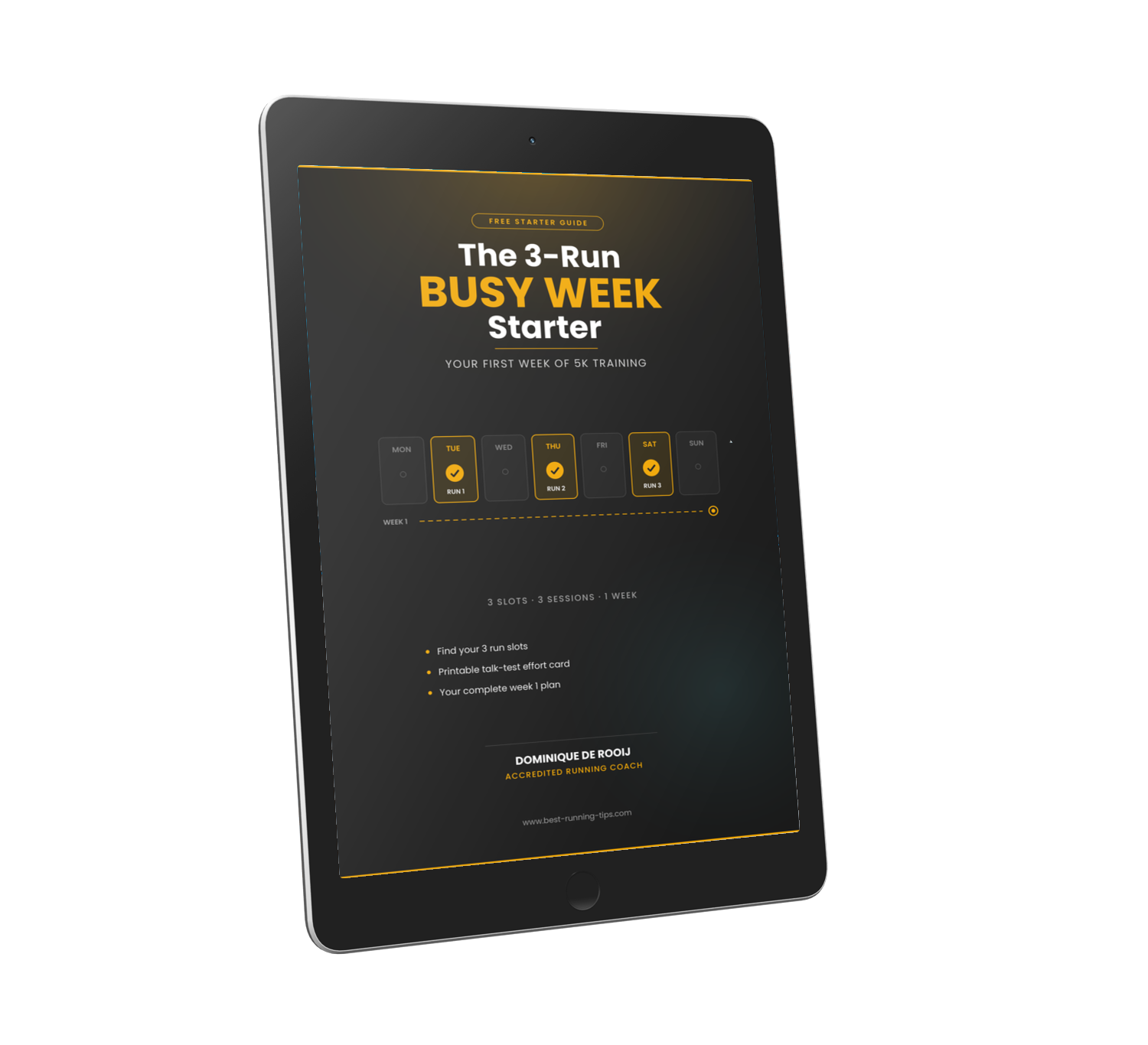
Start Running This Week, Even If Your Week Is Already Full
Most beginners don't quit for lack of motivation. They quit because their plan doesn't fit their life. The 3-Run Busy Week Starter plans your first week around the week you actually have.
- Find 3 run slots you can actually keep
- The talk test: the simple way to stop running too fast
- Your complete week 1 plan: 3 run/walk sessions, about 20 minutes each
I'll email you a link to confirm your address, then send the guide plus a short email every few days to help you through week 1. Unsubscribe any time. Privacy policy.
What's New?
-
Personalized Running Coaching - BRT | Run Smarter, Race Better
 Get a personalized running program built around your current fitness, goals, and schedule - not a generic app template. Choose from BRT Silver, Gold, or Platinum coaching with Dom, accredited running…
-
Sample 4-Day Marathon Training Week: Base to Taper
A full 4-day-a-week marathon training schedule, phase by phase - base, build, peak, and taper - with named workouts and weekly mileage. -
Marathon Taper for a 10-12 Week Training Cycle
How to taper correctly on a compressed 10-12 week marathon plan - the right taper length, why standard advice doesn't fit, and the week-by-week structure.