Beginner Half Marathon Training - Seven Running Tips That Help You Cross The Finish Line
A beginner can finish a half marathon (13.1 miles, or 21.1 kilometres), but the safest way is a nine-month build in three blocks, not the twelve-week plan most schedules offer. Below you'll find seven tips, in the order you will need them: how to split the nine months into blocks, starting with walk-runs three times a week, why to skip speed work for now, adding cross training to rest your lower legs, how often to run and how to build the long run, choosing short-term goals for motivation, and gear and how to pace race day.
Squeeze it into twelve weeks and that is where the injuries and the burn-out begin. I don't think that is quite enough for someone starting from scratch. Slow down the build-up, stay sensible, and you will cross that line smiling.
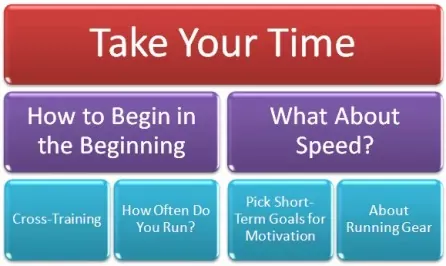
The Beginner Half Marathon Training Page in One Simple Picture
Tip #1 - Take Your Time: Nine Months, Three Blocks
There are beginner schedules out there that get you to a half marathon in only twelve weeks of training. I don't think that is quite enough.
I'd advise you to break your training down in three parts, each consisting of three months:
- Months 1–3: get to running 30 minutes non-stop.
- Months 4–6: build up to 10k.
- Months 7–9: make the final leap to the half marathon, 21.1 km (13.1 miles).
This is a slower approach, but you have got better chances of preventing frustration and injury. Your muscles adapt quickly; your tendons, bones and joints take far longer. Nine months gives them the time.
And do I have suggestions in mind for how to get to 30 minutes, 10k and the half marathon in those three month periods?
Hmm,well, yes I do... :)
Here it is:

Tip #2 - Start With Walk-Runs, Three Times a Week
When you start, you will not be able to cover large distances. That's fine. Just focus on getting out there three times a week and do walk-runs.
Walk-runs combine walking with running. Try 1 minute of running followed by 2 minutes of walking, repeated for 20–30 minutes. The walking breaks let you cover more ground than you could manage otherwise.
Build up your running slowly. Shorten the walking breaks slowly. Add a minute of running here, take a minute of walking away there. Before you know it you will be running for longer and longer. Consistency and patience are key.
Run every run at an easy pace. If you can't talk in full sentences, you are going too fast.
Tip #3 - Skip the Speed Work (For Now)
As a beginning runner, you don't need speed training or interval workouts. You need to work on building your endurance.
Intervals are very strenuous and give you a much higher risk of injury. Just focus on logging miles and being able to make it further and further. Easy running, week after week.
Now, I know that some people will not agree with me here. You may be a fan of Hyrox or CrossFit, high intensity interval training (HIIT) etc and are of the opinion that interval training is better.
Let's just make clear that mine is just another opinion. More research needs to be done on the long-term benefits of HIIT.
I can agree that in the short-term interval training can help you get fitter. But doing intense interval training long-term is pretty unsustainable.
And when you are training for a half marathon where endurance is key, intense intervals are not going to be your optimal way to train.
Tip #4 - Add Cross Training to Rest Your Lower Legs

Cross-training is a topic of much debate in the running community. I advise you to incorporate some cross training into your training schedule.
It gives your lower legs and feet a rest from pounding the pavement constantly, while still keeping you active.
Good examples of cross training are bike riding, swimming, yoga, pilates or weight lifting. Thirty to forty-five minutes of easy effort on a non-running day is plenty.
Also see the strength training for runners and the cross training for runners pages which talk about the benefits of strength training and cross training in more detail.
Tip #5 - How Often to Run, and How to Build the Long Run
Most of us see good improvements when we run at least three times per week.
And I would really advise you to stick to that. Three or four times per week is plenty for the recreational runner.
When you want to do more training, I'd really advocate throwing in some cross-training. Why? Well, did you know that in any given year, a large share of runners (published estimates range from roughly 20% to nearly 80%) have to take time off running due to injury troubles? Many of us just push through and are very bad listeners to our body.
So, in those first six months of training when you are building up to running 10k, I'd advise you to run at least three times per week. In the final three months of training, I'd push it up to four times per week.
The half marathon is a respectable distance. It warrants a bit of extra running training. And when you have got a solid base of six months of running three times per week, then adding another run in is not going to be too strenuous for most of us.
If you want to stick to only running three times per week, you are making it a bit harder for yourself. But it does not make the plan to run a half marathon impossible. What I always recommend you would do though is to add cross-training to your running routine in that instance.
The long run is the one that matters most in the final three months. Here is how I'd build it, starting from a comfortable 10k:
- Add 1–2 km to your long run each week, no more.
- Every fourth week, make it a consolidation week and drop the long run back to about 75% of the week before.
- Your longest run before the race should be around 16–18 km (10–11 miles), about three weeks out.
- Then ease off for two weeks. You don't need to run the full 21.1 km in training. The race-day crowd will carry you the rest of the way.
Run these long runs slowly — a minute per mile slower than you think you should. Slow is the point. Walk through the drink stations if you like, and practise doing so in training.
Tip #6 - Pick Short-Term Goals for Motivation
Working towards a race that is nine months away can be tough. You may find yourself losing motivation or not seeing the need for a training session when your race is so far away.
That's why it would be good if you'd pick some short-term goals. Find a parkrun or sign up for a 5k race that is three months away. Find a 10k race that is six months away. Then start focusing on your half marathon.
Believe me, it will have an influence on you when you are tired and grumpy and don't really want to do exercise!
And getting some race experience is really useful as well. You'll know what it feels like to run a race. To start off way too fast. To deal with many people around you. To share the joy of finishing a race with others. Lots of advantages. So do it!

Tip #7 - Gear, and How to Pace Race Day
As a beginning runner, you don't need all the bells and whistles to start off. Some running shoes, socks, shorts or tights and shirt is really all you need. This can be quite an inexpensive sport.
As you progress through the months, and as your budget permits, it can be useful to look into some of the "bells and whistles". If you are willing to spend big, carbonfibre plated running shoes are a great extra. Not at all necessary when you start running, but if you like to have the bouncy floating feeling of very light racing shoes, go for it!
Another suggestion would be to get a Global positioning system (GPS) Running Watch. A GPS running watch is a really useful tool to have. Just being able to keep track of your speed early in a race is so, so important. Most runners have difficulty containing themselves at the start of a race. So many races get destroyed by simply going out way too fast, then struggling through the second part of the race. Don't let it happen to you!
Clearly if you don't want to spend that type of money, that's quite ok, and there are plenty of cheap running apps that provide you the feedback of knowing how fast you go without having to fork out big dollars.
On race day, my advice to you is simple. Run the first 3 km 10–15 seconds per km slower than your target pace. It will feel too easy. Good. Settle in, hold your easy pace through the middle, and only push over the last 3–4 km if you feel strong. A steady first half and a stronger second half beats the reverse every time.
Don't try anything new on the day. Same shoes, same shirt, same breakfast, same drink you used on your long runs.
I'd say that that's about it. For starters. Have a further look on this website and follow some of the links above for further info.
In summary, beginner half marathon training is not rocket science.
All you need is persistence, consistency and a gradual build-up.
This type of approach is sure to get you to the finish line with a smile on your face!
Some Other Pages You May Like
About the author
Dominique de Rooij (Dom)
Advanced Running Coach certified by Athletics Australia with 20 years of writing about running and over a decade coaching runners, from first races to marathons. Dom created PlanMyRace, a training plan generator for any race from 1500m to the marathon. Now over 50, Dom still loves trail running, parkrun, and the coffee after.
Stop Guessing.
Get a Plan Built for Your Half Marathon.
PlanMyRace builds a personalised half marathon plan around your race date, your current fitness and the days you can actually train. Your weekly mileage and long runs build steadily, your paces come from a recent race result, and a proper taper brings you to the start line ready to race.
Get My Free Half Marathon Plan →No credit card needed. Your full first week is free.
What's New?
-
Cut 90 Seconds Off Your 1.5 Mile Run for the Army Test
Cutting 90 seconds off a 1.5 mile run in 3-4 weeks for the Army test: Dom breaks down realistic pacing to reduce 10:32 toward sub-9:00 for Paras selection. -
Improve Your 1.5 Mile Running Time to 10:30: Shin Splints
From 12:59 to 10:30 for 1.5 miles: Coach Dom's shin-splint fix and training plan to improve your running time in 2-3 months. -
Training for a 1.5 Mile Run - How to Qualify For Your Test
Coach Dom's 3-step plan for 1.5 mile run training: build aerobic base, add strides, then tempo and pace work to hit your test time.