Best Tips to Start Running
Six Beginner Running Tips, Plus Safety, Your First Month and Staying Motivated
The best tips to start running are to run slowly at an easy, conversational pace, mix in walk breaks, build your distance gradually, get properly fitted shoes, and add apparel and gear as you go rather than before you start. Below you'll find six tips, each answering a question every beginner asks, followed by whether running is safe for you, what to expect in your first four weeks, the warning signs of doing too much too soon, what to do when you want to quit, and the basics of sleep, nutrition and rest days.
Most beginners who stop in the first few weeks started too fast and decided running wasn't for them, when the real problem was pace. I get asked how to start all the time, so let me answer it properly, one question at a time.

The six tips are the core of this page, but starting out is about more than those six questions, so I've gone further. After the tips you'll also find whether running is safe for you specifically, what to expect in your first four weeks, the warning signs that you're doing too much too soon, what to do when you want to quit, and the recovery basics: sleep, nutrition and rest days. Each of those sections links to a deeper page if your situation is a bit more specific than “just starting out”.
Let’s get into it.
Best Tips to Start Running #1 - How Fast Do I Run?

Here’s the coaching reason, kept brief: easy running mostly trains your cardiovascular system — your heart. Train your heart and it gets stronger, so every heart beat pumps more blood around your body. You get more stamina and endurance, and you become an overall healthier person as your heart doesn’t have to work as hard.
There’s a coaching detail worth knowing too: I deliberately have my beginner athletes run slower than feels natural at first — slower than instinct tells you to. It feels almost too easy. That’s the point. Running at a slower pace is also just more enjoyable when you’re starting out — it’s far less demoralising than running with your heart pounding and your breathing out of control.
So: easy pace, first and foremost.
Best Tips to Start Running #2 - Is it OK to Take a Rest in Between?
Don’t be embarrassed if you can’t keep running the whole time. Can’t continue? Stop running and have a bit of a walk. That’s completely fine.
Plenty of new runners avoid starting at all because they feel embarrassed — worried they’ll be seen as the person who can’t run far. But avoiding it becomes a vicious circle: don’t exercise, get more unfit, feel worse about yourself, don’t exercise, get more unfit, feel worse about yourself. Break the circle by just starting.
Run until you get tired. Walk a bit. Run again when you feel ready. In fact, combining running and walking — the run/walk method — has real benefits: you spread the load on your legs, and you’re able to cover more ground than running alone would let you.
This is exactly why run/walk is the default method on our structured beginner running programs — not a fallback for people who “can’t run properly”, but the actual training method. If you’d rather follow a set plan than wing it, our Couch to 5K plan is built the same way, and within 8 to 12 weeks you’ll be running 15 to 30 minutes non-stop.
Best Tips to Start Running #3 - Which Distance Should I Run?

A slow build-up is the key to a long, injury-free running life.
A genuinely useful method: just add a minute or two to your running time every time you run, and see how you cope. At some point it’ll feel a bit too hard. When that happens, stop increasing for a few days, hold steady at your current level, and try building up again after a week or so.
The general rule of thumb here is the 10% rule — don’t increase your weekly mileage by more than about 10% at a time. It’s a rough guide, not a law — studies haven’t shown it prevents injuries — so let how your legs feel have the final say. The trick is really just taking baby steps. Don’t fall victim to doing “too much too soon” — that’s how you get injured, or overwhelmed once the initial few weeks of motivation wear off. Take it easy, tiger.
You may think this will never get you anywhere. But run three times a week, add a minute or two each session, and after two to three months you’ll be making fantastic progress.
Check out the increasing mileage safely page for more on how to build up the time and distance you run.
Free beginner guide - From Coach Dom
Plan Your First Week Around Your Real Week
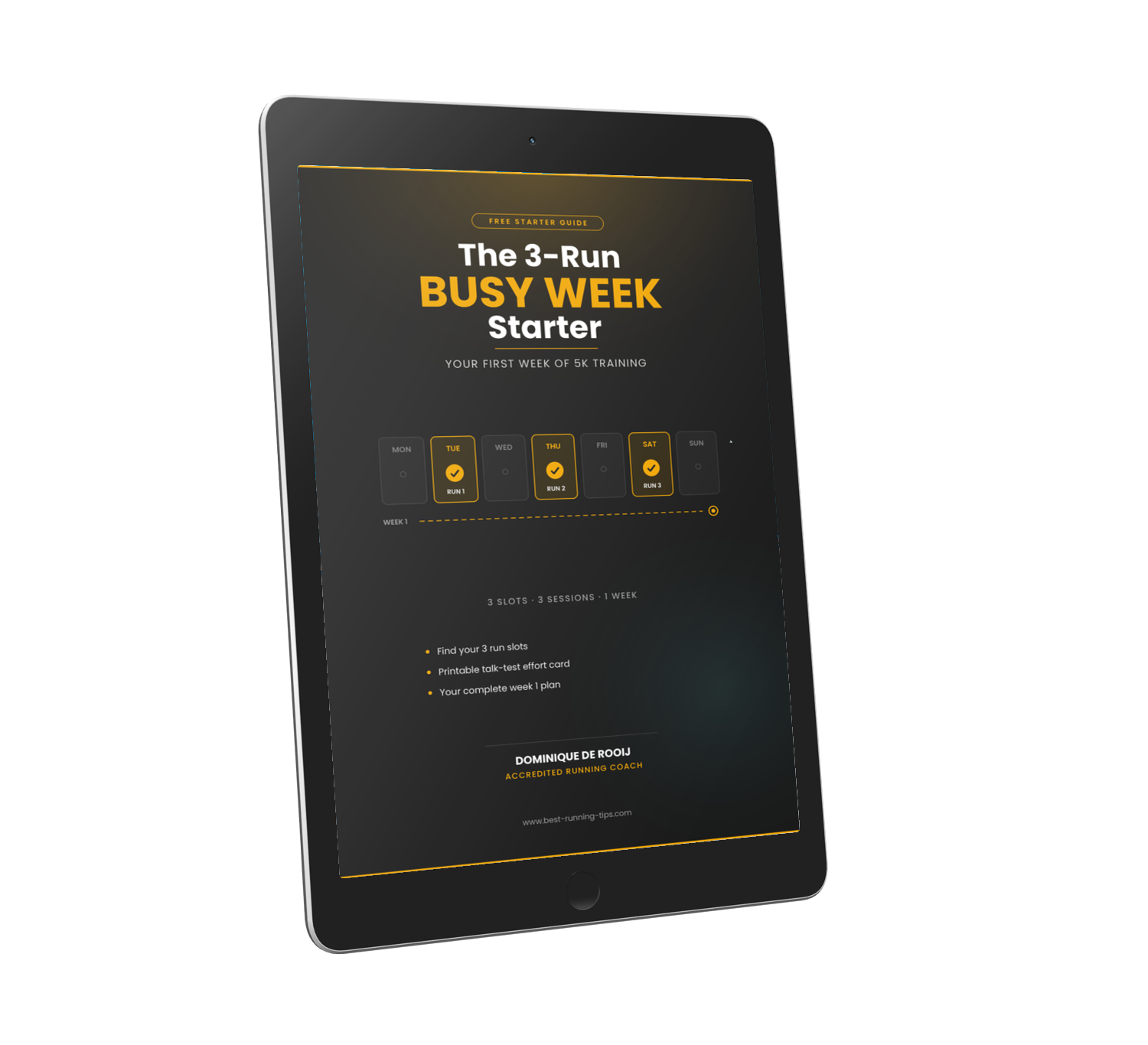
The 3-Run Busy Week Starter helps you find three run slots you can keep, then gives you a complete week 1 plan: three run/walk sessions, about 20 minutes each.
Get the Free Starter →Free guide. Just your email address.
Best Tips to Start Running #4 - Which Running Shoes Should I Wear?

Once you’ve decided you’re in it for the long haul, though, I’d really recommend getting running shoes right for your feet — different feet feel better in different types of running shoes.
Go to a specialised running shoe store. A good store gets you to run on a treadmill, films your feet and lower legs as you run, and watches how your feet land — that’s gait analysis, and it’s how I get the new athletes I coach properly matched to a shoe. Based on that, they’ll recommend the right shoes for your feet.
One extra tip: shop for running shoes later in the day. Your feet swell slightly as the day goes on, so a fitting in the afternoon or evening gets you a truer size than one first thing in the morning.
Getting this right matters — next to doing “too much too soon”, shoes that don’t suit your feet can contribute to injury. If you’re starting out at a higher body weight, our shoes suited to a heavier starting point page covers what to look for specifically.
Best Tips to Start Running #5 - Do I Need Special Running Apparel?
When you’re just starting to run, you don’t need a whole lot of fancy running attire.
Got shoes, socks, shorts or leggings, and a shirt? Then you’re ready to hit the road.
Decide to keep on running? Then gradually acquire better running apparel. For now, anything sporty you can get hold of will do.
There are genuine advantages to proper running apparel, though. It’s much nicer to run in moisture-wicking materials than in cotton clothing — cotton chafes more easily and is generally less comfortable to run in.
One of the first pieces of running apparel I’d recommend is a pair of running socks. When I first started running I had issues like blisters and even a black toenail or two — after the very small investment in proper running socks, I never had those problems again.
And if you’re female, a good running bra / sports bra is essential.
Best Tips to Start Running #6 - Any Useful Gear I Should Know About?

Doing a run/walk programme? A free or cheap interval timer app that alerts you to the change-over between running and walking is pretty handy. There are decent apps out there too that handle global positioning system (GPS) tracking, distance, and average pace while you run. I used iSmoothrun for a while, a long time ago — there are plenty of others now.
Once you’re further into running and don’t feel like carrying a phone, you may want a GPS running watch — to track your heart rate, your power, or both. I’ve used various Garmin models for years and years, but I’ve heard good things about COROS as well. You’ll figure out what suits you.
Running with power or heart rate can help a lot when you’re starting out. It helps you train at the right intensity, and gives you an objective gauge of your progress.
Look, I’m a Dutchman. I physically hurt a little when I spend money. So from that perspective, there’s nothing wrong with starting out simple, low-key, and low-budget before you’re pounding the pavement in the fancy gear. Once you’re further along in your running career, you’ll know when you’re ready to start spending on the gadgets.
Is Running Safe for You Specifically?
Everything above assumes you’re generally ready to start. But your age, your weight, or years of inactivity can change how you should approach that first run — not whether you can start, just how carefully. I’ve built a full decision framework, including when to see a doctor first, on is running safe for you specifically — worth a read if any of those apply to you.What to Expect in Your First 4 Weeks
Beyond “build up slowly”, you’ll want an actual plan for what your first month looks like, day by day — that’s different from following one of the week-by-week programs above. I’ve put together a real day-by-day first month schedule to give you exactly that. If you'd like just the first week planned around your real calendar, my free 3-Run Busy Week Starter gives you three run/walk sessions (alternating running and walking) of about 20 minutes each, plus a worksheet for choosing run slots you can keep.Warning Signs You’re Doing Too Much Too Soon
Some soreness in your first few weeks is completely normal — new movement, new muscles. But there’s a difference between normal beginner soreness and a niggle that’s turning into an early injury signal, and it pays to listen to your body and know which is which before it becomes a bigger problem. Beware pushing through pain that doesn’t ease off after a day or two of rest. I’ve set out the warning signs you’re doing too much too soon in full.When You Want to Quit in the First Few Weeks
Here’s something worth knowing: wanting to quit in weeks one to three is common. It doesn’t mean it isn’t working, and it doesn’t mean you’re not cut out for this. If you’re at that point right now, want to quit already? read this first before you make a decision.Recovery Basics: Sleep, Nutrition, Rest Days
Recovery is part of the plan, not something optional you fit in around it. Sleep, food, and rest days do as much for your progress as the running itself does. I’ve covered the essentials on recovery basics for new runners.Frequently Asked Questions
Do I need to see a doctor before I start running?
Only if specific risk factors apply — your age, an existing health condition, or a long period of inactivity. Otherwise, it’s fine to start cautiously. See is running safe for you specifically for the full criteria.
Should I run or walk-run as a complete beginner?
Walk-run is the default recommendation for nearly all true beginners — not just an accommodation for people who “can’t run properly”.
What should I eat before and after my first runs?
A light, carb-based snack beforehand if you’re running more than 20 to 30 minutes, and a mix of protein and carbs afterward. Full detail is on recovery basics for new runners.
Is this different if I'm already active (e.g. from other sports)?
Yes, a bit. If you're coming from another sport — tennis, dance, anything that's kept you moving — you're not starting from zero, so the approach is slightly different. I've covered that case for runners already active in another sport.
What if I'm starting to run after a back injury or nerve damage?
That's specific enough to need its own answer. I've written a full guide for starting to run after a back injury or nerve damage, built around a run/walk plan that protects the weaker leg.
So, there you have it — six answers to your most pressing beginner questions, plus the deeper reading if your situation calls for it. You don’t need a whole lot of special equipment, apparel, or gear to start running, and you definitely don’t need it all on day one.
Just get out of that door and start an easy run. Do a bit of walking in between. Build it up slowly. And before you know it, you’ll be running like the wind.
More Pages on This Topic
Some Other Pages You May Like
About the author

Dominique de Rooij (Dom)
Advanced Running Coach certified by Athletics Australia with 20 years of writing about running and over a decade coaching runners — from first-timers to marathoners. Dom's beginner programs have guided thousands of runners and been praised above plans from Jeff Galloway, Hal Higdon, and Runner's World. Now over 50, Dom still loves trail running, parkrun, and the coffee after.
Free beginner guide • From Coach Dom
Start Running This Week, Even If Your Week Is Already Full
Most beginners don't quit for lack of motivation. They quit because their plan doesn't fit their life. The 3-Run Busy Week Starter plans your first week around the week you actually have.
- Find 3 run slots you can actually keep
- The talk test: the simple way to stop running too fast
- Your complete week 1 plan: 3 run/walk sessions, about 20 minutes each
I'll email you a link to confirm your address, then send the guide plus a short email every few days to help you through week 1. Unsubscribe any time. Privacy policy.
What's New?
-
Personalized Running Coaching - BRT | Run Smarter, Race Better
 Get a personalized running program built around your current fitness, goals, and schedule - not a generic app template. Choose from BRT Silver, Gold, or Platinum coaching with Dom, accredited running…
 -
Sample 4-Day Marathon Training Week: Base to Taper
A full 4-day-a-week marathon training schedule, phase by phase - base, build, peak, and taper - with named workouts and weekly mileage. -
Marathon Taper for a 10-12 Week Training Cycle
How to taper correctly on a compressed 10-12 week marathon plan - the right taper length, why standard advice doesn't fit, and the week-by-week structure.
