Tempo Running: Pace, Workouts, and How to Build It Into Your Training
Tempo running means running at a comfortably hard pace you could sustain for roughly an hour, sitting between your easy pace and your interval pace (faster repeats with rests in between). For most runners that is roughly their 10K (10-kilometre race) pace plus 15 to 20 seconds per mile (roughly 9 to 12 seconds per kilometre), moving closer to half-marathon pace as you get faster. Below: what a tempo run is, tempo pace by race time, why tempo runs work, the core tempo workouts, how they fit into your week, how to build them up over time, common mistakes, pace by age and fitness level, and warm-up and cool-down basics.Knowing you should run comfortably hard doesn't help much when you're standing at the start of a session staring at your watch, deciding how fast to go. I coach runners through tempo sessions every week, and the pace question is the one that trips people up most, so I'll give you real numbers to start from, the exact sessions I use with my own athletes, and a plan for fitting it into your week without wrecking the rest of your training.
What Is a Tempo Run?
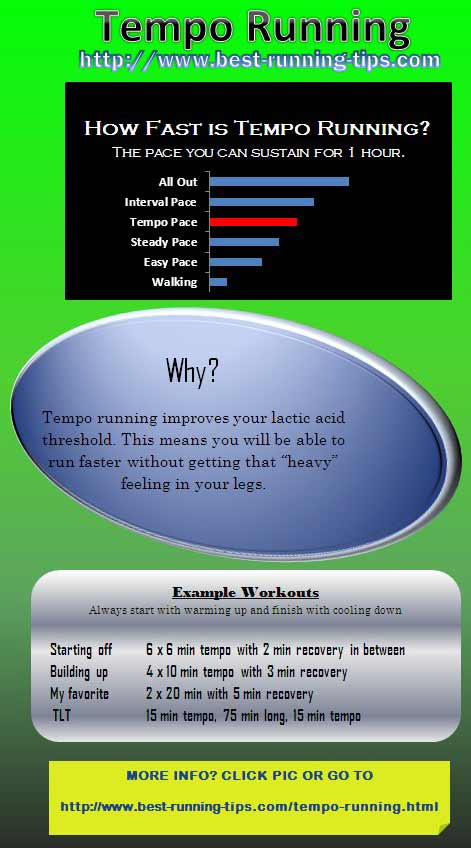
Tempo pace is the pace you could sustain for roughly one hour — sitting right between your easy pace and your interval pace. It's functionally the same as lactate-threshold pace. Why it matters: running at this pace trains your body to clear lactic acid faster, so today's hard pace becomes tomorrow's manageable one.Tempo Pace by Race Time — Precise, Not Vague

| Recent Race Time | Tempo Pace |
|---|---|
| Back-of-pack runner | Your current 10K race pace, plus 15-20 seconds per mile (roughly 9-12 seconds per kilometre) |
| Mid-pack runner | Your current 15K-to-half-marathon race pace |
| Faster / sub-elite runner | Your current half-marathon race pace |
Start here, then refine by feel. Tempo pace should feel comfortably hard — roughly 7-8 out of 10 effort, breathing hard enough that you can only speak in short sentences.
For a pace built around your own numbers, try the tempo pace calculator, or use the general running pace calculator if you'd rather work from a different race distance.
Why Tempo Runs Work (Lactate Threshold, Explained Simply)
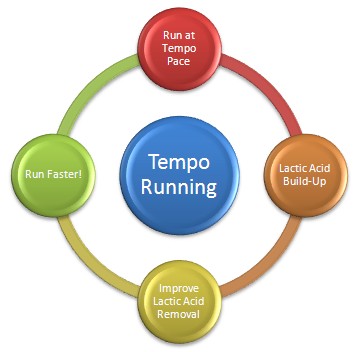
Below tempo pace, your body clears lactic acid easily — it barely builds up. Push faster than tempo pace, like in an interval session, and lactic acid builds up faster than your body can remove it. Before long, your legs feel heavy and you need a recovery break.At tempo pace, you're sitting right on the edge. Some lactic acid builds up, but your body has just enough capacity to clear it. That's the whole point: you're training the removal system itself.
Do this consistently and the same pace gets easier over time. Your body gets better at clearing lactic acid, so the next time you run at that pace, you won't build up as much of it — and you'll clear what you do build up faster.
Here's roughly what that looks like:
Tempo Workouts — The Core Session Types
Pick one structure per tempo session — don't try to run all of these in the same week.Short Tempo Intervals (Mile Repeats)
Run 4-6 x 1-mile repeats at tempo pace, with 2-3 minutes' jog recovery between each. This is the entry format I recommend for most runners new to tempo work; if a full mile at tempo pace is too much, start even shorter with 5 x 4-5 minutes and a 2-minute break (see Building Tempo Training Over Time below).Longer Tempo Intervals
Once you've built a base of tempo work, try 4 x 10 minutes (4-5 minute jog recovery), 3 x 12 minutes (4-5 minute jog), or 2 x 20 minutes (5 minute jog).That last one is particularly brutal. Build up over several weeks of tempo workouts before attempting it, and don't make it a weekly habit — and if you want to build up a genuine dislike of tempo running, do that one every week :)
Continuous Tempo Runs
The simplest format: one sustained 20-30 minute effort at tempo pace. Good if you'd rather skip interval structure altogether.Pyramid Sessions by Heart-Rate Zone
I use longer pyramid sessions when preparing for races — 50, 70 or 90 minutes, built from 10-minute blocks in different heart-rate zones. See the Zoladz Method heart-rate zones guide for how I define each zone.| Session | Heart-Rate Zone Pattern |
|---|---|
| 50-Minute Session | Zone 1-2-3-2-1 |
| 70-Minute Session | Zone 1-2-3-2-3-2-1 |
| 90-Minute Session | Zone 1-2-3-2-3-2-3-2-1 |
The 90-minute session is deliberately tough — it combines long-run duration with hard running in a single workout.
The TLT Session (Tempo-Long-Tempo)
Jack Daniels, one of the most respected coaches in the sport, built a session called the TLT — Tempo-Long-Tempo. After a warm-up, you run a block of tempo intervals, then a long-run block, then finish with another tempo run or tempo intervals.The purpose is twofold: you train your long run on already-tired legs, and you train mental toughness by finishing hard. One warning, in a word: it's a monster. Not a weekly staple — but it has its place in a well-structured programme.
How Tempo Runs Fit Your Weekly Schedule
A tempo session counts as a hard day. Schedule an easy day after it — cross-training, a recovery run, or complete rest — and avoid stacking it against another hard session like a long run or interval workout.Most runners do well with one tempo session a week. For the full breakdown of where tempo work sits alongside your long runs and speed sessions, see fitting tempo runs into your week.
If you'd like tempo runs placed into a complete plan for your next race, PlanMyRace builds a personalised week-by-week plan around your race date, fitness and schedule. Your first week is free.
Building Tempo Training Over Time
Whenever you're starting tempo work — for the first time, or returning after a base-building block — start with the shortest interval format. Try 5 x 4-5 minutes at tempo pace with a 2-minute break, rather than jumping straight to mile repeats.Early sessions can feel discouraging. I've felt it myself — the sense that you can't run fast anymore. That's normal, and it improves within a couple of weeks. For the full week-by-week build, see the 8-week tempo progression plan.
Common Tempo Running Mistakes

Running too fast. If you need to slow down within the first couple of minutes, your pace is wrong — dial it back.
Tackling hilly routes too soon. Get comfortable controlling your pace and effort on flat ground first.
Ignoring the heat. Quality workouts get much harder when it's hot — adjust your pace down accordingly.
See the common tempo running mistakes page for the full list.
Tempo Pace by Age and Fitness Level
The race-time table above is a starting formula, not a finished answer. Age-related recovery needs and fitness-level adjustments deserve their own treatment rather than a generic footnote — see tempo pacing by age and fitness level for the full picture.Warm-Up, Cool-Down, and Execution Basics
Start with a dynamic warm-up, then 10-20 minutes of easy running before the tempo effort begins. Your body needs to be warm before you push past easy pace.Cool down with 5-10 minutes of easy-pace running, plus some gentle stretching. See post-run stretches for a full routine.
The Whole Page, Summarised in One Picture
Tempo running is one of the most effective ways to get faster. If you're training for middle or long distance, it deserves a regular place in your programme.
Tempo workouts are just one piece of a complete training week. For the full range of session types, see other running workout types.
If you do not have a recent race at the distance you need for the pace table, my race conversion calculator will convert a result from a different distance into a predicted time.
Frequently Asked Questions
How do I know if I'm running my tempo run at the right pace?
Use the race-time pace table above as a starting point, then confirm by feel: hard but sustainable, breathing hard enough that you can only speak in short phrases.
How often should I do tempo runs each week?
Once a week for most runners. Treat it as a hard day, and follow it with an easy one.
What's the difference between a tempo run and a threshold run?
None in practice. "Tempo pace" and "lactate-threshold pace" are used interchangeably in most coaching language, including on this page.
Should I do a tempo run before or after a rest day?
Either works, but never schedule it right after another hard session like a long run or intervals. Pair it with an easy or rest day on the other side.
Can beginners do tempo runs, or should they wait?
Build a consistent running habit first. When you do start tempo work, begin with a short interval format (mile repeats, or 5 x 4-5 minutes if that is too much) rather than a continuous effort.
More Pages on This Topic
Some Other Pages You May Like
About the author

Dominique de Rooij (Dom)
Advanced Running Coach certified by Athletics Australia with 20 years of writing about running and over a decade coaching runners, from first races to marathons. Dom created PlanMyRace, a training plan generator for any race from 1500m to the marathon. Now over 50, Dom still loves trail running, parkrun, and the coffee after.
Stop Guessing.
Train for Your Best Race.
PlanMyRace builds a personalised, week-by-week training plan for any race from 1500m to the marathon, around your race date, your current fitness and the week you actually have.
Get My Free Plan →No credit card needed. Your full first week is free.
What's New?
-
Cut 90 Seconds Off Your 1.5 Mile Run for the Army Test
Cutting 90 seconds off a 1.5 mile run in 3-4 weeks for the Army test: Dom breaks down realistic pacing to reduce 10:32 toward sub-9:00 for Paras selection. -
Improve Your 1.5 Mile Running Time to 10:30: Shin Splints
From 12:59 to 10:30 for 1.5 miles: Coach Dom's shin-splint fix and training plan to improve your running time in 2-3 months. -
Training for a 1.5 Mile Run - How to Qualify For Your Test
Coach Dom's 3-step plan for 1.5 mile run training: build aerobic base, add strides, then tempo and pace work to hit your test time.