Training for Police Physical Test
by Shitesh V
(India, U.P., Allahabad)

I am a 26 years old male and I am a beginner. I am trying for a police oriented job. I need to run the following distances:
I have only 2-3 months. Is this possible? I started practice but I feel pain in both my knees. I run 1.6kms in 8 mins.
So what type of running training should I do? Can you please give me any ideas on how to go about this? Thank you.
Answer by Dominique:
Hi there,
Thank you for reaching out with your question about running training for a police physical test! I'm really excited for you that you're aiming for this change in career. It's a challenging goal, but with dedication and the right strategies, I think it is possible for you to achieve it.
Let's cover the following:
1. How hard is it to achieve this?
2. About your knee pain
3. Training for a Police Physical Test
How Hard is it to Achieve this?

It's true that two to three months may not seem like a long time to train, but when you're starting from square one, you'll actually see improvements more quickly than an experienced runner would.
Your body is starting from a lower base level of fitness. Any increase in your physical activity should bring noticeable changes. So, even though it's a tight timeline, it's good to remember that beginners often make faster progress!
About Your Knee Pain
Let's discuss your knee pain now, which concerns me. When you mention pain in both knees, it makes me curious as to what might be triggering it.
Perhaps it's simply because you're not accustomed to running yet. Because when you start something new, like running 1.6 kilometers as quickly as you can, it can be a bit of a shock to your joints and muscles.
Or it could be that your running shoes aren't supporting you properly.
If the pain persists, it’s wise to get it checked out by a doctor. Please do not ignore the problems, try to diagnose what is going on and try to solve them early.
Training for a Police Physical Test
1. Start Easy
When you are starting to run, I'd like to ask you to start running at an easy pace. When you are inexperienced and can't run far yet, a run/walk program is a useful approach to start out.
When run/walking, your runs should be easygoing jogs, nothing too strenuous. Mix this with brisk walking.
Starting out this way is gentler on your body, which might alleviate or even eliminate your knee pain. Plus, it helps you last longer on your feet, building up the stamina you need.
There are run/walk programs on this website that you could use as a guide. You don't have to follow them workout per workout, but use the approach laid out there to suit your own pace and progress:
Beginner Running Programs
2. Keep It Consistent
Consistency is the key to improvement. As an absolute minimum I'd suggest running three times per week. More is better, but I am concerned about this knee pain. Train three or four times a week for eight to twelve weeks without interruptions and chances are, you're likely to see substantial progress.
When you are running three times per week, there is time left over for other activities. Cross training is an important way to build your endurance whilst giving your running muscles and joints a rest.
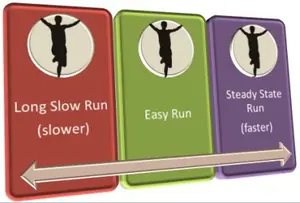
For now, distance should be your main focus, rather than speed. Fast running is certainly more strenuous on the body and can potentially cause running injuries. A mistake beginner runners make is to pick a certain distance they can cover. Then try to run it faster and faster every workout. It can yield some short-term results, but it is important to build endurance.
It would be great if you could build up your runs to be 8k / 5 miles in length or so. More is great, but time is limited, so we just need to see how much you can build up, while doing so safely.
I'd like to see you get really comfortable with 5k-8k runs. It provides a decent base of endurance, which should be well sufficient to run the 5k in 30 minutes. And I hazard a guess that with that stronger endurance base your 1.6 mile time will be much faster than the current 8 minutes as well. Simply for the fact that with a stronger base, you will be able to hold your speed for longer.
Some speedwork
Only easy running can get a bit dull. Variety is the spice of life and incorporating a little bit of faster running in your training program would be smart. Especially because you also need to be able to cover 100m in 16 seconds. You certainly need to have really decent speed to achieve that.
After easy runs, it would be useful to do a few strides a couple of times per week.
Additionally, I'd recommend looking into fartlek workouts, interval running and tempo running. Do one faster workout per week, maximum.
Once again, you should prioritise endurance over speed. All of the above combined should provide you with the ingredients you need to create a personalized running program.
When that continues to be difficult, you can also check out my running coaching services for a 1-on-1 laser-targeted approach to get you ready for this police physical test challenge.
I hope these suggestions assist you in your preparation for the police physical test.
Best of luck on your journey.
Kind regards,
Dominique
Free Download
10 Workouts to Pass Your
1.5 Mile Fitness Test
The exact training sessions used by military and police candidates to hit their target time.
"I did it — even had time to spare!" — James, Ohio
No spam. Unsubscribe any time.
What's New?
-
Want To Do 5 Miles In 38 Minutes
Expert running coach answers how to run 5 miles in 38 minutes. Realistic assessment of the 7:36/mile pace goal plus specific training strategies to get you there. -
Training for a Faster 10K - Expert Running Coach Advice
Expert running coach advice on breaking through 10K plateaus with periodization, proper training structure, and mileage progression for sub-38 performance. -
Base Running: Build Your Aerobic Foundation
 Learn the essential base running foundations every runner needs. Coach Dom explains how to build aerobic fitness safely with step-by-step drills and training tips.