Is Weight a Factor When Beginning to Run?
I am over 200 pounds and wondering if I can safely participate in one of the beginning running programs on your site. Or should I wait until I drop a significant amount of weight before running?
I was limiting myself to walking and other low impact aerobic activity for fear of getting hurt, but then watched a program on television that had very heavy people running on treadmills as well as outdoors. This kind of messed up my thinking.
I would like to get the weight off as quickly as possible and have read that running is the way to go. Could you advise me in this area?
– WinterIsOver, Ilinois
Answer by Dom: Hi WinterIsOver... :), Thanks for your question. By the way, here in Australia the temperatures are dropping, the days are getting shorter and winter is ready to begin! I was actually just working on a few reviews of running gloves... Anyway, back to your question. Yes, you can start now, and you don't need to lose weight first. The trick is to start with run/walk intervals and keep the effort low.
- Why waiting for weight loss is a trap
- What your first three weeks look like, in minutes
- The talk test: how slow is slow enough
- Walking days, shoes and surface
- When to hold a week or back off
Why waiting for weight loss is a trap

You are in a bit of a vicious circle if you first need to drop weight before you can start doing cardio. Regular cardio is one of the most useful tools for getting fit and managing your weight, so waiting just delays the thing that helps.
The Beginners Running Programs are specifically designed for people with a very low fitness base. They combine running and walking. They build up the time spent running very slowly. The focus is solely on getting you to run, and getting you to run slowly. No fast stuff.
The reason many starting runners get injured is that they start off way too enthusiastic. Runs are too quick, they build up the length of the runs too eagerly, and so on. That is the real danger, and it applies at any body weight. My advice to you: be the boring beginner. Boring beginners stay healthy and keep running.
What your first three weeks look like, in minutes
Here is a sample start, and you can adjust it to suit you. Walk briskly for 5 minutes to warm up. Then alternate 1 minute of very gentle jogging with 2 minutes of walking, eight times. Finish with a 5 minute easy walk. That is about 34 minutes in total, but only 8 minutes of it is running.
Do that three times in week one, with a rest or walking day between each session. In week two, I'd recommend lengthening the jog to 90 seconds and keeping the 2 minute walk. In week three, try 2 minutes of jogging, 2 minutes of walking, six or seven times.
Notice what I haven't asked for: speed, distance, or any target pace. A jog can be barely faster than a brisk walk — that is fine. Your only job in these early weeks is to turn up, and finish feeling you could have done a little more.
The talk test: how slow is slow enough

The programs ask you to run at a slow, conversational pace. Here is how to check it. During every jog, you should be able to speak a full sentence out loud without gasping. Try reciting your address or humming a song. If you can't, slow down or walk.
You can also use rate of perceived exertion (RPE), the 1–10 effort scale where 1 is very easy and 10 is all-out. Your jogs should sit around 3 to 4. Your walking breaks should drop back to 1 or 2, so your breathing settles before the next jog.
Most heavier beginners I hear from make one mistake — they jog too fast in the first minute because the legs feel fresh, then they are wrecked by minute six. Start slower than feels necessary. You can't go too slowly at this stage, and the pace will take care of itself as you build up.
Walking days, shoes and surface
Running puts more load through your feet, shins, knees and hips when you carry more weight. Your muscles and fitness adapt fast. Your tendons and joints adapt more slowly — which is exactly why the rest days matter. On the days between runs, walk for 20 to 40 minutes at a steady pace. You keep the habit going and burn energy without the pounding.
For shoes, visit a proper running shop and get fitted. Ask for a cushioned shoe with room for your toes, and expect to spend a bit more than you'd like. It is the one piece of kit that matters.
For surface, a treadmill, a park path or a running track is kinder than concrete. If you run outdoors, choose flat routes while you build up. Skip the hills for now. Hills raise the effort quickly, and they will still be there in a couple of months.
When to hold a week or back off
You don't need to move on every week. If a session left you wrecked, or you finished the week sore rather than pleasantly tired, repeat that week. That is a consolidation week, and it is a smart move rather than a failure.
Back off if you feel a sharp or one-sided pain, or a niggle that gets worse as you run rather than easing off. Swap the run for a walk and give it a few days. Dull muscle ache the next morning is normal. Pain that changes how you walk is not, so listen to your body.
I cannot guarantee that you will stay injury free. Just as with riding a bike, or stepping on a rowing machine or lifting weights, you can pull a muscle, hurt a tendon, etc. But that should not stop you from giving one of the running programs a try. So, don't let the ghost stories out there scare you too much and start your running career today!
One last thing on weight. You said you want it off as quickly as possible. I'd rather you think consistent than quick. Three easy sessions a week for three months will change your body and your fitness far more than a hard fortnight followed by an injury. You have already taken the hardest step by asking the question. Best of luck.
Kind regards,
Dom
Some Other Pages You May Like
About the author

Dominique de Rooij (Dom)
Advanced Running Coach certified by Athletics Australia with 20 years of writing about running and over a decade coaching runners — from first-timers to marathoners. Dom's beginner programs have guided thousands of runners and been praised above plans from Jeff Galloway, Hal Higdon, and Runner's World. Now over 50, Dom still loves trail running, parkrun, and the coffee after.
Free beginner guide • From Coach Dom
Start Running This Week, Even If Your Week Is Already Full
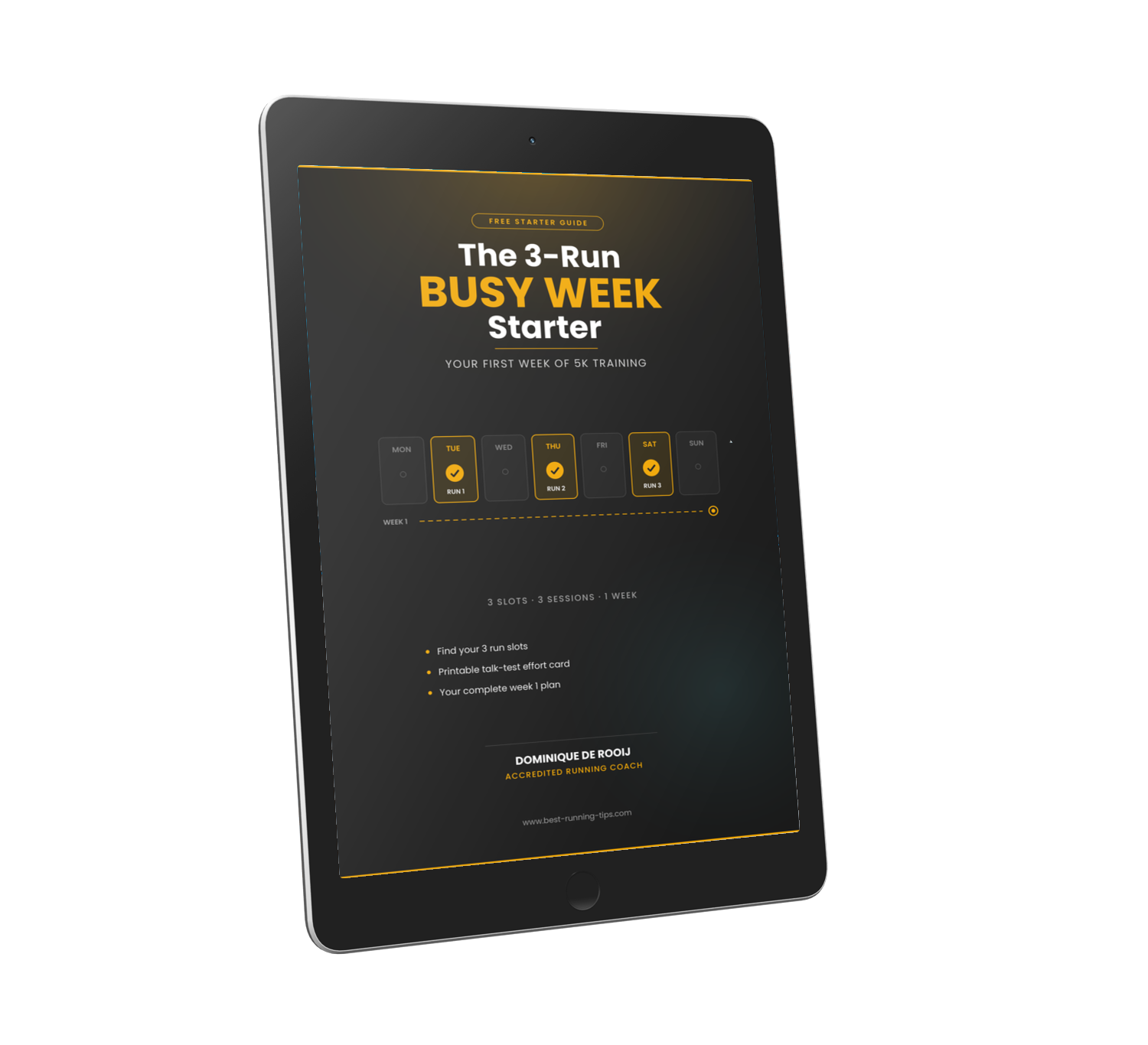
Most beginners don't quit for lack of motivation. They quit because their plan doesn't fit their life. The 3-Run Busy Week Starter plans your first week around the week you actually have.
- Find 3 run slots you can actually keep
- The talk test: the simple way to stop running too fast
- Your complete week 1 plan: 3 run/walk sessions, about 20 minutes each
I'll email you a link to confirm your address, then send the guide plus a short email every few days to help you through week 1. Unsubscribe any time. Privacy policy.
What's New?
-
Cut 90 Seconds Off Your 1.5 Mile Run for the Army Test
Cutting 90 seconds off a 1.5 mile run in 3-4 weeks for the Army test: Dom breaks down realistic pacing to reduce 10:32 toward sub-9:00 for Paras selection. -
Improve Your 1.5 Mile Running Time to 10:30: Shin Splints
From 12:59 to 10:30 for 1.5 miles: Coach Dom's shin-splint fix and training plan to improve your running time in 2-3 months. -
Training for a 1.5 Mile Run - How to Qualify For Your Test
Coach Dom's 3-step plan for 1.5 mile run training: build aerobic base, add strides, then tempo and pace work to hit your test time.