How Do I Prepare for My First 5k?

Hello, I'm a 21 female who is about 30 lbs overweight. I used to do sports in high school but haven't really run in a long time. I want to do a 5k in 3.5 months. I know I need to start running now but how long for how many days?
– Annette, Lawrence, KS
Answer by Dom: Hi Annette, you have about 15 weeks, and that is plenty of time to get ready for a first 5k. You have a sporty background, a clear goal and a sensible question, all good signs. Here is how I'd use those 15 weeks:
- Run/walk from day one, with real numbers
- Three days a week is enough
- Your 15-week schedule
- Strength training twice a week
- Look after your knees and shins
- Race day: start slower than you think
1. Run/Walk From Day One, With Real Numbers

Don't try to run for 20 minutes non-stop in week one. Many beginners who do that end up sore, discouraged or injured within a few weeks.
Start with 1 minute of easy running followed by 2 minutes of brisk walking, and repeat it 8 times. Add a 5-minute walk before and after. That is roughly a 34-minute session, and it will feel easier than you expect. Good. You want to finish each session thinking "I could have done a bit more".
The walking breaks do three jobs. They lower the pounding on your joints, they let your breathing settle, and they give you a finish line every couple of minutes, which matters more than you'd think on a cold, wet morning.
"Easy" has a simple test: you can speak a full sentence while running. If you can't, slow down or walk sooner.
2. Three Days a Week Is Enough
For someone in your situation, I recommend you run/walk three days a week. Make them non-consecutive (say Monday, Wednesday and Saturday), so your legs get a day to adapt in between. Muscles recover quickly; tendons and bones take longer, and that is where beginners get into trouble.
Should you add a fourth day? Not yet. If you feel great after week 8, swap one rest day for an easy 30-minute walk. Keep it a walk.
On the in-between days, do some cross-training such as cycling, swimming or a long walk, if you feel like it. See below for strength training.
A great program to follow alongside this is Beginners Running Program 3. It gets you ready for 30 minutes of running in 12 weeks using a run/walk approach. Use it as your base and my schedule below as a guide for the extra weeks you have.
Now Live - Built by Dom from best-running-tips.com
Get a 5K Plan Built Around Your Race Date
PlanMyRace turns your current fitness, your weekly schedule and your race date into a personalised week-by-week 5K plan, with paces set from a recent race result. Your first week is free.
Get My Free 5K Plan →No credit card needed.
3. Your 15-Week Schedule
Each session starts and ends with a 5-minute walk. The schedule below covers the running part:
- Weeks 1–2: run 1 min, walk 2 min, repeat 8 times
- Weeks 3–4: run 2 min, walk 2 min, repeat 6 times
- Weeks 5–6: run 3 min, walk 2 min, repeat 5 times
- Weeks 7–8: run 5 min, walk 2 min, repeat 4 times
- Weeks 9–10: run 8 min, walk 2 min, repeat 3 times
- Week 11: run 10 min, walk 1 min, repeat 3 times
- Week 12: run 15 min, walk 1 min, then run 10 min
- Week 13: run 20 minutes non-stop, twice, plus a third easy 10-minute run
- Week 14: run 25 minutes non-stop, easy pace, once; the other two sessions 20 minutes
- Week 15 (race week): two short, easy 20-minute runs early in the week, then rest
One rule matters more than the schedule itself. If a week felt hard, repeat it. That's a consolidation week, and it's what makes the build-up sensible. This schedule uses all 15 weeks, so each repeated week pushes your build-up back by a week. If one week needs repeating, you can skip the 25-minute step in week 14 and go into race week on your 20-minute runs; if you need more than one repeat, pick a 5k a few weeks later.
Your runs by week 14 will be 25 minutes. A 5k at beginner pace takes roughly 33–40 minutes, so on race day you'll be running further than you've ever done in training. That's normal and fine, because the crowd, the adrenaline and a slow start carry you through. If you want to be safe, add a 30-minute non-stop run in week 14 instead.
4. Strength Training Twice a Week

Strength work makes running feel easier and keeps your knees, hips and ankles happy while you carry a bit more weight than you'd like. You don't need a gym. Since you are carrying a bit of extra weight, a quick check-up with your doctor before you ramp up is worth it, and see them if you get any pain that doesn't settle.
Two sessions per week, 15–20 minutes each, on your non-running days. Do these:
- Bodyweight squats
- Lunges
- Glute bridges
- Calf raises
- Planks
Start with 2 sets of 10 repetitions (20–30 seconds for the plank), and move to 3 sets after a month. Push-ups are a nice extra for your upper body, but your legs, hips and glutes do the work on race day, so spend your time there. Check the link for more ideas for strength training for runners.
5. Look After Your Knees and Shins
Carrying extra weight adds load with every stride, so your joints and shins need more patience than most. Three things help:
- Shoes: Get fitted at a proper running shop. Don't go on looks or price. Replace them somewhere between 300 and 500 miles.
- Surface: Run on grass, trails or a track when you can, and pavement when you can't.
- Minor aches: A dull ache that fades once you warm up is normal. Sharp pain, or pain that gets worse as you run, means stop. Take two or three days off and walk instead.
Listen to your body. Missing three days costs you nothing. Running through a shin injury costs you weeks.
6. Race Day: Start Slower Than You Think
Most first-time racers go out far too fast. The first kilometer (1 km is about 0.6 miles) feels easy and by the third you're out of steam.
Start at the back of the pack, run at the pace you've trained at, and use the same run/walk pattern you practiced. Walking in a race is not cheating. Plenty of people walk through a 5k, and nobody at the finish line is counting. Eat what you normally eat, wear what you've already run in, and do not try anything new on the day.
Finish the first 5k, then decide whether to go faster, further or both. I have a feeling you'll want to.
Kind regards,
Dom
Some Other Pages You May Like
About the author
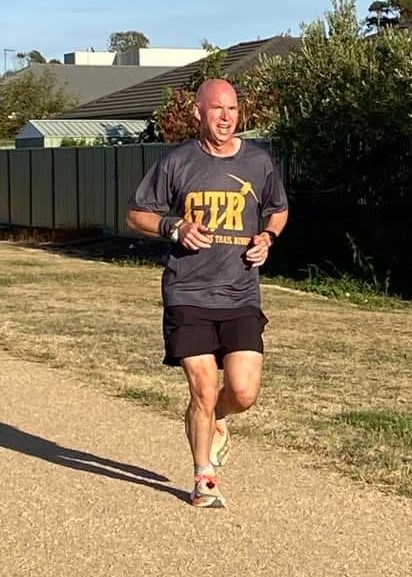
Dominique de Rooij (Dom)
Advanced Running Coach certified by Athletics Australia with 20 years of writing about running and over a decade coaching runners, from first races to marathons. Dom created PlanMyRace, a training plan generator for any race from 1500m to the marathon. Now over 50, Dom still loves trail running, parkrun, and the coffee after.
Stop Guessing.
Get a Plan Built for Your 5K.
PlanMyRace builds a personalised 5K training plan around your race date, your current fitness and the days you can actually train. Your paces come from a recent race result, so hard days are hard enough and easy days stay easy. Made for runners who can already cover 5K and want to run it faster.
Get My Free 5K Plan →No credit card needed. Your full first week is free.
What's New?
-
Cut 90 Seconds Off Your 1.5 Mile Run for the Army Test
Cutting 90 seconds off a 1.5 mile run in 3-4 weeks for the Army test: Dom breaks down realistic pacing to reduce 10:32 toward sub-9:00 for Paras selection. -
Improve Your 1.5 Mile Running Time to 10:30: Shin Splints
From 12:59 to 10:30 for 1.5 miles: Coach Dom's shin-splint fix and training plan to improve your running time in 2-3 months. -
Training for a 1.5 Mile Run - How to Qualify For Your Test
Coach Dom's 3-step plan for 1.5 mile run training: build aerobic base, add strides, then tempo and pace work to hit your test time.