Base Running: Build Your Aerobic Foundation

I need to tell you something that might surprise you: for any race distance 800m and up, endurance matters more than speed. Yes, even for a short race like the 800m, aerobic endurance trumps speed. Of course, as race distances increase, the reliance on your base becomes bigger and bigger. You need rock-solid endurance to run hard for long periods. Without that aerobic foundation, your speed becomes pretty useless.
So, want to race 800m or longer? Then easy running needs to be a massive part of your running program. Easy running builds endurance. Easy running builds a strong aerobic system. Everything else builds on top of this.
I always use the house-building analogy with my runners: your aerobic base is your foundation, the stud walls and the quality building materials. Your speed is the fancy paint or wallpaper on the wall. Neglect your aerobic base and that fancy painted wall will start to show cracks soon enough and before you know it the entire house collapses.
What Makes Base Running So Effective

You want to run easy — the pace where you can hold a conversation, or even slower. This is almost completely aerobic running.
Every heartbeat pumps blood through your body. That blood carries the oxygen your muscles desperately need to function. When you do base running consistently, you train your heart to pump more blood with every beat.
More base running → stronger heart → more blood pumped → more oxygen delivered to your working muscles.
But base running does more than strengthen your heart. Easy running transforms your muscles at the cellular level. Your muscles learn to:
- Increase mitochondria that process oxygen
- Burn fat efficiently as fuel
- Receive oxygen better
- Handle lactic acid more effectively
The Essential Base Running Drills

Base Running Drill #1: Long Slow Run
A weekly long run every weekend works well for most serious runners. Usually reasonably slow, sometimes with quality mixed in. Depending on where you are in your program and how advanced you are, this runs between 30 minutes and roughly three hours.
In the end, the long run is the longest run of the week. If that's 10 minutes for you now, that's fine, you'll build it up over time. Your pace can be markedly slower than easy running, or right at easy pace. If you use a heart rate monitor, you'll run in Zone 1 (about 50 beats below max heart rate) up to Zone 2 (about 40 beats below max).
The key isn't speed — it's time on your feet. You teach your body to use fat as fuel and build the aerobic machinery that'll serve you in every race.
Base Running Drill #2: Easy Running

Most runners mess this up by going too fast. If you can't talk comfortably, slow down. Your ego might take a hit, but your fitness will soar.
Want some heart rate guidance? Your easy running should be at about 70% of max heart rate. That's an upper limit. Base Running Drill #3: Recovery Running
When your legs feel tired from yesterday's hard workout, get out and log some miles anyway. Recovery running helps against muscle soreness and adds miles to your weekly total.
Speed matters far less than just getting out there and putting yourself through a few slow miles.
Also note that cross-training works well for recovery from hard running days.
Base Running Drill #4: Steady State Running
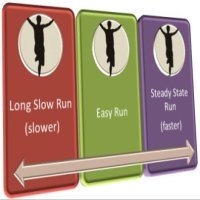
Runners should cover all running speeds in training. Each speed delivers its own benefits. Steady state running should be part of your running program.
Base Running Drill #5: Progressive Long Runs
Sometimes you want to combine different types of running in one session. The progressive long run does this perfectly — you gradually increase your speed as the run progresses.
Not technically pure base running, but it combines easy running and steady-state running with even faster running.
This type of workout helps you get ready for running on tired legs. This is important for all races, but especially half marathons and marathons where you spend a prolonged time on tired legs. An example run like this is a 90 minute session where you increase pace every 15 minutes. You might start at very slow, easy pace and finish at moderately hard or hard pace, close to your tempo pace.
An alternative to the progressive long run is the long run with a fast finish. As you'd expect, you run easy for most of the distance with the last 2-4 miles at faster pace. For example, a 2 hour run with the last 15 minutes at marathon pace.
And yet another alternative is to do a long run with some faster steady-state intervals, e.g. a 12 mile run with 4 x 1 mile at sub-threshold / steady state pace.
Drill Progression Table: Beginner vs Intermediate vs Advanced Base Runners

Beginner Runners (0-1 years of consistent running)
Weekly Structure:
- Long runs: 45-75 minutes, very conversational pace
- Easy runs: 20-40 minutes, 3-4 times per week
- Recovery runs: 15-25 minutes after any harder efforts
- Steady state: Regular intervals. You may start with something like 3 x 5 minutes steady state with 1 minute recovery.
- Progressive runs: Save these for later in your development
Intermediate Runners (1-3 years of consistent running)
Weekly Structure:
- Long runs: 75-120 minutes, mix of easy and steady-state pace
- Easy runs / recovery runs: 30-60 minutes, 2-4 times per week
- Steady state: 2-3 x interval sessions ranging 25-30 minutes of intervals (5 x 5 min, 3 x 8 min, 3 x 10 min, etc)
- Progressive runs: Monthly, starting with 60-minute progressions
Advanced Base Runners (3+ years of consistent running)
Weekly Structure:
- Long runs: 90-180+ minutes, incorporating various paces and efforts
- Easy runs / recovery runs: 45-75 minutes, 2-4 times per week
- Steady state: 2-3 x interval sessions ranging 30-45 minutes of intervals
- Progressive runs: Bi-weekly, up to 2+ hour progressions
The progression isn't just about doing more — it's about doing it smarter. Advanced runners can handle more complexity in their base training while beginners need to focus on consistency above all else.
Common Mistakes Runners Make During Base Phase Training
Common mistakes plague runners during base phases. Here's how you can avoid them.Mistake #1: Running Your Easy Days Too Hard
This is the big one. You check your watch, see you're running 8:30 pace when you "should" be running 8:00 pace, and speed up. Wrong move.
Easy means easy. Keep that heart rate low. If you can't hold a conversation, you're going too fast. The pace doesn't matter as much as the effort — run by effort, not by pace.
The fix: Leave your watch at home occasionally. Run by feel and breathing. When you can chat comfortably, you've found your easy pace.
Mistake #2: Skipping Recovery Runs Completely
You think rest days mean complete rest. Sometimes that's true, but often a 20-30 minute shuffle does more good than sitting on the couch.
Recovery runs promote blood flow, reduce muscle stiffness, and maintain your running rhythm. They're not junk miles — they're active recovery.
The fix: Make your recovery runs stupidly easy. If you feel any strain at all, slow down more. The goal is movement, not training stimulus.
Mistake #3: Making Every Long Run a Grind
Your long run becomes this massive sufferfest every weekend. You finish exhausted, and you need three days to recover. That's not building your base — that's just beating yourself up.
At times, this may become inevitable. When you are training for your first marathon, pushing the long run up to 3 hours or even longer, it can become a really difficult challenge.
But most long runs should feel relatively comfortable. You should finish feeling like you could keep going if you had to.
The fix: Run your long runs at a pace where you could theoretically continue for another 30-60 minutes. Save the grind for specific workouts.
Mistake #4: Ignoring the Steady State Gap
You do easy running and you do tempo running, but you never touch that middle ground. Steady state running — that comfortably hard pace between easy and tempo — gets completely ignored.
This leaves a gap in your aerobic development. Steady state builds crucial capillary density and teaches your body to process lactate more efficiently.
The fix: Add one steady state session per week. Start with 20 minutes and build up. Do this type of "somewhat faster" work in intervals. And it should feel comfortably hard — you're working, but not straining. A good check on whether you are going too fast: are you checking your watch regularly to see how much more is left? Then you're likely going too fast!
Mistake #5: Rushing Through Base Building
You spend 4-6 weeks doing base work, then immediately jump into intense speed work. Your base isn't nearly established enough to support that higher intensity.
Real base building takes months and years, not weeks. The longer you can stay in base building mode, the higher your ceiling becomes for everything else.
The fix: Plan longer base phases. If you're used to 6 weeks of base work, try 12-16 weeks. Your body will adapt better and your eventual speed work will be more effective.
I would argue that you can focus on just base building and not do any type of interval running and continue to improve for a very long time (years!).
Mistake #6: Doing Too Much Too Soon
You read that advanced runners do 70-mile weeks, so you jump from 10 miles to 30 miles to 50 miles overnight. Your body isn't ready for that volume increase.
The 10% rule exists for a reason. Gradual increases in volume allow your connective tissues, bones, and aerobic system to adapt safely.
The fix: Increase weekly mileage safely. A reasonable rule is to do it by no more than 10% each week. Still, patience beats aggression every time. Take your time to build up and go lower than 10% per week if niggles appear.
Mistake #7: Neglecting Consistency for Perfection
You miss a few runs, then try to "make up" for lost time by doing extra-long or extra-hard sessions. Or you don't quite have time to do the session as planned, and because of that, you decide not to run at all. This disrupts the steady, consistent stimulus that base building requires.
Base building is about consistent, moderate stress over long periods. Individual heroic efforts don't build your base.
The fix: Prioritise showing up over perfect execution. A consistent 80% effort beats sporadic 100% efforts every time.
Connecting Base Running to Your Complete Training System
Base running doesn't exist in isolation — it's the foundation that supports everything else in your program. Here's how these drills connect to the bigger picture.Your base work directly feeds into more specific training phases. Those steady-state runs prepare you for quality sessions. The aerobic capacity you build through long runs becomes the platform for effective interval running later.
When you're ready to add variety to your base training, fartlek sessions offer a perfect bridge between pure aerobic work and structured speed work. These playful speed sessions maintain the aerobic emphasis while introducing your legs to faster running.
The base phase is also ideal for building supporting systems through strength training. The lower running intensity leaves energy for resistance work that'll pay dividends in later training phases.
Remember, everything in training connects. Your base running creates the platform for specific workouts, supports your ability to hit goal pace in races, and provides the aerobic foundation needed for advanced training methods.
The time you invest in base running now determines how effectively you'll handle every other aspect of training. This isn't the glamorous part of running, but it's the most important part.
Advanced Base Running Strategies


Marathon Pace Integration
In marathon preparation, I recommend doing plenty of marathon pace runs during the base phase. Start with 8-mile marathon pace efforts early in the training plan, then gradually build to 16 miles over time.
General rule of thumb is that if you can do a 16 mile marathon pace run, and you have done all the other training, you should be able to do the full marathon at marathon pace.
These runs build race-specific endurance on top of your aerobic foundation.
Combination Workouts
Advanced base builders can handle workouts that blend different training systems. Here are some favourites:
TLT (Tempo-Long-Tempo): Do a 15 minute tempo run, 60-90 minute long run, then finish with a 15 minute tempo run. This develops both aerobic capacity and lactate tolerance. That last 15 minutes seems to last forever...!
Long Run with Inserts: Long run with 3 x 3-6 minutes faster running inserted somewhere. Make sure to include plenty of easy running between the faster parts. You don't want this to become a full-blown interval session.
These combination workouts train your body to run faster on tired legs, which is exactly what racing demands.
Terrain Variation
Don't do all your base running on flat roads. Hills during easy runs build strength and power while maintaining the aerobic emphasis. Trail running adds proprioceptive challenges and keeps your mind engaged during long efforts.
I recommend doing at least 20% of base running on varied terrain. This makes runners more complete while reducing the repetitive stress of road running.
Seasonal Periodisation
As stated before, you can get by on building your base alone. For a very long time. Months and years. And you'll continue to see improvements. For many of us that type of training does not offer enough variety. So many runners will want to move to some speed training as part of their race preparations. As the race gets closer you can add some more race-specific training into your program. Even then, the majority of your running should still be at the easy / steady-state level.
Building your base forms the foundation of every successful training program. Master it, keep at it, avoid the common mistakes, and progress systematically through the levels. Your racing will improve as a natural consequence of better aerobic development.
The magic isn't in the individual workouts — it's in the consistent application over months and years. Base running rewards patience and punishes shortcuts. Do the work, trust the process, and watch your running transform.

Some other pages you may like
Home > Training & Performance > Base Running Drills

About the author

Dominique de Rooij (Dom)
Advanced Running Coach certified by Athletics Australia with 20 years of writing about running and over a decade coaching runners — from first-timers to marathoners. Dom's beginner programs have guided thousands of runners and been praised above plans from Jeff Galloway, Hal Higdon, and Runner's World. Now over 50, Dom still loves trail running, parkrun, and the coffee after.
Free weekly coaching • Join 3,500+ runners
Train Smarter, Not Just Harder
Get your free guide when you join the BRT Coaching Letter
No spam, ever. Unsubscribe in one click, any time.
What's New?
-
Personalized Running Coaching - BRT | Run Smarter, Race Better
 Get a personalized running program built around your current fitness, goals, and schedule - not a generic app template. Choose from BRT Silver, Gold, or Platinum coaching with Dom, accredited running…
 -
Sample 4-Day Marathon Training Week: Base to Taper
A full 4-day-a-week marathon training schedule, phase by phase - base, build, peak, and taper - with named workouts and weekly mileage. -
Marathon Taper for a 10-12 Week Training Cycle
How to taper correctly on a compressed 10-12 week marathon plan - the right taper length, why standard advice doesn't fit, and the week-by-week structure.