Hill Running Workouts: 5 Sessions to Build Strength and Speed

But conquer the hills and you'll reap the rewards. I'm lucky enough to live somewhere with plenty of hills, so I build them into my long and easy runs often — and I notice the difference in races. I fly past runners who've skipped the hill work. Hill running is strength training in disguise.
Below are five structured hill workouts, the technique that makes them count, and where hill training fits into different types of training weeks.
What Is a Hill Running Workout?
A hill running workout is a structured set of efforts run uphill, at varying steepness and duration, built to develop strength, lactate threshold and running mechanics that flat running can't reach on its own. Most sessions mix two broad categories: short 8-10 second sprints for raw power, and longer 1-10 minute efforts for lactate threshold and aerobic strength. Here's why that combination works so well.Why Hill Running Transforms Your Running
Before we get into the workouts, it's worth understanding what hills are actually doing to your body — because once you get it, you'll stop avoiding them.
Strength without the gym
Hill running forces your glutes, hamstrings, and calves to work significantly harder than flat running. You're building the kind of leg strength that prevents iliotibial (IT) band issues, runner's knee, and shin splints — without a single squat rack in sight.Speed without the track
Running uphill at threshold effort improves your lactate threshold — your body's ability to keep clearing lactic acid while you hold pace. That adaptation carries directly into faster times on flat ground. Add consistent hill work and your flat running gets faster almost as a side effect.Better mechanics, automatically
Hills force better form. You naturally adopt a slight forward lean, a higher cadence, and a more efficient arm swing. These improvements don't stay on the hill — they carry into all your running.Mental toughness you can bank
Hills teach you to keep going when it hurts. That mental edge shows up in races when things get hard in the final kilometres and others start to fold.Hill Running Technique: Uphill and Downhill
Get these five things right and you're ready to run hills well today.
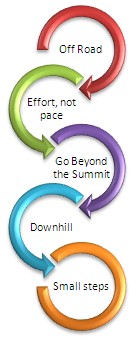
Run by Effort, Not Pace

Run by feel. Your pace will drop. That's fine. That's correct.

Go Beyond the Summit

Push on a little further past the summit instead — it helps clear the lactic acid that's built up, and it's exactly where places get made in races. Almost everyone slows down the moment they crest a hill. Practise pushing past it deliberately in training, and it becomes automatic.
Train Off-Road When You Can

Small Steps, Big Arms Uphill

- Lean forward from the ankles, not the waist
- Shorten your stride and raise your cadence
- Drive your arms to help power you forward
Master the Downhill (Briefly)

My own rule for downhill running is simple: let go of your legs, and let go of your brain. I cover the full downhill running technique and safety breakdown on its own dedicated page.
The 5 Hill Running Workouts

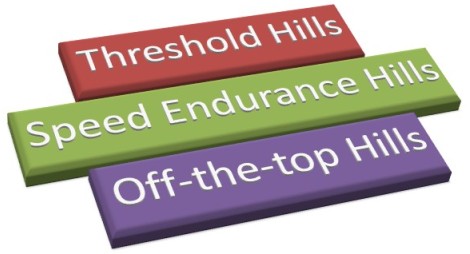
| Workout | Purpose | Session Structure | Effort |
|---|---|---|---|
| Threshold Hills | Build lactate threshold and muscular endurance | 12-20 reps, 1-2 min up at threshold effort, jog back down in 1-3 min | 7-8/10 |
| Speed Endurance Hills | Build power, speed endurance and mechanical efficiency | 8-12 reps, 30-45 sec sprint up, walk/jog back down | 8-9/10 |
| Off-the-Top Hills | Train you to keep pushing once you've crested | 8-12 reps, hard 30-90 sec up plus 30-90 sec sustained past the crest, 2-3 min recovery | 8/10 |
| Hill Sprints | Build maximum power and running economy | 4-8 reps, 8-10 sec at absolute max, full 90 sec-2 min recovery | 10/10 |
| Seasonal Long Hill | Build aerobic strength for sustained climbs | 3-5 reps on a 5-10 min climb, jog/walk back down | 6-7/10 |
Workout 1: Threshold Hills
The purpose: Build lactate threshold and muscular endurance — this is your bread-and-butter hill session.The session:
- Warm up: 15 minutes easy
- Main set: Run up at threshold effort for 1–2 minutes, jog back down in 1–3 minutes. That's one rep.
- Repeat 12–20 times
- Cool down: 10 minutes easy
One session I do on a hill near me: 2 minutes up at threshold, 3 minutes jog back down. It's a tricky one. Two minutes on a hill at threshold effort really starts to hurt quickly. But that's exactly the adaptation you're after.
Progress it: Start at 12 reps, add one or two per week until you're doing 20. This is the same rep-progression rule I use with athletes moving from base into hill-specific strength work.
Your uphill pace will be significantly slower than flat threshold pace — that's correct. Run by effort, not the numbers. This type of session fits perfectly with tempo running principles — it's all about training at your lactate threshold.
Workout 2: Speed Endurance Hills
The purpose: Build power, speed endurance, and mechanical efficiency.The session:
- Warm up: 15 minutes easy
- Main set: Sprint up the hill for 30–45 seconds. Walk or jog back to the start. Repeat 8–12 times.
- Cool down: 10 minutes easy
This one builds the kind of leg power that translates directly into faster race times. The short recovery keeps you working at a high intensity without completely blowing up.
Workout 3: Off-the-Top Hills
The purpose: Train your body to keep pushing once you've crested a hill — essential for racing.The session:
- Warm up: 15 minutes easy
- Main set: Run up hard for 30–90 seconds, then continue at the same effort for another 30–90 seconds beyond the summit. Recover for 2–3 minutes. Repeat 8–12 times.
- Cool down: 10 minutes easy
The key is not backing off at the top. That's what everyone else does — that's why you'll be passing them. This workout conditions that reflex out of you so it doesn't happen in races.
Workout 4: Hill Sprints
The purpose: Build maximum power and running economy. These are an excellent alternative to strides.The session:
- Warm up: 15 minutes easy plus some dynamic drills
- Main set: Find a steep hill. Run up at absolute maximum speed for 8–10 seconds. Walk down slowly and rest for a full 90 seconds to 2 minutes. Then go again.
- Start with 4–6 sprints, build to 6–8 over several weeks
- Cool down: 10 minutes easy

This endurance/strength framing of hill sprints is different from the shorter, pure speed-focused version — for hill sprints as part of a speed session, see speed training for runners.
Workout 5: Seasonal Long Hill
The purpose: Build aerobic strength and endurance over sustained climbs — more relevant for trail runners and hilly road races.The session:
- Find a hill that takes 5–10 minutes to climb
- Run up at a controlled, sustainable effort (6–7 out of 10)
- Jog or walk back down as recovery
- Repeat 3–5 times
- Total climbing time: 20–40 minutes
This builds the aerobic engine specifically for sustained climbing. If your target race has long climbs rather than short punchy ones, this is the session you want.
Building Hill Work Into Your Training
You don't need to do all five workouts every week. Here's how to slot them in sensibly.
If You're New to Hill Training
Keep it simple: hill sprints only for the first two weeks, add threshold hills from week three, and work up to the full rotation by weeks seven to eight. Start on gentler gradients around 3–5%, and get your form right before you add intensity.If You've Been Running Consistently for 6+ Months
A solid weekly pattern:- One threshold or speed endurance hill session
- Hill sprints once a week (6–8 reps)
- Include rolling hills in one easy run per week
- Long run with natural hills built in where possible
If You're Racing Regularly
In the 4–6 weeks before a hilly race:- Off-the-top hills once a week (practising the race-specific behaviour)
- Hill sprints maintained for power
- Drop total hill volume in the final 10 days — maintain quality, reduce quantity
Recovering From Hill Sessions (and Knowing When You're Overdoing It)
Hills create more muscle damage than flat running, especially downhill work. Here's how to recover well.
After a hard hill session:
- Keep moving for 10 minutes easy — don't just stop
- Eat something with both protein and carbs within 30–45 minutes
- Gentle stretching on your calves and hip flexors
- Easy run or cross-training only
- If your legs are genuinely sore, walk instead — don't force it
- Persistent heavy legs that don't improve after an easy day
- Motivation dropping significantly
- Resting heart rate creeping up
No Hills Nearby? Using a Treadmill
Yes, with some limitations. A treadmill at a 4–8% incline reasonably replicates uphill effort, so hill sprints and threshold hills both translate well indoors.
What it can't replicate is downhill loading — a real chunk of the skill — so get outside for that whenever you can. See treadmill hill grade and pace conversions for the exact numbers to use.
Common Hill Running Mistakes
Going out too hard
The most common one. You attack the first hill and blow up by the third. Fix it by treating effort as your governor, not pace. Your global positioning system (GPS) watch does not understand hills — you need to.Only training the uphill
Going up gets all the attention. But the downhill is where you make up time and places in races. Put 20–30% of your hill session focus on downhill technique.Cutting the recovery short
Especially on hill sprints. Short recovery = lower quality reps = less adaptation. The rest is part of the workout.Jumping in too fast
Adding hard hill sessions before you have enough easy running in your legs is a reliable path to injury. Get 4–6 weeks of consistent base running sorted before you start structured hill work. This ties in with speed training for runners — you need a solid foundation before you can layer on intensity work.Ignoring flat-ground recovery
Hill sessions are more taxing than flat sessions at the same duration. Plan easy days after them accordingly. You can find more on this in my how to improve my running time article, which covers the balance between hard work and recovery.Include a few of these workouts in your training schedule and do them consistently. Use the forward lean, use your arms, push through the summit, and let go on the downhills.
The next time you race on a hilly course, you'll know exactly what to do — and so will your legs.
For more on how hill workouts fit with other training, I recommend Daniels Running Formula by coach Jack Daniels.
Frequently Asked Questions
How steep should my training hills be?
3-6% is ideal for threshold and interval work, and 6-8% for hill sprints. Steeper than 8% tends to force walking or break your form rather than improve the training effect.
Should I run hill training by pace or by effort?
Always effort. Your pace up a given hill will run 15-30% slower than your equivalent flat-effort pace — and that's correct, not a sign you're underperforming.
Can I do hill training on a treadmill instead?
Yes, for the uphill portion, using a 4-8% incline. A treadmill can't replicate downhill loading, so get outside for that whenever you have the option — see treadmill hill grade and pace conversions for exact numbers.
Are hill workouts safe for injury-prone runners?
Generally yes for the uphill portion — it's lower-impact on the knees than flat running. Downhill is where the load increases, so start uphill-only and reintroduce downhill technique gradually. The strength you build on hills also complements dedicated strength training for runners — both approaches help injury-proof your legs. For a full breakdown by injury history, see hill training modifications for injury-prone runners.
Should I sprint or jog back down the hill between reps?
It depends on the workout. Walk all the way down after hill sprints — full recovery matters more than the clock. Jog back down after threshold or off-the-top hills to keep the session's overall effort up.
More Pages on This Topic
Some Other Pages You May Like
About the author

Dominique de Rooij (Dom)
Advanced Running Coach certified by Athletics Australia with 20 years of writing about running and over a decade coaching runners — from first-timers to marathoners. Dom's beginner programs have guided thousands of runners and been praised above plans from Jeff Galloway, Hal Higdon, and Runner's World. Now over 50, Dom still loves trail running, parkrun, and the coffee after.
Free weekly coaching • Join 3,500+ runners
Train Smarter, Not Just Harder
Get your free guide when you join the BRT Coaching Letter
No spam, ever. Unsubscribe in one click, any time.
What's New?
-
Personalized Running Coaching - BRT | Run Smarter, Race Better
 Get a personalized running program built around your current fitness, goals, and schedule - not a generic app template. Choose from BRT Silver, Gold, or Platinum coaching with Dom, accredited running…
 -
Sample 4-Day Marathon Training Week: Base to Taper
A full 4-day-a-week marathon training schedule, phase by phase - base, build, peak, and taper - with named workouts and weekly mileage. -
Marathon Taper for a 10-12 Week Training Cycle
How to taper correctly on a compressed 10-12 week marathon plan - the right taper length, why standard advice doesn't fit, and the week-by-week structure.
