Beginner Running Program Rest Days: How Many & When
A beginner running program needs at least one rest day between each of your three weekly running days, and you choose which days those are. Below I answer the most common questions about rest days and your weekly schedule, choosing and moving between Programs 1, 2 and 3, and adjusting the program to your fitness level.I leave the days open on purpose, because I've watched plenty of beginners quit right after missing a single workout on a schedule too rigid to bend. A fixed timetable looks tidy on paper but it's what gets people to give up, so use the answers below to build a week that bends around your actual life.
Haven't started a program yet? Head back to the full Beginner Running Program overview. Prefer a named, dated plan instead of numbered weeks? Looking for a Couch to 5K-style plan instead? — that's the other route into the same run/walk method.
Rest Days & Weekly Schedule
How many rest days do I need on a beginner running program?At least one. Run three days a week, and leave at least one rest day between each of them. I deliberately don't dictate which days, because a fixed schedule is exactly what trips people up when life gets in the way.
Can I walk on my off days between running days?
Yes. Walking on a rest day doesn't interfere with your recovery, and it helps your overall fitness besides — just don't let it leave you too tired for the next running day.
Does it matter which days I take as rest days?
No, and that's on purpose. Run three times a week however it fits your life, as long as you keep at least one rest day between running days.
Within a week, do I need to do the workouts in a specific order (Workout 1, then 2, then 3)?
Follow the numbered sequence as written. The numbering reflects the intended progression through the week, not an arbitrary label.

Yes, but do it properly. Either repeat that week's workouts on the extra days, or move into next week's workouts early — repeating is the safer default. Daily running risks burnout and injury long-term, so use cross-training on your non-running days instead.
I'm used to 45-60 minutes of exercise; the program only fills 20-30 minutes — how do I fit my normal routine around it?
Bookend the prescribed run/walk workout with 15-20 minutes of brisk walking before it and again after it, to reach your usual total time — without altering the running program itself.
Choosing & Progressing Through the Programs

Start with Program 1 if you're new to running. Once an earlier program starts to feel easy, transition into Program 2 or Program 3 partway through — around week 7-8 — rather than restarting each new program from week 1.
What do I do after finishing Beginner Running Program 1?
Don't restart at week 1 of Program 2. Jump into the middle of Program 3's full 12-week schedule instead, around week 4, which offers a smoother transition toward 30 minutes of continuous running.
Can I skip ahead in a beginner running program if it feels too easy?
Yes, if your fitness level and injury history support it. Skip ahead, but be willing to step back a week if it turns out to be too much, and take extra caution if you have any history of injury.
What program should I follow after finishing Program 3, if I want to run a 5K?
You don't need a separate 5K program. Finishing Program 3's goal of 30 minutes non-stop puts you close to 5K-ready, depending on your pace. The natural next step from there is progressing beyond Program 3 toward longer distances, starting with Best Running Tips' 10K program.
Adjusting the Program to Your Fitness Level

Yes. The programs are guidelines, not fixed prescriptions. Reduce the run intervals below what's listed, as long as you stick to three non-negotiables: run at least three times a week, build up gradually, and reduce your walking time over time.
I'm brand new — what do I actually do on day one?
Follow the exact prescription for that day. Program 1's day one, for example, is a six-minute walk only — no running. The early days are intentionally very easy for some people and appropriately challenging for others, and that variation is expected.
Are walking breaks during a run a sign I'm doing something wrong?
No. Walking breaks mid-run are a legitimate, recommended technique at the beginner stage — they let you sustain a faster overall pace and go longer than running non-stop, and they're built into Best Running Tips' programs by design.
Some Other Pages You May Like
About the author

Dominique de Rooij (Dom)
Advanced Running Coach certified by Athletics Australia with 20 years of writing about running and over a decade coaching runners — from first-timers to marathoners. Dom's beginner programs have guided thousands of runners and been praised above plans from Jeff Galloway, Hal Higdon, and Runner's World. Now over 50, Dom still loves trail running, parkrun, and the coffee after.
Free beginner guide • From Coach Dom
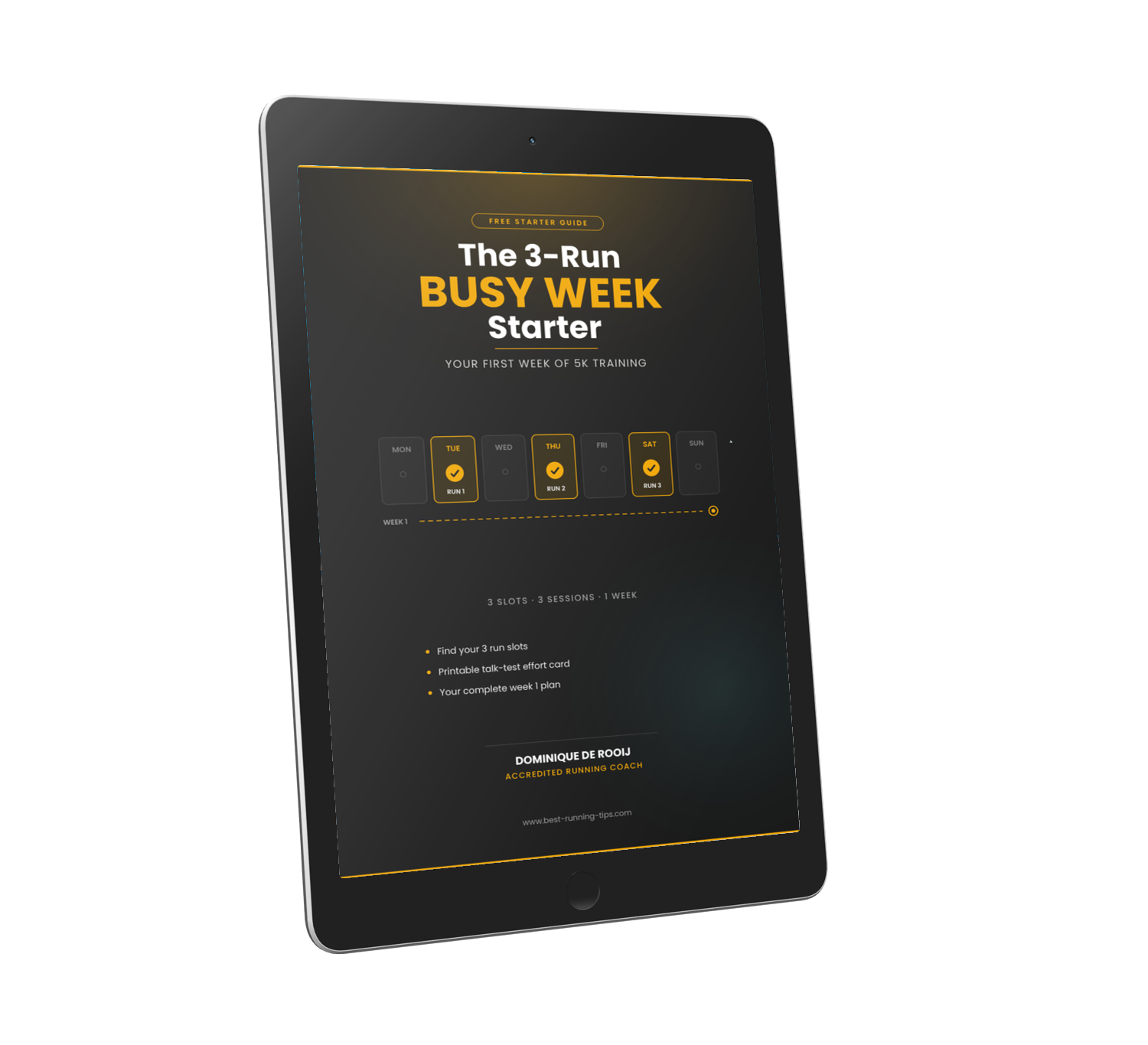
Start Running This Week, Even If Your Week Is Already Full
Most beginners don't quit for lack of motivation. They quit because their plan doesn't fit their life. The 3-Run Busy Week Starter plans your first week around the week you actually have.
- Find 3 run slots you can actually keep
- The talk test: the simple way to stop running too fast
- Your complete week 1 plan: 3 run/walk sessions, about 20 minutes each
You'll get the guide plus a short email every few days to help you through week 1. Unsubscribe any time. Privacy policy.
What's New?
-
Personalized Running Coaching - BRT | Run Smarter, Race Better
 Get a personalized running program built around your current fitness, goals, and schedule - not a generic app template. Choose from BRT Silver, Gold, or Platinum coaching with Dom, accredited running…
 -
Sample 4-Day Marathon Training Week: Base to Taper
A full 4-day-a-week marathon training schedule, phase by phase - base, build, peak, and taper - with named workouts and weekly mileage. -
Marathon Taper for a 10-12 Week Training Cycle
How to taper correctly on a compressed 10-12 week marathon plan - the right taper length, why standard advice doesn't fit, and the week-by-week structure.