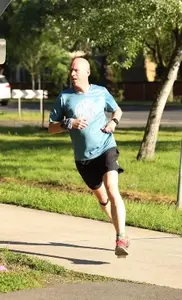
Beginner Runner's Stride and Heart Rate
by Mike McC
(Seattle, WA, USA)
I'm a beginning runner, two weeks now. Over the hill(50+) about 20 to 25 lbs overweight.
Never ran before, but in recent years gone for long walks, 2 to 3 hours, at a good rate. I believe my resting heart rate is between 57 and 63bpm.
Two questions: my heart rate easily ramps up when I exercise. I am following a run/walk program. When I run level for about a minute my bpm is about 170 and at walk it is about 140. Repeat 12 times. After a half hour cool down my bpm is 120. Is this heart rate just from being a slug for the last 6 years?
Combined with that question is stride. I have been told that my stride is too long. that I should focus on foot strikes per minute instead. However I feel my stride is easier long instead of shortening it.
So your thoughts on those numbers ...... I'm just out of shape, I'm way over doing it, what?
I'm thinking of modifying the run/walk so that ever other run is my comfortable pace and the rest are the targeted heart rate and steps per minute.
Answer by Dominique:
Hi there,
Thanks for your questions regarding your running training.
Good on you for picking up running after "being a slug for the past six years"... :)
By the way, it is generally recommended that people over 40 who pick up running consult their physician regarding their abilities to do an exercise program.
With each heart beat the heart pumps blood through the body to your muscles. Your muscles need the oxygen in that blood to function. When you are undertrained your heart becomes weaker and pumps less blood through your body with every beat.
Now that you are suddenly telling your heart to get active again, it's got a bit of difficulty keeping up and that can explain why your heart rate is quite high during and after your run/walks. Your muscles require a lot of blood for the exercise you are doing and as a result your heart pumps out of your chest.
I am a big fan of run/walks for beginning runners. It is a great way to get used to running. When you are a beginning runner it is also best to do your runs at an easy, comfortable pace. They usually refer to it as conversational pace, the pace at which you would still be able to talk to someone if they were running with you. At 170 bpm I am not sure if you're able to do that, so you might have to slow it down a bit.
Regarding stride rate and short strides vs long strides:
Unless your stride rate is truly very low, I don't think you have much to worry about. One of the things that improves your stride rate and technique is running more.
As you are starting off, give it some time. The body is an amazing machine that will find the most efficient way to move you forward. Also see the page about running cadence for more info.
Hope this helps and provides some food for thought.
Cheers,
Dominique
Free weekly coaching • Join 3,500+ runners
Train Smarter, Not Just Harder
Get your free guide when you join the BRT Coaching Letter
No spam, ever. Unsubscribe in one click, any time.
What's New?
-
Personalized Running Coaching - BRT | Run Smarter, Race Better
 Get a personalized running program built around your current fitness, goals, and schedule - not a generic app template. Choose from BRT Silver, Gold, or Platinum coaching with Dom, accredited running…
 -
Sample 4-Day Marathon Training Week: Base to Taper
A full 4-day-a-week marathon training schedule, phase by phase - base, build, peak, and taper - with named workouts and weekly mileage. -
Marathon Taper for a 10-12 Week Training Cycle
How to taper correctly on a compressed 10-12 week marathon plan - the right taper length, why standard advice doesn't fit, and the week-by-week structure.