Maximum Heart Rate and Altitude
by Esteban Suarez
(Quito-Ecuador)
Hi there,
I live in Quito (Ecuador) at an altitude of 9300 ft.
I played soccer all my life, and have been climbing mountains (up to 19,600 ft) since I was 15. Although I used to run frequently as part of my training for mountaineering, I only started running more systematically one year ago.
I am currently running about 35 km (~20 miles) a week, and my runs usually involve several steep hills (it is very difficult to avoid hills where I live)... Recently I started using a heart rate monitor and I was wondering if I should be worried about my heart beat... After my long runs (10 to 12 km) I do not feel wasted and I am not in pain, but I am recording an average of 166 bpm... Is this too high? Does altitude have anything to do with my heart rate while running? I am 38, but my HRmax, estimated through field test is 188.
Thank you very much for any advice and best wishes from the Andes!
Esteban
Answer by Dominique:
Hi Esteban,
Thanks for your running training question. I am originally from Holland, one of the flattest countries in the world... but living in Australia now, living about 700ft higher than the highest point in Holland, I do get to run in the hills very regularly.
Let's get into:
1. Running at altitude and heart rate
2. Hill running / running in undulating terrain

Running at Altitude and Heart Rate
At higher altitudes, the amount of oxygen available in the air is reduced due to lower air pressure. This can impact the functioning of your heart and lungs. As a result, your heart rate tends to increase during exercise at higher altitudes as the body tries to compensate for the reduced oxygen levels.
It's been proven that when you move to higher altitude your rest heart rate is higher, your exercise heart rate is higher, but your maximum heart rate is lower.
After having been at a certain altitude for about two weeks your body acclimatizes and heart rates would move back to their original levels.
That's the theory, but given you live quite high in the mountains, I am not sure if the body will ever fully acclimatize. It could simply mean that your exercise heart rate would always be higher than what you would see if you were to run at lower altitude.
Hill Running / Running in Undulating Terrain
You also mention that hills are pretty much unavoidable. They can really make your heart rate jump up. When I go on my easy runs my heart rate generally stays pretty low. But as soon as I start hitting hills, no matter how easy I take it, the heart rate goes up.
Hill running is strength training in disguise. You are simply going to be working harder when you run up hills.
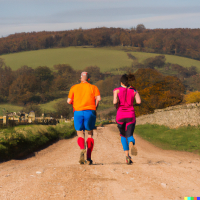
It would be interesting to not only see your average heart rate for a run, but also the spread and if the heart rate is actually at a lower level for part of your run, but goes up when you go up the steep hills. This could also be an explanation of the reason why your average heart rate is higher than what you'd expect.
Given the terrain and the altitude, I would definitely not go by heart rate monitor alone. "Run by feel". So make sure an easy run feels like an easy run first and foremost and worry less about the heart rate because I am not sure the standard heart rate monitor running theory applies to you. Tricky territory, because I know when hills are involved, it is easier to say "run by feel" than actually do it!
A better alternative than heart rate, could be using a power meter like Stryd. Power meters take into a range of factors such as humidity, temperature, terrain and elevation change to calculate how much power you are using. Worth looking into. Having said that, if you can't avoid the steep hills, do expect some variation in power / heart rate etc. whichever device you use.
Lastly, it may not feel like you are doing your running in an optimal environment, and it would be good if you could do some of your runs on flatter grounds, but you can be certain that all that hill running is helping you build some very strong legs!
All the best.
Kind regards,
Dominique
What's New?
-
Personalized Running Coaching - BRT | Run Smarter, Race Better
 Get a personalized running program built around your current fitness, goals, and schedule - not a generic app template. Choose from BRT Silver, Gold, or Platinum coaching with Dom, accredited running…
 -
Sample 4-Day Marathon Training Week: Base to Taper
A full 4-day-a-week marathon training schedule, phase by phase - base, build, peak, and taper - with named workouts and weekly mileage. -
Marathon Taper for a 10-12 Week Training Cycle
How to taper correctly on a compressed 10-12 week marathon plan - the right taper length, why standard advice doesn't fit, and the week-by-week structure.
