Base Running - The Foundation of Your Running
Unless you are a sprinter, base running should be the core of your running program.

It is literally the foundation of your running.
Did you know that for any race distance 800m and up endurance is more important than speed? It's remarkable isn't it? But the truth is that you need to have a strong endurance, in order to be able to run hard for long. Without the endurance, the speed is pretty useless!
So, want to run a race that is 800m or more? Then easy running needs to be a massive part of your running program. Because easy running builds a strong endurance, a strong aerobic system.
I usually use the analogy of a house being built:
Your aerobic base, your endurance, is your foundation. Without a strong foundation, the walls will start to crumble sooner or later until, eventually, the house breaks down.
Have got the speed, but not the strong foundation?
Then it will not take long before you are out of breath and eventually, have to slow down or stop.
That's why you will read in every running book, on every running website and forum advice like:
So, let's explore base running a little bit more.
What is it exactly, why should you do it, what types of different base running activities can you do, etc. Read on to learn more!
By the way... if you don't want to read, why don't you check out the video instead?
What is Base Running?

Base running is running slower than tempo speed.
You are not or hardly building up any lactic acid in your running muscles.
Your breathing is reasonably relaxed.
It's all about running easy.
The pace at which you'd be able to have a conversation, or even slower running.
It's almost completely aerobic running.
Why Exactly Should I Do Base Running?
Well, with every heart beat your heart pumps blood through your body.
This blood contains oxygen, which is necessary for the muscles to function.
When you are base running you train your heart, so that it will pump more blood through your body with every beat.
So, more base running = stronger heart = more blood through your body = more oxygen delivered to your muscles
And, as science found out, the great thing about base running drills is that they will do many good things for the running muscles as well.

So, basically:
Base running = good for you!
And if you don't want to take my word for it, listen to Lorraine Moller, winner of the bronze medal in the 1992 Olympics marathon in Barcelona!
Different Types of Base Running
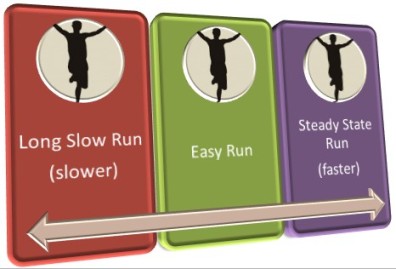
Base Running Drill #1 : Long Slow Run
I, like most runners, do a weekly long run on the weekends. Most of the time reasonably slow. Sometimes with a bit of quality in it. Depending on where I am at in my running program this is a run in between 90 minutes and roughly three hours.
Speed can be markedly lower than easy running, but can be easy running pace as well. If you go by heart beat, you'd be running in Zone 1, about 50 beats lower than your maximum heart rate upto Zone 2, about 40 beats lower than your maximum heart rate.
Base Running Drill #2 : Easy Running
This is the pace at which you could maintain a conversation. In heart rate monitor training you'd be going at about 40 beats lower than maximum heart rate.
Base Running Drill #3 : Recovery Running
When your legs are tired from a hard workout the previous day, or earlier that day, it is good to still go out and log some miles.
Running a bit has been proven to help against muscle soreness and you add another few miles to your weekly total.
Speed is far less important than just going out there and put yourself through a few slow miles.
Also note that cross-training is a good way to recover from a hard day of running.

Base Running Drill #4 : Steady State Running
Funnily enough you don't see many running websites or running books nowadays which mention steady state running.
It is a pace in between easy and tempo running. About 35 heart beats slower than your maximum heart rate. Close to half marathon pace / marathon pace for many runners.
I strongly believe that as a runner you should try to cover all running speeds in your training. Each speed delivers its' own benefits. Steady state running should be part of your running program.

Base Running Drill #5 : Including Faster Running
And then there are also workouts which combine different types of running together.
Progressive Long Run
An example is the progressive long run, in which you increase your speed as your long run progresses.

It's an important workout in race preparation as it requires you to run faster on tired legs. An example of a run like this is a 90 minute run in which you increase the pace every 15 minutes. You might start at a very slow, easy pace and finish at a moderately hard or hard pace, close to your tempo pace.
An alternative to the progressive long run is the long run with a fast finish. As you would expect it is an easy long run with the last 2-4 miles at a faster pace. E.g. a 2 hour run with the last 15 minutes at marathon pace.
Marathon Pace Run
In marathon preparations it is good to do plenty of marathon pace runs. At the start of your marathon running program you may do about 8 mile marathon pace runs. Then build this up slowly over time to about 16 miles.
General rule of thumb is that if you can do a 16 mile marathon pace run, and you have done all the other training, you should be able to do the full marathon at marathon pace.


Include Some Faster Running
And then there are endless variations in which you include some faster running in your long run. The general goal is to combine the benefits of long runs with sharpening your race pace and mental attitude. Running fast with already tired legs is physically and mentally demanding.
Examples:
1) TLT - Tempo-Long-Tempo: do a 15 minute tempo run, 60-90 minute long run, then finish with a 15 minute tempo run.
2) Long run with 3 x 3-6 minutes fast running inserted somewhere. Make sure to include plenty of easy running between the faster parts. You don't want this to become a full-blown interval session.
And I am sure you'll be able to think of a few variations yourself as well!
I hope this explanation about base running has made it clear to you why base running is so important and how you do your different base running drills.
Base running is super important. Other types of running are important as well, so don't forget to visit these pages as well:
Some Other Pages You Might Enjoy







Helpful
Resources
-
Beginner Running Tips
Are you a beginning runner? Then this is your best starting point. Many tips and running programs on offer, dedicated to you.
-
Running for Weight Loss
Aiming to lose a few pounds? Get into the Running for Weight Loss section for tips and advice.
-
Running Training
The Running Training section of the site has got the most articles. It is constantly getting updated with new tips and information. A must-visit if you are serious about improving your running performance.
-
5k Running Tips
The 5k is a great distance to run and train for. The great thing is that you can do it quite often and see big improvements.
-
10k Running Tips
The 10k is a real challenge. You need to run fast for an uncomfortably long time! Check out this section if you are strong of mind and legs!
-
Marathon Running Tips
The marathon is a massive challenge. Proper training is so important! Make sure to check out this section if you have got your mind set on the marathon!