Treadmill vs. Outdoor Running: What Actually Changes
"Other than boredom are there any major drawbacks from running solely on the treadmill? I feel that when I run on a treadmill it is much easier than running outside. Do you know if this is true, or maybe I just am not maintaining a consistent pace outside?
– John, Penn Laird, Virginia, USA
Answer by Dom: Hi John, thanks for the question. Yes, a flat treadmill is easier — but the gap is small, and I'll show you how to test whether your outdoor pacing is the real issue.
Here's what I'll cover:
- Why Treadmill Running Feels Easier (and When It Actually Is)
- Global Positioning System (GPS) Watch vs. Treadmill Display: Why They Never Quite Agree
- Practical Differences: Weather, Traffic, and Terrain
- Impact and Injury-Risk: Belt vs. Pavement
- Where the Treadmill Wins
- Training for an Outdoor Race on a Treadmill
- Staying Cool and Managing Heart Rate Indoors
Why Treadmill Running Feels Easier (and When It Actually Is)
You're right, John — a flat treadmill is easier. At 0% incline there's no air to push through. The same displayed pace costs you less effort than it does outdoors.Jones & Doust (1996) found that a 1% treadmill incline offsets the missing air resistance closely enough to match outdoor effort at typical paces. It's a good approximation rather than an exact match for every pace and runner. For easy running it's close enough. At faster paces air resistance grows, so the gap widens a little.
I cover the full incline-adjusted pace table, and how to nudge the figure up for faster intervals, in my guide on the treadmill's 1% incline rule.
Now to your real question: are you pacing badly outside? Here's a simple test. Pick one easy route you know well. Run it outdoors at an effort you'd call a 3 or 4 on the rate of perceived exertion (RPE) scale, the 1–10 effort scale where 1 is very easy and 10 is all-out. Note your average pace. A few days later, run the same duration on the treadmill at 1% incline and the same RPE. Then compare.
If the treadmill pace is only a little quicker, that's normal — effort-based pacing outdoors varies from day to day, so you're not pacing badly. If it's much quicker, check the belt. Run 1 mile (or 1.6 kilometres) on a 400-metre track at an easy effort, and time it. Then run the same distance by the treadmill display. If the times differ by more than a few seconds, the belt is reading fast or slow, and that alone could explain why it feels so easy.
Last thing: if your outdoor pace swings wildly from mile to mile, you're probably starting too fast. Go by effort, not the number on your watch, for the first mile.
Global Positioning System (GPS) Watch vs. Treadmill Display: Why They Never Quite Agree
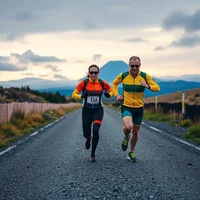
GPS relies on a clear satellite signal, and a roof and walls interfere with that. Indoors, most watches fall back to motion-based estimation, reading your arm swing and stride rather than tracking you by satellite, and that method drifts. Expect it to read long or short by a small, inconsistent margin, run to run.
Trust the treadmill's own speed and distance readout over your watch when you're indoors, full stop. Save the GPS number for outdoor runs, where it's actually doing the job it's built for. If you want your watch to agree better with the belt, calibrate it. Most watches let you enter the treadmill's distance after a run and will adjust their stride estimate over the next few sessions.
Practical Differences: Weather, Traffic, and Terrain

It also makes your pace very steady. Outdoors, hills, junctions, headwinds and gentle bends all nudge your speed up and down without you noticing. That's one reason your outdoor pace may look inconsistent. It's often the route, not you. A treadmill removes all of that, which is a plus for tempo work and a minus for race preparation.
The trade-off is monotony, and, as I'll get to next, a lot less terrain variety for your legs to adapt to. You also can't easily change your stride length on a belt, you get no downhill running, and your ankles, hips and calves never practise cornering or stepping around things. Boredom is a real cost too. I'd recommend a podcast, a playlist or a TV series saved for treadmill days only — it gives you a reason to look forward to them.
Impact and Injury-Risk: Belt vs. Pavement

Don't overstate it, though. If there is a difference, it's a small one. Running exclusively on a treadmill doesn't make you injury-proof, and it comes with its own quiet cost. A treadmill belt is perfectly flat and camber-free, session after session. Outdoor terrain normally forces small stride variations (a slight camber here, an uneven patch there, a root or crack somewhere else), that some runners' legs come to rely on. Take that away entirely, and some runners lose that adaptive stimulus as much as they gain a softer landing.
I'd call this one a wash, not a win for either surface.
Where the Treadmill Wins
The treadmill isn't just a compromise — it has real advantages of its own, and interval work is the clearest one. Slow down outdoors during the last rep of a hard session, and nobody's watching. Slow down on a treadmill and you're stepping off the back of the belt, so it keeps you honest in a way outdoor intervals simply don't.I also like a treadmill's built-in programs for structured hill and tempo variety, especially when you can't get outside for it. And because the conditions stay the same (same surface, same temperature, same effort for the same number on the display) a treadmill gives you one of the purest ways of tracking progress from one session to the next.
Training for an Outdoor Race on a Treadmill

For the full transition plan, see my transitioning from treadmill to road racing guide.
For you, John, here's the weekly mix I'd suggest. Do two or three treadmill runs a week — easy runs and one structured session at 1% incline. Then do one outdoor long run, every week, at a steady easy pace. If you're building towards a road race, add a second outdoor run as the race gets closer and do your race-pace efforts outside. Keep your total mileage rising by no more than about 10% a week, and take a consolidation week every fourth week. That outdoor long run is where you practise pacing by effort, in wind, on hills, with real surfaces under your feet. Over a few weeks the gap between the two surfaces shrinks, and you'll stop second-guessing your outdoor pace.
Staying Cool and Managing Heart Rate Indoors
Indoor air doesn't move past you the way outdoor air does, so your body temperature, and your heart rate, climb faster on a treadmill at the same effort. Expect your heart rate to sit noticeably higher than outdoors on a warm day, even when the effort feels identical.A fan pointed at your chest and face fixes most of this. An open window, a cold towel and water within reach all help too. Wear lighter kit than you would outdoors, and don't skip your drink just because you aren't out in the sun.
It matters most if you train with a heart rate monitor. A heart rate zone is a band of beats per minute that matches a type of effort, for example, zone 2 is the easy, conversational aerobic band. On a hot treadmill, that same effort can push you into a higher zone than it would outside. If that happens, slow the belt a little or cool down rather than chasing your usual zone. Go by RPE and talking ease, not just the number. If you can't chat in short sentences on an easy run, you're going too hard.
So no, John. You're not imagining the treadmill's easier feel, and you're not necessarily pacing yourself badly outside either. Set that 1% incline, trust the belt's numbers over your GPS watch indoors, and get outside every week so race day doesn't feel like a different sport.
Kind regards,
Dom
Some Other Pages You May Like
About the author

Dominique de Rooij (Dom)
Advanced Running Coach certified by Athletics Australia with 20 years of writing about running and over a decade coaching runners, from first races to marathons. Dom created PlanMyRace, a training plan generator for any race from 1500m to the marathon. Now over 50, Dom still loves trail running, parkrun, and the coffee after.
Stop Guessing.
Train for Your Best Race.
PlanMyRace builds a personalised, week-by-week training plan for any race from 1500m to the marathon, around your race date, your current fitness and the week you actually have.
Get My Free Plan →No credit card needed. Your full first week is free.
What's New?
-
Cut 90 Seconds Off Your 1.5 Mile Run for the Army Test
Cutting 90 seconds off a 1.5 mile run in 3-4 weeks for the Army test: Dom breaks down realistic pacing to reduce 10:32 toward sub-9:00 for Paras selection. -
Improve Your 1.5 Mile Running Time to 10:30: Shin Splints
From 12:59 to 10:30 for 1.5 miles: Coach Dom's shin-splint fix and training plan to improve your running time in 2-3 months. -
Training for a 1.5 Mile Run - How to Qualify For Your Test
Coach Dom's 3-step plan for 1.5 mile run training: build aerobic base, add strides, then tempo and pace work to hit your test time.