Heart Rate & Pace Targets for Heavier Beginner Runners
A higher rest heart rate and a higher heart rate on an easy run are normal at a higher body weight — not dangerous on their own. Your heart works harder to move more mass. Standard age-based heart-rate zones are built for average-weight, already-fit runners. They'll read as misleadingly high for you. The talk test — can you speak in short sentences? — is a more reliable early guide than any zone chart or wrist monitor.I coach a lot of heavier beginners who ask me this exact question in their first few weeks. Below, I'll walk you through what your numbers actually mean, what pace to expect, and the one low-tech tool that beats every gadget on the market.
Why Standard Heart Rate Zones Read High and Misleading Right Now
Let's clear up the mechanism first, because it changes how you read everything else on this page. Heart rate reflects total workload — how hard your heart has to work per minute — and moving more body mass at any given pace costs more of that, regardless of your fitness level.Most heart-rate zone tables put "vigorous" effort at 70–85% of your estimated maximum heart rate. Those percentages assume an already-conditioned, average-weight body. At a higher body weight, the same easy-paced walk or jog can push you into that "high" zone on paper. Your actual effort stays genuinely easy.
That's a starting-point mismatch, not a red flag. It narrows as your fitness improves — the same effort produces a lower number over time. Beware treating today's reading as a verdict on how hard you're actually working.
Realistic Beginner Pace Ranges to Expect
Now the part that matters most: pace. Heart-rate zones only go so far; you also need to know what they mean for actual pace on the road.For a walk-run beginner at a higher body weight, run segments in the first few weeks typically sit somewhere around 15 to 20 minutes per mile. Walk segments run slower again. Treat that as a starting range, not a target to chase.
Here's the thing: pace this early is a byproduct of effort, not something to force directly. Chasing a faster pace before your cardiovascular base is built is the single most common way beginners derail themselves — through burnout, niggles, or simply quitting. Build the base first. Speed follows.
If you don't have a structured plan yet, a structured walk-run program to apply these targets to is a sensible place to start, and the week-by-week run/walk timeline this pace range fits into shows exactly how that pace should progress, session by session.
The Talk Test: Your Most Reliable Early Tool
If you take away one tool from this page, make it this one. Many of us are trained to trust a number on a screen over how we actually feel — the talk test flips that instinct, and for good reason.| Talk-Test Level | Can You Talk? | What It Means |
|---|---|---|
| Full sentences, or singing | Easily | Too easy to build fitness quickly — but fine for a recovery day |
| Short sentences, with some effort | Yes, but you notice it | Your correct easy-run intensity — stay here for most sessions |
| Single words or grunts | Barely | Too hard — slow down |
The talk test is the first tool I hand every heavier or deconditioned beginner I coach — ahead of any heart-rate zone or pace chart.
Heart Rate Monitor Accuracy Issues to Know About
A quick word on the device on your wrist. Wrist-based optical heart-rate monitors read light through your skin. That reading gets less reliable during sudden effort changes — the walk-to-run and run-to-walk transitions that make up most beginner sessions. Fit matters too: a loose strap or a lot of wrist movement adds noise to the number.Treat a wrist-monitor reading as a rough guide, cross-checked against the talk test — not as ground truth. If you want a more accurate numeric tool, a chest-strap monitor reads the electrical signal directly and is far less prone to this lag. You don't need one to train safely, though — the talk test works with no equipment at all.
How to Calculate a Rough Personal Heart Rate Zone (If You Want One)
If you'd still like a number to work from, here are the two simplest methods. Treat both as rough estimates, not precise science, for exactly the reasons covered above.| Method | How to Calculate | Best Used For |
|---|---|---|
| 220 minus your age | Subtract your age from 220 for an estimated maximum heart rate | A rough ceiling — expect it to run high for you, per the section above |
| 180 minus your age | Subtract your age from 180 for a more conservative low-intensity estimate | A gentler ceiling, often a better starting point for a deconditioned beginner |
What Counts as Too High, and When to Ease Off
Reassurance only helps if it comes with an actual line, so here's mine. Ease off, stop, and check in with a doctor if you get chest pain, dizziness, nausea, or a heart rate that doesn't come down at all within several minutes of stopping.That's different from a heart rate that's high but recovering normally — pulse dropping steadily, speech limited but present. A brief spike on a hill or a run segment isn't automatically dangerous if it comes back down with rest and you can still speak in short sentences once you've recovered. Sustained inability to recover is the actual flag, not one elevated number.
As a coach, that's the threshold I actually work to with my heavier and deconditioned beginners — sustained non-recovery plus symptoms, not a single reading on a watch. It's a line I can defend, and one you can use with confidence.
For symptoms beyond heart rate alone, see the warning signs that go beyond a high heart rate.
How Your Targets Should Shift Over the First Few Months
Here's the key point: your numbers are supposed to move. Expect the same perceived effort — the same talk-test level — to produce a lower heart rate and a faster pace over roughly 8 to 12 weeks of consistent training. That's fitness working as intended, not you failing to hit a fixed target.Re-check your rough heart-rate estimate and pace range every 4 to 6 weeks rather than treating your first week's numbers as permanent. That's the cadence I use with heavier-beginner clients I coach, and it catches the recalibration most people miss entirely.
For the fully structured, session-by-session version of this progression, the week-by-week timeline page builds directly on the ranges above.
Once your effort levels are dialled in, shoes built for your body weight, once your effort levels are dialled in is the natural next practical step. And if you landed here looking for the wider picture, here's back to the full plan for starting to run when you're overweight to return to.
Frequently Asked Questions
Why does my heart rate feel so high even when I'm just walking briskly?Moving more body mass costs your heart more effort per minute regardless of pace, and a less-conditioned cardiovascular system compounds that. It's normal at this stage, not a danger sign on its own.
What pace should I actually expect to run at when I'm starting out at a higher body weight?
Roughly 15 to 20 minutes per mile for run segments in the first few weeks of a walk-run approach, treated as a starting range rather than a target — full progression on the week-by-week timeline page.
Should I use age-based max heart rate formulas, or are they inaccurate for beginners?
They're a rough estimate only. They assume an already-conditioned, average-weight body and will read as misleadingly high for a deconditioned or higher-body-weight beginner — use them alongside the talk test, not instead of it.
Is it normal for my heart rate to spike quickly and take a while to come down?
Some spike and a gradual recovery is normal, especially early on. The flag is a heart rate that doesn't come down at all within several minutes of stopping, paired with chest pain, dizziness, or nausea.
Could medications I'm taking affect my heart rate zones?
Yes — some blood pressure and other common medications blunt or alter your heart rate response to exercise, which is another reason the talk test is a more reliable guide than a fixed numeric zone for some readers.
Some Other Pages You May Like
About the author

Dominique de Rooij (Dom)
Advanced Running Coach certified by Athletics Australia with 20 years of writing about running and over a decade coaching runners — from first-timers to marathoners. Dom's beginner programs have guided thousands of runners and been praised above plans from Jeff Galloway, Hal Higdon, and Runner's World. Now over 50, Dom still loves trail running, parkrun, and the coffee after.
Free beginner guide • From Coach Dom
Start Running This Week, Even If Your Week Is Already Full
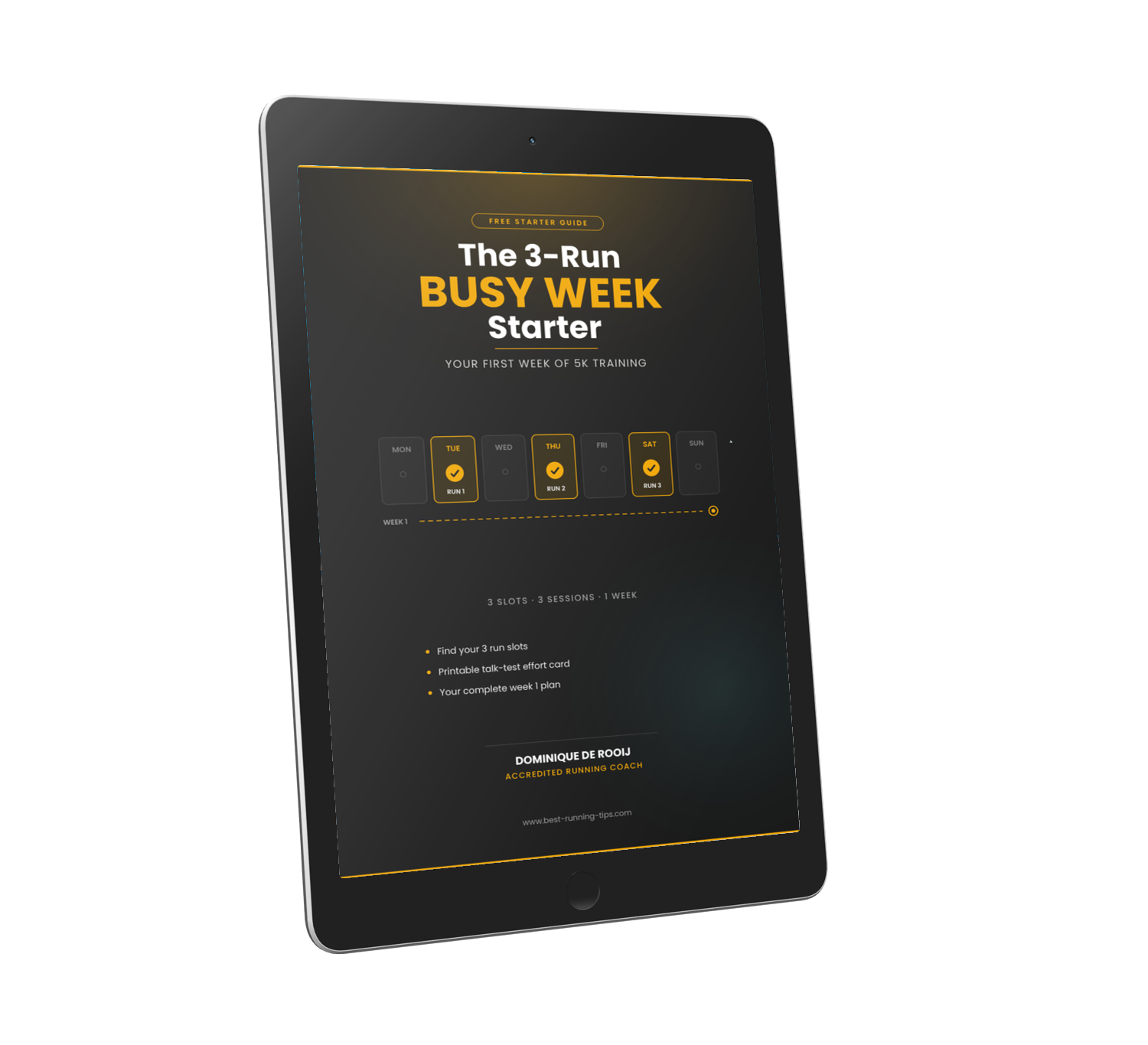
Most beginners don't quit for lack of motivation. They quit because their plan doesn't fit their life. The 3-Run Busy Week Starter plans your first week around the week you actually have.
- Find 3 run slots you can actually keep
- The talk test: the simple way to stop running too fast
- Your complete week 1 plan: 3 run/walk sessions, about 20 minutes each
You'll get the guide plus a short email every few days to help you through week 1. Unsubscribe any time. Privacy policy.
What's New?
-
Personalized Running Coaching - BRT | Run Smarter, Race Better
 Get a personalized running program built around your current fitness, goals, and schedule - not a generic app template. Choose from BRT Silver, Gold, or Platinum coaching with Dom, accredited running…
 -
Sample 4-Day Marathon Training Week: Base to Taper
A full 4-day-a-week marathon training schedule, phase by phase - base, build, peak, and taper - with named workouts and weekly mileage. -
Marathon Taper for a 10-12 Week Training Cycle
How to taper correctly on a compressed 10-12 week marathon plan - the right taper length, why standard advice doesn't fit, and the week-by-week structure.
