Couch to 5K Plan: Best Running Tips' Beginner Run/Walk Program, Explained
Yes, Best Running Tips has a Couch to 5K plan. Couch to 5K is the generic name for a beginner run/walk plan that builds you from no running to finishing your first 5k. My Beginners Running Program 3 is a 12-week progression following the run/walk principle, and here is the plan itself. Below: the plan at a glance in four phases, how to pick your starting week, what pace to run the intervals at, what to do if a week feels too hard, pain versus soreness, and what comes after week 12.
Most beginning runners like yourself who drop out don't lack willpower. The plan asked too much too soon, and a niggle or burnout followed. I've coached beginners through exactly this build for over 20 years and I am proud to say that my beginner programs have been praised as being better than the ones presented by famous coaches like Jeff Galloway and Hal Higdon. Read along, and I'll explain how to get started, what pace, how to deal with pain and quitting-point questions that get you set up for success.
Free beginner guide - From Coach Dom
Plan Your First Week Around Your Real Week
The 3-Run Busy Week Starter helps you find three run slots you can keep, then gives you a complete week 1 plan: three run/walk sessions, about 20 minutes each.
Get the Free Starter →Free guide. Just your email address.
The Plan at a Glance
OK, so this plan gets you to 30 minutes of non-stop running, not 5k. Technically true. However, in practice, when you get to the stage that you can run 30 minutes non-stop, you'll be very close to covering 5k. So, it is more or less the same thing anyways. Let's start with a high-level overview of the plan. You don't need the full day-by-day table immediately to see the shape of this plan — just the four phases it moves through. Here's the condensed version, pulled straight from the actual Beginners Running Program 3 schedule:| Phase | Weeks | What's happening | A session by week's end |
|---|---|---|---|
| 1 | 1–3 | Mostly walking, short run bursts | 2 x 5 min walk, 1 min run → 2 x 5 min walk, 3 min run |
| 2 | 4–6 | Walk and run get closer to even | 2 x 7 min walk, 4 min run → 5 x 1 min walk, 4 min run |
| 3 | 7–9 | Running dominates, walk breaks shrink | 4 x 1 min walk, 6 min run → 3 x 1 min walk, 9 min run |
| 4 | 10–12 | Continuous running, no walk breaks by the end | 2 x (1 min walk, 8 min run) + 1 x (1 min walk, 11 min run) → 30 minutes non-stop |
Want the exact day-by-day breakdown, all three sessions a week, all 12 weeks? The full 12-week schedule has it — this page is the map, that page is the territory. Before you go there, just make sure you check out some of tips below.
How to Pick Your Starting Week
You don't have to start at week 1. If you've done a bit of regular exercise already, start at a point that still feels a little too easy for you — not a stretch. Many of us make the same mistake: starting too ambitiously, then paying for it in week 2 or 3. The thing is, a gentle start costs you nothing and saves you the dropout. And if you are starting at week 1 with a crowded calendar, my free 3-Run Busy Week Starter plans that first week around the week you actually have.I've had readers join this exact program partway through and finish it without issue — the flexible start works in practice, not just in theory.
What Pace Should I Run the Intervals At?

I've written a full breakdown of exactly how fast to run and walk each interval, including what to do once effort alone stops being a reliable guide. For Couch to 5K, effort-based is all you need.
What if a Week Feels Too Hard?
Repeat it. That's the whole answer.Struggling with a week isn't failure — it's normal, and it happens to most people at some point in this plan. Go back and run the same week again rather than pushing on regardless. I've written a longer answer on what to do when a week feels too hard, including when to drop back further than just one week.
Pain vs. Soreness During the Plan
Beware the difference between pain and soreness. It does matter. Soreness is (generally) symmetric, dull, and eases off within a few days; it's just adaptation. Pain is sharp, one-sided, or gets worse as you keep running — that's your cue to stop and reassess, not push through."Listen to your body" can sound vague; here it means something specific. A bit of muscle soreness is fine. That is the body adapting. That doesn't need to stop your running. But if you are hurting or developing a niggle, you should stop. One day off at the right time is so much better than pushing through and then being sidelined for weeks. I go into it properly, including what to actually do about it, on pain vs. soreness during the plan.
What Comes After Week 12?

It's a little early to start contemplating what's next. But in case you are interested at this stage, check out what to do after you finish.
Frequently Asked Questions
Can I do Couch to 5K if I'm very out of shape or overweight?
Yes. The gradual structure of this plan is built specifically for very deconditioned starting points — that's the entire point of run/walk. If weight is part of your starting picture, my Is It Safe to Run When Overweight? guide covers the extra safety questions this page doesn't.
Can I do Couch to 5K on a treadmill instead of outside?
Yes — the walk/run structure works identically on a treadmill. The one change is that your pace becomes literal rather than effort-based: you set a walking speed and a running speed instead of judging effort by feel.
What if I miss a few days of the program?
Pick up where you left off rather than restarting from week 1. The one exception is a gap of two weeks or more — then repeat the last week you completed before moving on.
Do I need a running app to follow Couch to 5K?
No. Best Running Tips' plan is followable from the schedule table alone. A free interval-timer app or fitness watch with basic interval set-up can help you manage the walk/run switches without watching a clock, but it isn't required.
So, what are you waiting for? Pick your starting week honestly, run each interval at conversational effort, repeat any week that beats you. Start the 12-week schedule and let it pace you, rather than the other way round. Thousands of readers of Best Running Tips' full run/walk program hub have used exactly this build to get from the couch to 30 minutes of non-stop running.
More Pages on This Topic
Some Other Pages You May Like
About the author

Dominique de Rooij (Dom)
Advanced Running Coach certified by Athletics Australia with 20 years of writing about running and over a decade coaching runners — from first-timers to marathoners. Dom's beginner programs have guided thousands of runners and been praised above plans from Jeff Galloway, Hal Higdon, and Runner's World. Now over 50, Dom still loves trail running, parkrun, and the coffee after.
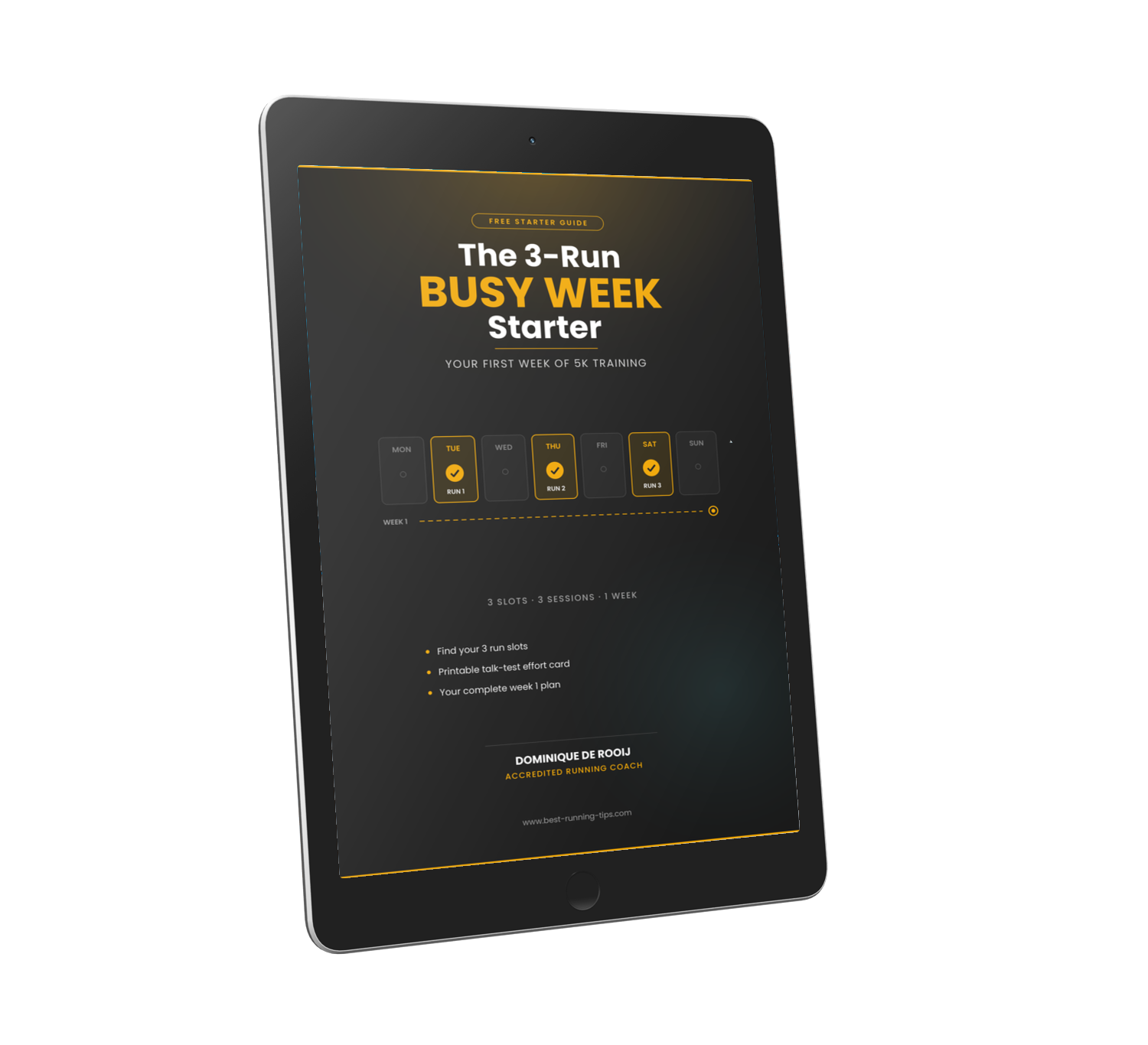
Free beginner guide • From Coach Dom
Start Running This Week, Even If Your Week Is Already Full
Most beginners don't quit for lack of motivation. They quit because their plan doesn't fit their life. The 3-Run Busy Week Starter plans your first week around the week you actually have.
- Find 3 run slots you can actually keep
- The talk test: the simple way to stop running too fast
- Your complete week 1 plan: 3 run/walk sessions, about 20 minutes each
I'll email you a link to confirm your address, then send the guide plus a short email every few days to help you through week 1. Unsubscribe any time. Privacy policy.
What's New?
-
Cut 90 Seconds Off Your 1.5 Mile Run for the Army Test
Cutting 90 seconds off a 1.5 mile run in 3-4 weeks for the Army test: Dom breaks down realistic pacing to reduce 10:32 toward sub-9:00 for Paras selection. -
Training for a 1.5 Mile Run - How to Qualify For Your Test
Coach Dom's 3-step plan for 1.5 mile run training: build aerobic base, add strides, then tempo and pace work to hit your test time. -
Improve Your 1.5 Mile Running Time to 10:30: Shin Splints
From 12:59 to 10:30 for 1.5 miles: Coach Dom's shin-splint fix and training plan to improve your running time in 2-3 months.