Is It Safe to Run When You're Overweight?
Yes — running is safe at any body weight for almost everyone. Start with a walk-run approach, build up gradually, and get medical clearance first if you have joint pain, heart disease risk factors, or haven't exercised in years. Pace and joint impact are real concerns — but they're manageable, not reasons to stay on the sidelines.I coach runners who've spent years hearing they need to lose weight before they're "allowed" to start — that's backwards. Below, I'll walk you through exactly who should see a doctor first, what's really happening to your joints on impact, and the walk-run method that gets you started safely, whatever your current weight. If you're still wondering is weight a factor when you're just starting out? — it isn't, and the rest of this page shows you why.
Do You Need to See a Doctor First? A Simple Screening Checklist
Let's get one thing straight before anything else: most people don't need a doctor's note to lace up and start a walk-run routine.
You should get medical clearance before you start if any of these apply to you:
- Uncontrolled blood pressure or diabetes — get your numbers checked and stable first.
- Chest pain, tightness, or dizziness during exertion — this needs a doctor's assessment before any exercise programme, not just running.
- Joint pain that's already present at rest — starting to run on top of existing joint pain needs a professional opinion on what's actually going on.
- A higher body mass index (BMI) plus other cardiac risk factors — family history, smoking, high cholesterol — the combination is what matters, not body weight alone.
- A completely sedentary history and you're over 45 — a quick check-in is a sensible precaution before you load up your heart and joints with something new.
Is Running Bad for Your Joints at a Higher Body Weight?
Here's the honest physics, not just reassurance: every footstrike sends a ground-reaction force through your joints of roughly 2.5 to 3 times your body weight. Carry more weight, and that number goes up. I'm not going to pretend otherwise.

- Your run/walk ratio — more walking, less continuous running impact, especially in your first weeks.
- Your starting mileage — begin lower than feels necessary, and let your joints adapt before you add more.
Walk-Run First: Why This Beats Straight Running or Straight Walking
Walk-run beats both alternatives. Walking alone won't build running-specific fitness — your body needs some running to get better at running. Running continuously from day one, on the other hand, is the fastest route to burnout or a niggle, especially while you're still deconditioned. Start with something like one minute of running followed by two minutes of walking, repeated for 20 to 30 minutes total. As that starts to feel comfortable, extend the running intervals and shorten the walking ones, week by week, until you're running non-stop.
Walk-run is the entry protocol I use with every higher-body-weight beginner I coach — what actually works, session after session.
This is exactly the structure behind a structured walk-run program — if you'd rather follow a set plan than build your own from scratch, that's the place to start.
Does Running Help You Lose Weight Faster Than Walking?
Per minute, yes — running burns more calories than walking. But that's not the full picture.A committed walker who racks up several hours a week often closes much of that gap simply through total volume — the real lever is consistency and total training load, not which modality you choose.
In my coaching experience, the readers who track consistency — minutes run, sessions completed — rather than the number on the scale are the ones still running three months in. That's worth remembering on the days progress feels invisible. If you're wondering how often you can safely run while losing weight, especially if you're tempted to add extra sessions to speed things up, that's covered in detail on the next page.
One caution, though: training purely for the scale is rarely the most durable motivation once the novelty wears off. If keeping yourself going through the early months feels like the harder part of this than the running itself, I've written more on overcoming body image and motivation barriers specifically for this stage.

Where This Page Sends You Next
This page covers the safety and starting-point questions. For the specifics, here's where to go next:- Running shoes matched to your body weight — footwear specifics for a heavier frame.
- A real week-by-week run/walk timeline — what progression actually looks like, week by week.
- Pace and heart rate targets for heavier runners — what "easy" should actually feel like for your body.
- Overcoming body image and motivation barriers — for when the mental side is the harder part.
- Low-impact cross-training to reduce joint load — extra recovery-friendly options between runs.
- Restarting after a long layoff or injury — if your weight concern is compounded by time away from running.
- Starting to run at 50 or older — if age is part of your starting point too.
Whatever your starting weight, the door's open. Start with the walk-run approach, get clearance if you need it, and build from there — one session at a time.
Frequently Asked Questions
What shoes are best for a heavier runner?Motion-control or added-stability shoes with more durable cushioning are often a better starting point, but the specifics depend on your gait — see the full breakdown on my dedicated shoe guide.
How do I deal with chafing when running?
Moisture-wicking, fitted (not loose) apparel, a friction-reducing balm on high-contact areas — inner thighs, underarms, waistband line — and testing your setup on a short run before race day or a long effort.
How do I stay motivated when I don't see quick results?
Track effort and consistency markers — minutes run, sessions completed — rather than the scale alone in the first month. I've written a full treatment of motivation and body image on my dedicated page.
Is it safe to run at 46 if I've only recently started jogging?
Yes. Age in your 40s isn't a limiting factor — what matters is that your pace and mileage increases stay gradual, and that you're going by feel (able to hold a conversation) rather than a fixed time target.
I'm out of shape and have never run before — can I still train for a 5K?
Yes. Most out-of-shape beginners can complete a first 5K in roughly three to six months using a walk-run progression — adding one minute of running at a time inside existing walks — regardless of pace.
More Pages on This Topic
Some Other Pages You May Like
About the author

Dominique de Rooij (Dom)
Advanced Running Coach certified by Athletics Australia with 20 years of writing about running and over a decade coaching runners — from first-timers to marathoners. Dom's beginner programs have guided thousands of runners and been praised above plans from Jeff Galloway, Hal Higdon, and Runner's World. Now over 50, Dom still loves trail running, parkrun, and the coffee after.
Free beginner guide • From Coach Dom
Start Running This Week, Even If Your Week Is Already Full
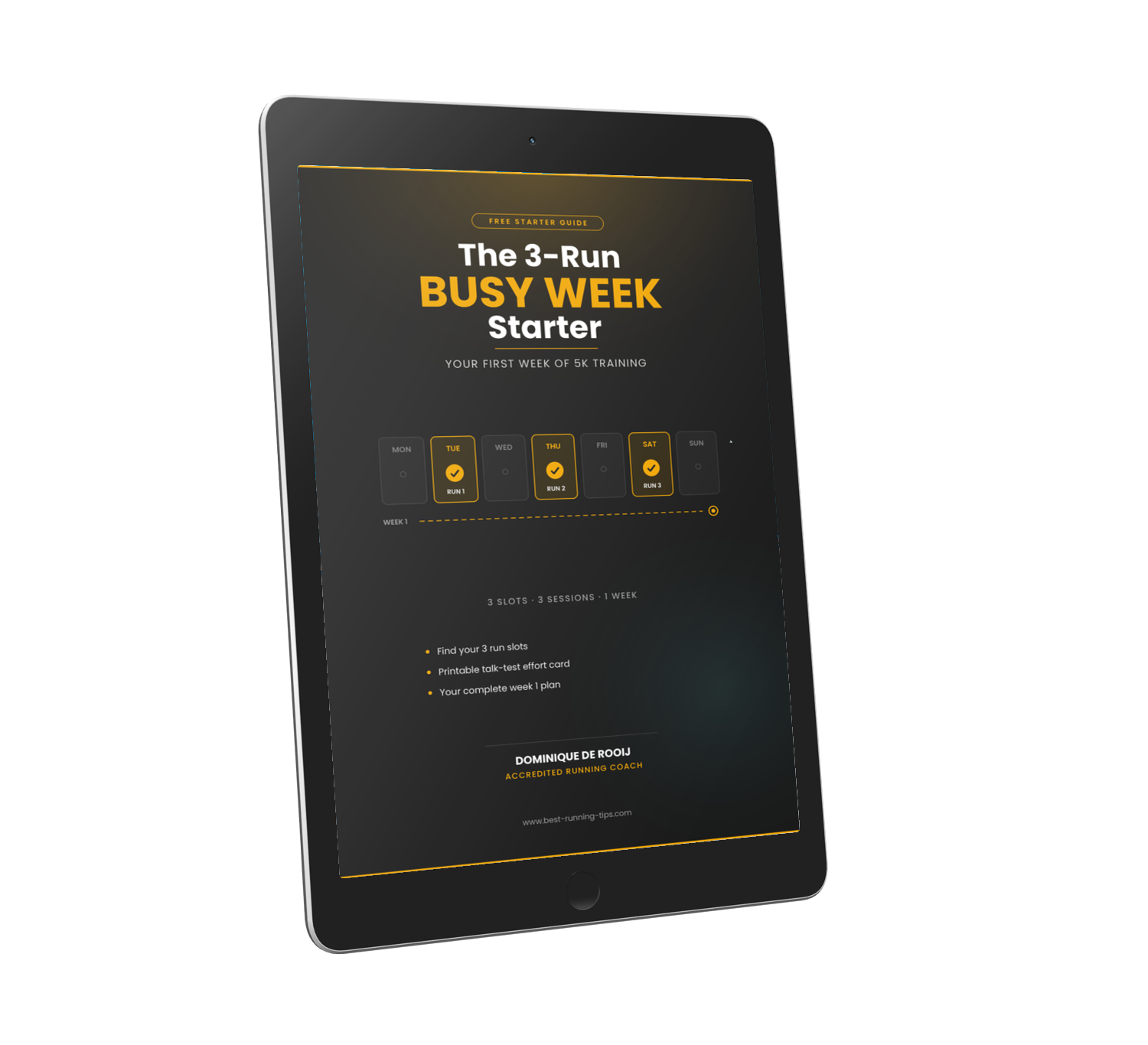
Most beginners don't quit for lack of motivation. They quit because their plan doesn't fit their life. The 3-Run Busy Week Starter plans your first week around the week you actually have.
- Find 3 run slots you can actually keep
- The talk test: the simple way to stop running too fast
- Your complete week 1 plan: 3 run/walk sessions, about 20 minutes each
You'll get the guide plus a short email every few days to help you through week 1. Unsubscribe any time. Privacy policy.
What's New?
-
Personalized Running Coaching - BRT | Run Smarter, Race Better
 Get a personalized running program built around your current fitness, goals, and schedule - not a generic app template. Choose from BRT Silver, Gold, or Platinum coaching with Dom, accredited running…
 -
Sample 4-Day Marathon Training Week: Base to Taper
A full 4-day-a-week marathon training schedule, phase by phase - base, build, peak, and taper - with named workouts and weekly mileage. -
Marathon Taper for a 10-12 Week Training Cycle
How to taper correctly on a compressed 10-12 week marathon plan - the right taper length, why standard advice doesn't fit, and the week-by-week structure.
