Beginner Running Guidance by Body Type, Age & Fitness Level
Let's face it — the generic "beginner running plan" doesn't actually fit every beginner, and if you've read one and thought that's not quite me, you were right to. Three things change your real starting point: your current fitness level, your age bracket, and your body weight and impact tolerance. I've coached beginners who fit every combination of these, and the fastest way to find yours is the self-placement checklist near the bottom of this page.Starting Point by Fitness Level: Sedentary, Lightly Active, or Moderately Active
Not every beginner starts from the same place, which is why one plan can't fit everyone. Here's how your starting point should actually change depending on where you're coming from.If you've been sedentary for years — no regular activity at all — start with a walking-only base. Build this for 2 to 3 weeks minimum before you introduce a single running interval. This isn't caution for its own sake — it gives your joints, tendons, and connective tissue time to adapt to regular movement before you add impact.
If you're lightly active — you move regularly but have no running background — start run/walk intervals from day one, but keep the running portions short and the walking recovery longer than you'd expect. Your cardiovascular fitness and your joints' impact tolerance rarely develop at the same rate.
If you're moderately active — you already exercise regularly in another sport or modality — start run/walk intervals immediately, and progress your running intervals faster than the other two groups. Your base fitness carries over. Your impact tolerance for running specifically still needs a few weeks to catch up.
Starting Point by Age Bracket: 20s–30s, 40s–50s, and 60s+
Age matters here too, and "older beginners should take it slower" isn't specific enough to actually help you. Let's break it down properly.In your 20s and 30s, the standard beginner progression applies with few modifications. Your recovery capacity is strong, and niggles that show up in week one usually resolve on their own within a few days.
In your 40s and 50s, build in a longer warm-up and pay closer attention to joint niggles that would previously have resolved themselves. You still have full running capacity — this isn't a decline story — but recovery takes a day or two longer than it did a decade ago, and it's worth planning around that rather than ignoring it.
In your 60s and beyond, slow your week-to-week progression down, extend your walk-run base for longer before moving to continuous running, and place recovery days more deliberately between harder efforts. The reason isn't fragility — it's that tendon adaptation and injury recovery genuinely take longer as you age, because the biology of tissue repair slows down, not because you're less capable. If you want to see what this looks like for one real 55-year-old starting from scratch, read starting to run in your 50s and beyond.
Body Type Considerations: Weight, Impact, and Footwear
Here's the part almost no beginner guide actually covers: how body weight changes your starting point, beyond a vague nod to "go easy."Carrying more weight increases the force per footstrike — more impact load on each landing, not necessarily more total injury risk, provided you pace it correctly. The adjustment is sensible and straightforward: slower running intervals, longer walk recovery between them, and building up your run time gradually rather than pushing through discomfort because you think you should be able to.
Footwear matters more here too. Look for more cushioning and more stability underfoot, and replace your shoes on a shorter mileage cycle than a lighter runner would — the midsole compresses faster under higher load, and worn cushioning stops doing its job well before the shoe looks obviously worn out.
If body weight is your main concern — not just one factor among three, but the central one — this section covers the adjustment principle only. For the complete plan, go to starting running at a higher body weight.
Joint Health and Managing Impact as a Larger or Older Beginner
Impact management deserves more than a passing mention, so here's what to actually do about it.Choose softer surfaces first. A track, a trail, or a treadmill puts less strain through your joints than concrete, and it's worth prioritising one of these for your first 4 to 6 weeks if you're a larger or older beginner.
But surface choice isn't your biggest lever — your walk-run ratio is. More walk recovery relative to run time reduces your cumulative impact far more effectively than switching surfaces alone. If you're choosing between concrete with a generous walk-run ratio and a soft trail with a stingy one, take the concrete with the better ratio.
Beware one signal in particular: joint soreness that doesn't ease within a day. That's not a niggle to push through — it's a sign to extend your walk-run ratio and give your body more recovery before you add more running.
When You Actually Need Medical Clearance First
"Talk to your doctor" is sound advice, so here's what it actually means in practice. Let's be specific instead.Get medical clearance before starting if any of the following applies to you: a known heart condition, uncontrolled high blood pressure, a joint replacement or recent joint surgery, or a history of chest pain or dizziness. Being both significantly sedentary for multiple years and over 60 is also worth a clearance check, simply because that combination changes what a safe starting point looks like.
Here's the reassurance that actually matters: most healthy beginners, across every fitness level and age bracket on this page, do not need medical clearance to start walk-run intervals. For the complete safety-screening breakdown, see confirming it's safe to start.
A Self-Placement Checklist: Find Your Starting Point
Here's the tool I actually use to place a new athlete, not a generic decision chart borrowed from somewhere else. Find the row closest to your situation, and start there.| Fitness Level | Age Bracket | Body Weight Consideration | Your Starting Recommendation |
|---|---|---|---|
| Sedentary for years | 60s+ | Higher body weight | Walking-first base, softer surfaces, medical clearance check |
| Sedentary for years | 40s–50s | No particular concern | Walking-first base for 2–3 weeks, standard surfaces fine |
| Lightly active | 20s–30s | No particular concern | Short run intervals, longer walk recovery from day one |
| Lightly active | 40s–50s | Higher body weight | Short run intervals, longer walk recovery, cushioned shoes, softer surfaces for 4–6 weeks |
| Moderately active | 20s–30s | No particular concern | Standard 3-day beginner plan applies as-is |
| Moderately active | 60s+ | No particular concern | Run/walk intervals from day one, but extend your walk-run base and progress week-to-week more slowly |
Frequently Asked Questions
Does my starting body weight change how I should begin running?Yes — it changes your pacing and your walk-run ratio, not whether you can start at all.
Should larger-bodied beginners avoid running on pavement?
Not avoid it — but prefer softer surfaces for the first several weeks while your pacing and walk-run ratio are still being established.
Does being previously sedentary for years change my starting point?
Yes — treat it as its own fitness-level bracket, not folded into "beginner" generally. A walking-first base applies.
Are walk-run ratios different for older beginners vs. younger ones?
Yes — more walk recovery relative to run time, extended for longer before you progress.
What joint or impact concerns should heavier beginners watch for?
Watch your surface choice and your walk-run ratio. Soreness that doesn't ease within a day means back off.
Some Other Pages You May Like
About the author

Dominique de Rooij (Dom)
Advanced Running Coach certified by Athletics Australia with 20 years of writing about running and over a decade coaching runners — from first-timers to marathoners. Dom's beginner programs have guided thousands of runners and been praised above plans from Jeff Galloway, Hal Higdon, and Runner's World. Now over 50, Dom still loves trail running, parkrun, and the coffee after.
Free beginner guide • From Coach Dom
Start Running This Week, Even If Your Week Is Already Full
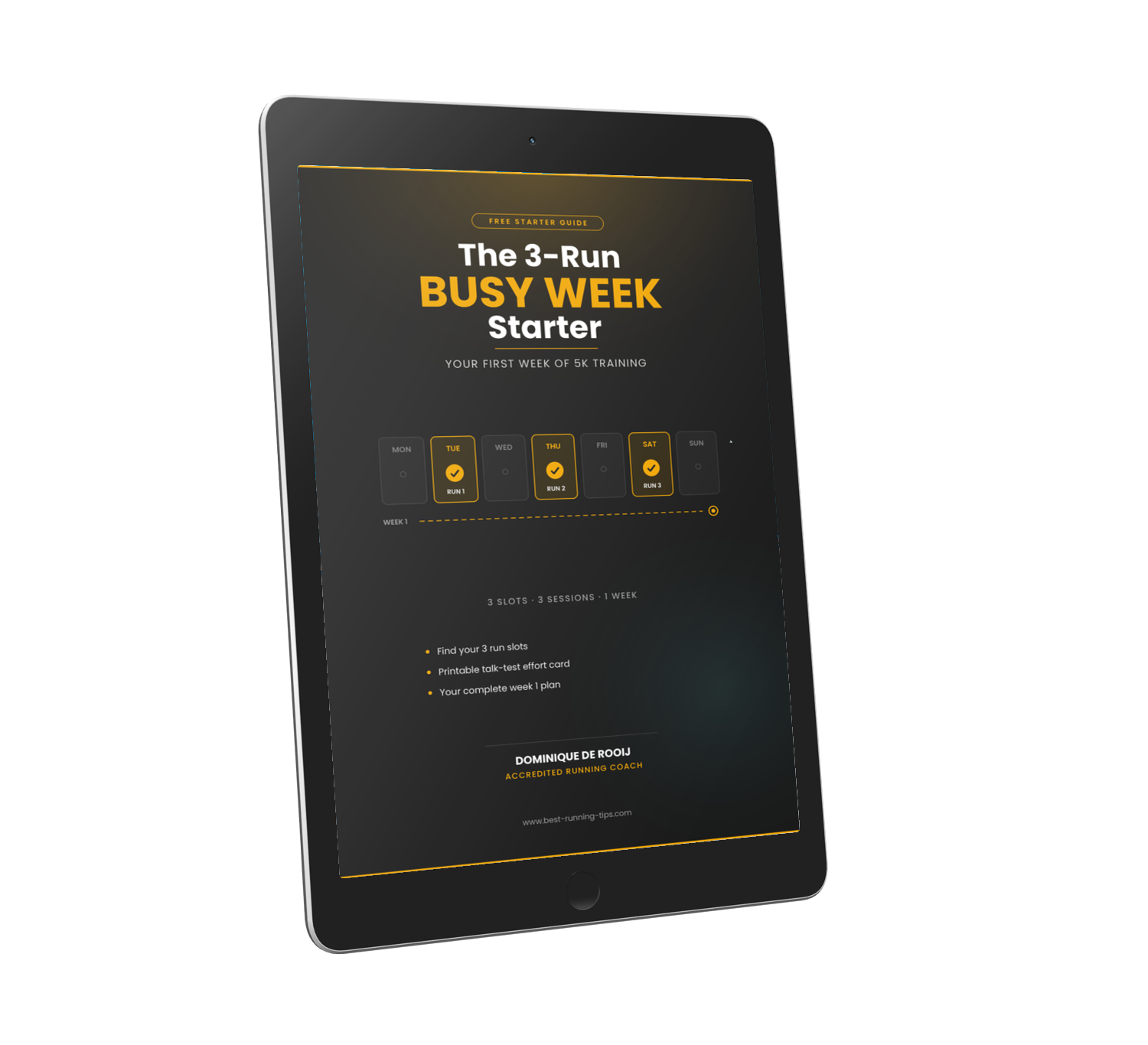
Most beginners don't quit for lack of motivation. They quit because their plan doesn't fit their life. The 3-Run Busy Week Starter plans your first week around the week you actually have.
- Find 3 run slots you can actually keep
- The talk test: the simple way to stop running too fast
- Your complete week 1 plan: 3 run/walk sessions, about 20 minutes each
You'll get the guide plus a short email every few days to help you through week 1. Unsubscribe any time. Privacy policy.
What's New?
-
Personalized Running Coaching - BRT | Run Smarter, Race Better
 Get a personalized running program built around your current fitness, goals, and schedule - not a generic app template. Choose from BRT Silver, Gold, or Platinum coaching with Dom, accredited running…
 -
Sample 4-Day Marathon Training Week: Base to Taper
A full 4-day-a-week marathon training schedule, phase by phase - base, build, peak, and taper - with named workouts and weekly mileage. -
Marathon Taper for a 10-12 Week Training Cycle
How to taper correctly on a compressed 10-12 week marathon plan - the right taper length, why standard advice doesn't fit, and the week-by-week structure.