What Pace Should Beginner Runners Run? Real Min/Mile Benchmarks by Fitness Level
Let's face it — type "good beginner running pace" into a search engine and you'll get three different answers on three different sites. Here's the real one: most true beginners run somewhere between 12 and 16 minutes per mile, a wide range, and where you land in it depends far more on your starting fitness than on your age or sex. Sites quoting a single range — 10-14, 12-15, 9-12 — are each describing a different starting-fitness slice without saying so.I coach runners across that entire spread every week, from complete beginners to people returning after years off. The confusion online always comes down to one thing: comparing your number to someone else's starting point, not your own.
Realistic Min/Mile Ranges by Starting Fitness Level
Here's the table that actually matters — find your own row rather than chasing a single number.| Starting Fitness Level | Realistic Min/Mile Range | What It Should Feel Like |
|---|---|---|
| Sedentary, new to exercise | 16-18 min/mile | A brisk walk with short jogging bursts — full sentences, no strain at all |
| Some walking or cardio base | 13-16 min/mile | A comfortable jog — you can hold a full conversation with light effort |
| Previously active, new to running | 11-13 min/mile | A steady jog — short sentences come comfortably, no gasping |
| Athletic background, new to running | 9-11 min/mile | Genuine running effort already — full sentences, but you notice it |
Why "Good Beginner Pace" Numbers Vary So Much Online
Here's the key point: those different numbers aren't actually disagreeing about what's normal. Each one describes a different slice of the table above. A group of athletic new runners will land near 9-12. A group of sedentary beginners will land near 14-18. Neither is wrong — neither is complete.Don't average the competing numbers together. Averaging 10-14 and 9-12 gets you a figure that describes nobody. Find your own row in the table above instead of relying on a single range.
Pace During the Run Segments of a Run-Walk Program
If you're following a run/walk structure rather than continuous running, the benchmarks above need one adjustment. Your pace during a 60-90 second run interval will naturally be faster than a sustained continuous-run pace at the same effort — short bursts always feel more forgiving than a run you have to hold for a mile straight.That's exactly why comparing your interval pace directly to the table above is misleading. It produces false alarm — "I'm too slow" — or false confidence — "I'm ready for more" — in roughly equal measure, and I see both mistakes constantly in the runners I coach through a run-walk build-up. The fix is simple: judge your run intervals by the talk test, not by matching them to the sustained-pace numbers above. For the run-walk interval structure these paces apply to, see the full programme.
Using Heart Rate Alongside Pace
Pace alone can mislead you, and this is why. Two runners at the identical min/mile pace can be at very different effort levels depending on starting fitness — one comfortably chatting, one working hard. That's not a flaw in the pace numbers. It's just what pace can't tell you on its own.Checking your heart rate alongside pace closes that gap. If you're using a monitor, aim to spend most easy runs in Zone 2 rather than chasing a specific number. No monitor? The talk test does the same job for free — if you can't speak in short sentences, you're working harder than the table above assumes.
How Hills, Trails, and Weather Change Your Expected Pace
None of the ranges above assume flat road in mild weather, so adjust for the conditions you're actually running in. Expect 30-60 seconds per mile slower, or more, on rolling trail or hills compared with flat road at the same effort. Heat and humidity have a similar slowing effect on your pace at a given effort level.The coaching point is simple: judge these runs by effort, not by holding the flat-road benchmark pace. A hilly trail run at talk-test-appropriate effort is doing exactly what it should, even if your watch says you've slowed right down.
What to Expect: How Your Pace Improves Over the First 8-12 Weeks
Here's what to expect. Over 8-12 weeks of consistent running, most beginners see their pace improve by roughly 30 seconds to 1-2 minutes per mile at the same effort level — highly variable by starting fitness, and not a guarantee.Tie that back to the table above: the realistic goal over this window is to move up a fitness-level row, not to hit an absolute number by a deadline. This 8-12 week window is the coaching expectation I set with real beginner clients — not a generic claim lifted from a study.
If you'd like the fuller framework this page sits inside, here's back to the full beginner running framework. And if you're still in your first few weeks, if you're in your first month, effort matters more than the number is worth reading first — plus how pace and recovery interact, once your training load starts to build.
Frequently Asked Questions
Is 15 minutes per mile too slow to count as "running"?No. If you're moving faster than a walk with proper form, it counts — and it's a completely normal starting point for many beginners.
Should I use pace or heart rate to guide my beginner effort?
Heart rate, or the talk test, is more reliable early on since pace-to-effort varies widely by starting fitness.
What's the difference between "beginner" and "average" running pace?
Beginner ranges (12-16 min/mile) reflect early aerobic-base building. "Average" figures usually blend in more experienced runners and skew faster.
Is it bad if I can't hold a conversation at my current pace?
It's a signal to slow down, not a fitness failure. The talk test is a real-time effort check, not a pass/fail grade.
Should I trust a global positioning system (GPS) watch pace or the talk test more as a beginner?
The talk test, especially early on, since watch pace alone doesn't account for terrain, heat, or interval structure.
Some Other Pages You May Like
About the author
Dominique de Rooij (Dom)
Advanced Running Coach certified by Athletics Australia with 20 years of writing about running and over a decade coaching runners — from first-timers to marathoners. Dom's beginner programs have guided thousands of runners and been praised above plans from Jeff Galloway, Hal Higdon, and Runner's World. Now over 50, Dom still loves trail running, parkrun, and the coffee after.
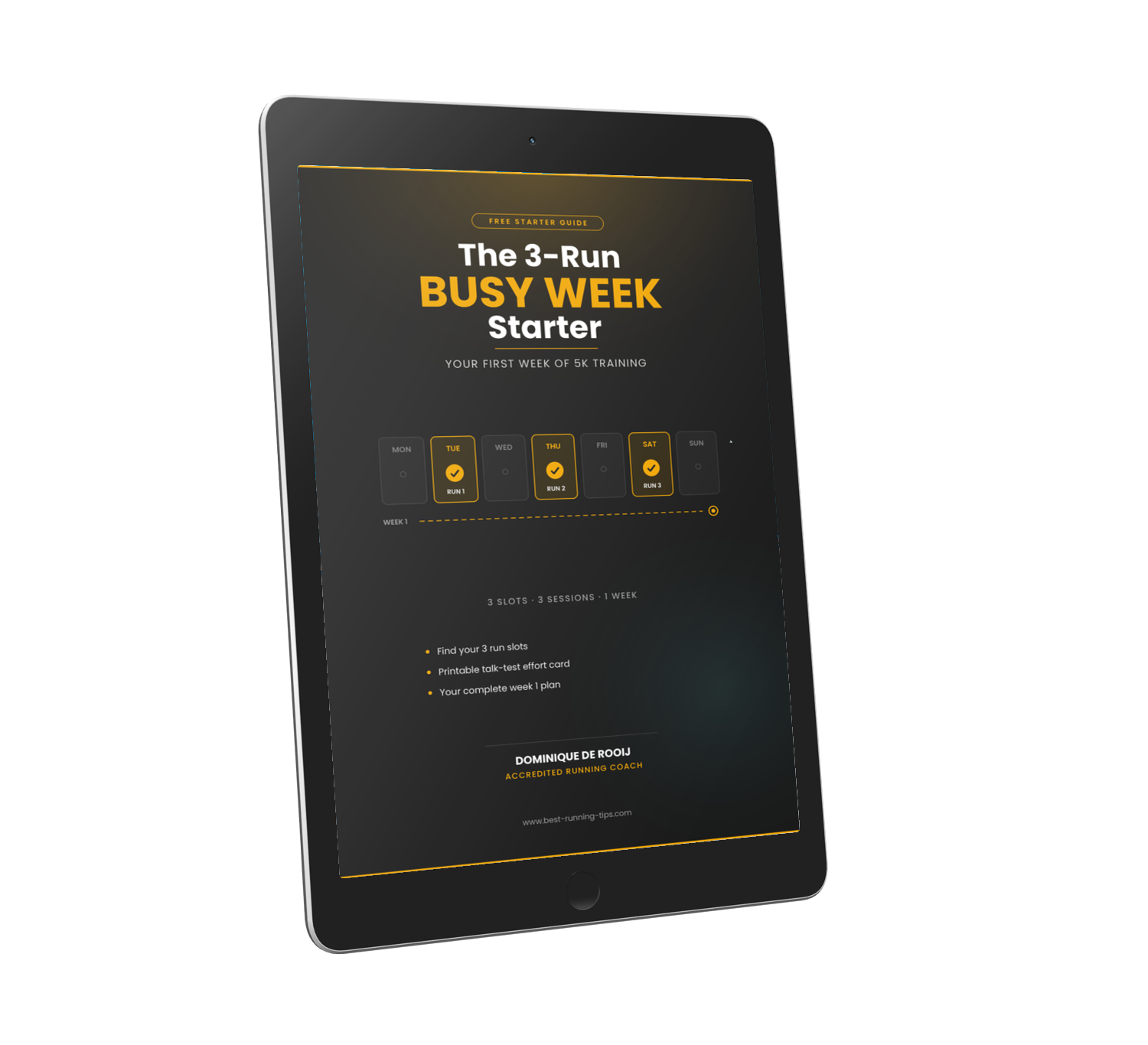
Free beginner guide • From Coach Dom
Start Running This Week, Even If Your Week Is Already Full
Most beginners don't quit for lack of motivation. They quit because their plan doesn't fit their life. The 3-Run Busy Week Starter plans your first week around the week you actually have.
- Find 3 run slots you can actually keep
- The talk test: the simple way to stop running too fast
- Your complete week 1 plan: 3 run/walk sessions, about 20 minutes each
You'll get the guide plus a short email every few days to help you through week 1. Unsubscribe any time. Privacy policy.
What's New?
-
Personalized Running Coaching - BRT | Run Smarter, Race Better
 Get a personalized running program built around your current fitness, goals, and schedule - not a generic app template. Choose from BRT Silver, Gold, or Platinum coaching with Dom, accredited running…
 -
Sample 4-Day Marathon Training Week: Base to Taper
A full 4-day-a-week marathon training schedule, phase by phase - base, build, peak, and taper - with named workouts and weekly mileage. -
Marathon Taper for a 10-12 Week Training Cycle
How to taper correctly on a compressed 10-12 week marathon plan - the right taper length, why standard advice doesn't fit, and the week-by-week structure.