Overcoming Body Image Fears When You Start Running
Yes — feeling self-conscious about being seen running in a bigger body is real and common, not a sign you don't belong on the road. It's one of the biggest reasons beginners delay starting or quit early. What follows are practical, specific tactics for visibility, gear, unwanted comments, and the days when motivation disappears completely.Why Body Image Struggles Are a Real Barrier to Starting — Not a Character Flaw
Let's name this honestly instead of glossing past it: feeling self-conscious about being seen running in a larger body is one of the most common reasons people delay starting, or quit within the first few weeks — and it says nothing about whether you're "cut out" for running. It's a barrier, not a verdict.This is different from ordinary beginner nervousness. Most new runners feel a bit awkward for their first few sessions, and that fades fast — usually within a week or two, once the unfamiliar becomes familiar. Body-image anxiety can behave differently. Left unaddressed, it tends to persist rather than fade on its own, because the discomfort isn't really about running technique — it's about being seen. That's exactly why it needs direct tactics, not just time.
Reframing Why You're Running (Beyond Weight Loss)
If weight loss is the only reason you're running, I want to reframe that before you start — not because losing weight is a bad goal, but because it's a fragile one. The scale moves slowly, and it doesn't move in a straight line. Plenty of runners do everything right for three weeks and see nothing change, then get discouraged and stop right before the trend would have turned.Process-based motivation holds up better. Track sessions completed, minutes run, or a resting heart rate that's slowly dropping, and you have evidence of progress every single week — not just on the weeks the scale cooperates. Energy, sleep quality, stress regulation, and being able to keep up with your kids or grandkids on a walk are all real, tangible wins, and each shows up long before body composition does.
In the runners I coach, the ones who track process metrics — sessions, minutes, consistency — rather than the scale show measurably better adherence through their first 90 days. That's not a coincidence. It's what happens when your evidence of progress doesn't depend on a number that's slow to move.
Handling Visibility: Routes, Timing, and Feeling Exposed
Being seen is the fear underneath most of this, so let's deal with it directly. Route and timing choices make a real difference here. Quieter residential streets typically feel less exposed than busy multi-use trails, and early morning or dusk sessions mean fewer people out altogether. An out-and-back route near home means you pass fewer strangers than a loop that puts you past the same onlookers three or four times.The treadmill is a legitimate on-ramp, not a cop-out. Plenty of runners start entirely indoors, build a few weeks of consistency in private, and only move outside once running itself feels familiar. There's no rule that says outdoor running has to come first.
In my coaching, the single adjustment that reduces self-consciousness fastest is usually timing — moving a run from a busy after-work slot to early morning — more than route choice alone. If you only change one thing this week, change when you run before you change where.
One more thing worth stating plainly: run-walk in visible stages is the method, not a failure. If you're walking the last two minutes of every interval where someone can see you, that's not you giving up — that's the training approach working exactly as intended.
Finding Gear That Fits and Feels Good
Gear confidence matters more than you might expect. A few things actually matter for comfort in a larger body:- Moisture-wicking, fitted-not-loose fabric — prevents chafing far better than baggy "athletic-looking" clothing. Loose fabric rubs; fitted technical fabric doesn't.
- Size-inclusive brands with ranges that run true to size — rather than guessing up or down between brands that size inconsistently.
- Properly fitted sports bra sizing, if you need it — get fitted rather than assuming your regular size will do the job while running.
Dealing With Comments, Stares, and Internalized Stigma
Most of what feels like scrutiny while you run isn't scrutiny at all. Other runners and passers-by are almost always focused on their own effort, their own pace, their own thoughts — not on you. That doesn't make the feeling less real while it's new, but it's worth repeating to yourself until it sinks in.For the comments that do happen, you don't owe anyone an explanation. A brief, non-engaging response works better than either ignoring it or getting drawn into a conversation you didn't ask for — "Thanks, I'm good," then keep running. Say it, mean it, and move on.
If starting again feels harder this time because of a bad experience in a gym, a physical education (PE) class, or diet-culture messaging you've absorbed over the years, that's a legitimate reason motivation feels different — not a personal failing. Coaching new runners through exactly this kind of internalised stigma is a regular part of my coaching, not a rare exception.
Building a Support System: Groups and Community
You don't have to do this alone, and for a lot of people, not doing it alone is what makes it stick. Before joining a running group, ask a few direct questions: is the group's messaging built around inclusion, or is it built around weight loss? Do beginners of different paces and sizes actually show up, or is the "beginner" pace still faster than yours? A group that talks constantly about calories and weight loss is a red flag, whatever else it gets right.Running with one trusted person is a lower-barrier alternative to a full group — less pressure, same accountability. And if in-person still feels like too much right now, online communities and accounts specifically for larger-bodied runners are a lower-stakes place to start. You get representation and practical tips without the visibility concerns a group run can bring.
Small Wins: Tracking Progress That Isn't the Scale
The scale is one number, and it's not even the most useful one. Track these instead:- Total minutes run this month — a number that only goes up as you stay consistent.
- Longest continuous run without walking — direct proof your endurance is building.
- A route completed without stopping — the same loop, done a little more easily each time.
- Your resting heart rate trend — usually the clearest sign your fitness is improving, weight aside.
What to Do on Days Motivation Disappears
Some days, body image struggles will make you want to skip the run entirely. Here's the rule I give the runners I coach for exactly this moment: commit to 10 minutes. You're allowed to stop after that — but you rarely will, because the hardest part of any run is usually the first ten minutes, not the last.If 10 minutes still feels like too much, swap the run for a walk instead. That counts. It keeps the habit alive, which matters more on a hard day than the specific session you had planned.
One question tells true rest apart from avoidance: would you regret skipping this in an hour? A genuine rest day, you won't. An avoidance day, you usually will — and that's your answer.
Frequently Asked Questions
What can I do if I feel like people are staring or judging me while running?Most of what feels like scrutiny is neutral, or imagined — other runners are focused on their own effort. Route and timing choices, like quieter streets or early morning and dusk sessions, can reduce the feeling while it's still new.
Should my goal be weight loss, or is that the wrong motivator to start with?
Weight loss alone is a fragile motivator because it's slow and non-linear — process goals like sessions completed, minutes run, energy, and sleep sustain your adherence far better through plateaus.
Are there running groups or communities specifically welcoming to larger-bodied runners?
Yes — look for groups explicitly framed around inclusion rather than weight loss, or start with an online community before committing to running in person.
What do I do on days when body image struggles make me want to skip a run entirely?
Commit to a 10-minute minimum-viable run, or swap it for a walk instead — both count, and dropping the all-or-nothing framing is what keeps the habit alive.
How long does it typically take before running starts to feel like it's "for me" rather than a chore?
Most beginners find the visibility anxiety eases noticeably within three to four consistent weeks, as routine and small wins add up.
Before you go, a few pages that build on this one: back to the full plan for starting to run at any body weight, a week-by-week timeline to build from here, and pace and heart-rate targets suited to your body. And if weight loss specifically is your main goal alongside this, I've written more on running specifically to lose weight.
Some Other Pages You May Like
About the author

Dominique de Rooij (Dom)
Advanced Running Coach certified by Athletics Australia with 20 years of writing about running and over a decade coaching runners — from first-timers to marathoners. Dom's beginner programs have guided thousands of runners and been praised above plans from Jeff Galloway, Hal Higdon, and Runner's World. Now over 50, Dom still loves trail running, parkrun, and the coffee after.
Free beginner guide • From Coach Dom
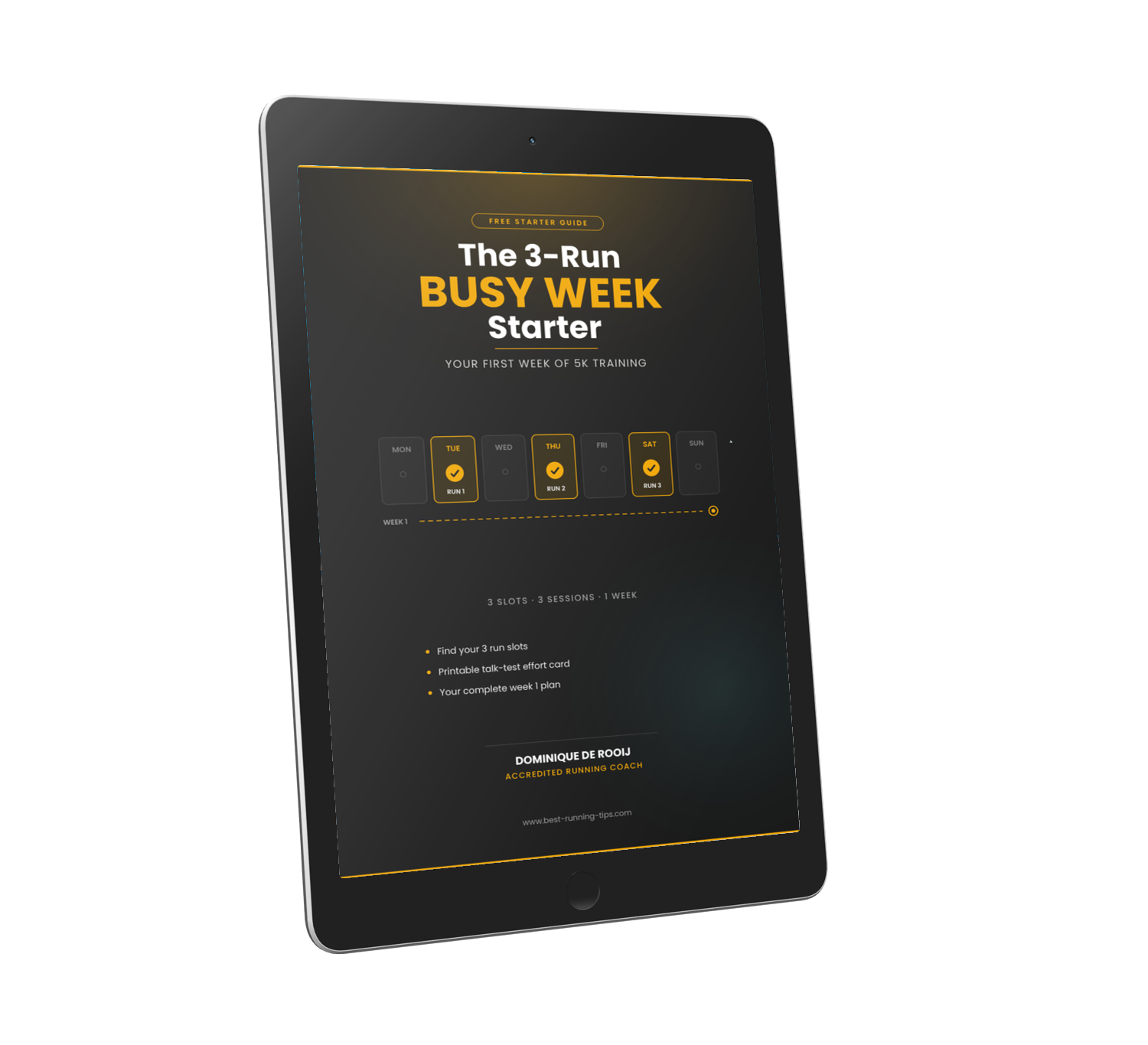
Start Running This Week, Even If Your Week Is Already Full
Most beginners don't quit for lack of motivation. They quit because their plan doesn't fit their life. The 3-Run Busy Week Starter plans your first week around the week you actually have.
- Find 3 run slots you can actually keep
- The talk test: the simple way to stop running too fast
- Your complete week 1 plan: 3 run/walk sessions, about 20 minutes each
You'll get the guide plus a short email every few days to help you through week 1. Unsubscribe any time. Privacy policy.
What's New?
-
Personalized Running Coaching - BRT | Run Smarter, Race Better
 Get a personalized running program built around your current fitness, goals, and schedule - not a generic app template. Choose from BRT Silver, Gold, or Platinum coaching with Dom, accredited running…
 -
Sample 4-Day Marathon Training Week: Base to Taper
A full 4-day-a-week marathon training schedule, phase by phase - base, build, peak, and taper - with named workouts and weekly mileage. -
Marathon Taper for a 10-12 Week Training Cycle
How to taper correctly on a compressed 10-12 week marathon plan - the right taper length, why standard advice doesn't fit, and the week-by-week structure.
