Foot and Ankle Strengthening Exercises
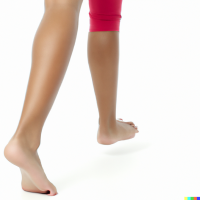
Your feet are the part of your running body almost nobody trains, until something hurts and everything above them starts to compensate. Most of these you can do sitting down while watching television, so there is very little reason not to start this week.
Exercise 1. Toe Tapping
Sit in a chair with your feet flat on the floor. Lift your toes as high as you can while keeping your heels on the ground. Hold for a few seconds, then lower your toes back to the ground. Repeat this exercise for several sets. Start with 2–3 sets of 15–20 taps, once a day. Once that feels comfortable, slow the tempo down — a 2-second lift, a 2-second lower — rather than piling on extra reps.
Exercise 2. Toe Walking
Stand on your tiptoes and walk around for a few minutes. This exercise helps strengthen the muscles in the front of your feet and your calf muscles. Start with 2–3 bouts of 20–30 seconds. Build up toward 60 seconds at a time, then make it harder again by walking on a slight incline.
Exercise 3. Heel Walking
Similar to toe walking, stand on your heels and walk around for a few minutes. This exercise targets the muscles in your shins and helps improve balance. Use the same build-up as toe walking — 2–3 bouts of 20–30 seconds, working toward 60 seconds before you look for a harder variation.
Exercise 4. Calf Raises
Stand with your feet hip-width apart. Slowly raise your heels as high as you can while keeping your toes on the ground. Hold for a few seconds at the top, then lower your heels back down. Repeat for several sets. Start with 2–3 sets of 12–15 reps on both legs together. Once that's easy, switch to single-leg raises, then slow the lowering phase to a 3-second count — that slow lowering is your way into the eccentric work covered in Exercise 10.
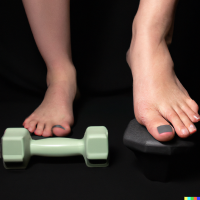
Sit on the floor or in a chair with your feet lifted off the ground. Pretend your big toe is a pencil, and write the alphabet in the air with your big toe. This exercise helps improve ankle mobility and strengthens the muscles surrounding the ankle. One full alphabet per foot, once or twice a day, is a sensible starting point. Progress by writing in capital letters for a bigger range of motion, or loop a light resistance band around your foot for extra tension.
Exercise 6. Marble Pickup
Place a small bowl of marbles on the floor in front of you. Using your toes, pick up each marble and place it in another bowl. This exercise improves toe dexterity and strength. 10–15 marbles per foot is plenty to start. Time yourself and try to beat your own time, or switch to smaller objects like dried beans for finer control once marbles feel easy.
Exercise 7. Resistance Band Exercises
Use a resistance band to perform exercises that work the muscles of the foot and ankle. Wrap the band around your foot and perform resistance exercises such as flexing and pointing your toes, and moving your foot side to side. Work in 2–3 sets of 15 reps per direction — flexion, extension, and side-to-side. When 15 reps starts to feel easy, move up to a heavier band rather than adding more reps; the dosage should scale with load.
Exercise 8. Towel Scrunches
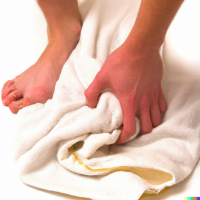
Place a small towel on the floor and use your toes to scrunch it up toward you. This exercise targets the muscles in your arches. 2–3 sets of 10–12 scrunches per foot is a good starting dose. Progress by placing a light weight — a tin of food works well — on the far end of the towel.
Exercise 9. Balance Exercises
Stand on one foot for 30 seconds to 1 minute, then switch to the other foot. As you progress, try closing your eyes to challenge your balance further. You can also perform balance exercises on uneven surfaces like a balance board or foam pad. Hold for 2–3 rounds of 30–60 seconds per side, and progress in this order — eyes open, then eyes closed, then a firm surface, then a foam pad or balance board. Don't jump straight to eyes-closed-on-foam — each change adds its own difficulty.
Stand on the edge of a step with your heels hanging off. Slowly lower your heels below the step and then raise them back to the starting position. This exercise can help strengthen the calf muscles and Achilles tendon. This is the highest-value exercise on this list for loading the Achilles tendon — and the one most often under-dosed. A few reps a couple of times a week won't produce the adaptation you're after. Do 3 sets of 15 reps, once or twice a day, and once bodyweight sets feel easy for two consecutive weeks, add load with a loaded backpack.
Exercise 11. Short Foot Exercise
While sitting or standing, try to contract the muscles of your arch by gently pressing your toes into the ground without curling them. This exercise strengthens the intrinsic muscles of the foot. Start seated, with 2–3 sets of 10 holds of 5–10 seconds each. Progress to standing, then to single-leg standing, before you fold it into a balance exercise.
Which exercises matter most for your condition
If you've landed here from a specific injury page, you don't need all eleven exercises in equal measure. Here's where to focus:
Ankle instability or recurrent ankle sprains — prioritise the Ankle Alphabet, Balance Exercises, and the Resistance Band work. These target the proprioception and the stabilising muscles around the ankle that repeat sprains tend to compromise.
Shin splints — prioritise Toe Walking, Heel Walking, Calf Raises, and Eccentric Heel Drops. These build the calf complex and shin muscles' tolerance for load — exactly what shin-splint rehab is training for.
Runner's knee — prioritise the Short Foot Exercise, Marble Pickup, Towel Scrunches, and Balance Exercises. Foot and arch control feeds up the chain and affects alignment at the knee, and balance work addresses the hip-to-foot control that's often part of the problem. Think of these as a supporting piece alongside hip and quad strengthening, not a replacement for it.
The beauty of these exercises is that you do not need to do them often. As a preventative measure, doing them once or twice a week is sufficient. And for many of these, you don't even need to leave the couch. Just do them sitting down for 10-15 minutes while watching TV and you are doing all you need to keep your feet happy and healthy.
You can also incorporate some of these exercises, such as calf raises and heel drops, in your cool-down after a run. Check out the Running Stretches page for more guidance on what to do during warm-up and cool-down.
Red flags — when to stop
Prevention is king, but know when to pull back. Stop any exercise that causes sharp, localised pain — that's a different signal from the mild fatigue or burn these exercises are meant to produce.
If an exercise reliably brings back the pain from your underlying condition — ankle, shin, or knee — drop it from your routine and flag it to whoever is treating that condition, rather than pushing through.
No meaningful improvement in comfort or stability after 2–3 weeks of consistent practice? That's your sign this generic routine isn't enough for your case. See a physical therapist for a tailored program instead of continuing to self-manage.
These are prevention and maintenance exercises — not a substitute for a diagnosis if you have an active, unresolved injury. Start with your specific condition page's own guidance first.
Lastly, if you are currently experiencing heel pain, check out the Pain in Heel When Running page to learn about common heel injuries for runners and what you can do to treat and prevent them.
Some Other Pages You May Like
Which Running Injury Do You Have?
Modifiable vs. Structural Causes of Running Injuries
Return to Running After Injury
Red-Flag Symptoms in Running Injuries
Knee Pain After Running
Running Stress Fractures
Shin Splints
Beginner Running
Home > Running Injuries > Injury Prevention > Foot and Ankle Strengthening Exercises

About the author

Dominique de Rooij (Dom)
Advanced Running Coach certified by Athletics Australia with 20 years of writing about running and over a decade coaching runners — from first-timers to marathoners. Dom's beginner programs have guided thousands of runners and been praised above plans from Jeff Galloway, Hal Higdon, and Runner's World. Now over 50, Dom still loves trail running, parkrun, and the coffee after.
Free weekly coaching • Join 3,500+ runners
Train Smarter, Not Just Harder
Get your free guide when you join the BRT Coaching Letter
No spam, ever. Unsubscribe in one click, any time.
What's New?
-
Personalized Running Coaching - BRT | Run Smarter, Race Better
 Get a personalized running program built around your current fitness, goals, and schedule - not a generic app template. Choose from BRT Silver, Gold, or Platinum coaching with Dom, accredited running…
 -
Sample 4-Day Marathon Training Week: Base to Taper
A full 4-day-a-week marathon training schedule, phase by phase - base, build, peak, and taper - with named workouts and weekly mileage. -
Marathon Taper for a 10-12 Week Training Cycle
How to taper correctly on a compressed 10-12 week marathon plan - the right taper length, why standard advice doesn't fit, and the week-by-week structure.
