Beginner Running Guide: Your Complete Start-to-Finish Plan
Beginner running works best on three days a week, with a rest or easy day between each session, building to four days once your body has settled into the routine. This guide puts the whole plan in order: weekly structure, first goals, fuelling and recovery, strength work, personalising the plan by body type, age and starting fitness, injury warning signs, and what comes after your first month.Let's face it — a grab-bag of tips isn't enough to get you started, and the new runners who stick with it are the ones who follow a plan in order. I've coached people through exactly this stretch for over twenty years, so you'll get the sequence you actually need it in.
Haven't confirmed it's safe for you to start yet? Sort that out first — see confirming it's safe to start — then come back here. Want the scannable version instead? Beginner Running Tips is that. This page is the ordered plan.
How to Structure Your Beginner Running Week

Here's the 3-day template I use with beginner athletes:
| Day | Session | Effort |
|---|---|---|
| Monday | Rest | — |
| Tuesday | Run, 20-25 min | Easy |
| Wednesday | Rest, or strength | — |
| Thursday | Run, 20-25 min | Easy |
| Friday | Rest | — |
| Saturday | Run, 25-30 min (the week's longest) | Easy |
| Sunday | Rest | — |
And the 4-day variant, for once you're ready:
| Day | Session | Effort |
|---|---|---|
| Monday | Run, 20-25 min | Easy |
| Tuesday | Rest, or strength | — |
| Wednesday | Run, 20-25 min | Easy |
| Thursday | Rest | — |
| Friday | Run, 20-25 min | Easy |
| Saturday | Rest, or strength | — |
| Sunday | Run, 25-30 min (the week's longest) | Easy |
Move to four days only once you've held three days comfortably for two to three weeks straight — no excess soreness, no dread on run mornings. That's the trigger. Not a date circled on the calendar. Jump too early, and a niggle turns into a real injury fast.
For the full day-by-day breakdown — including exactly which effort level suits which day — see the day-by-day weekly structure guide.
Setting the Right First Running Goals

| Milestone Type | Example Goal |
|---|---|
| Time-based | Run continuously for 10 minutes |
| Distance-based | Complete a 5K — run/walk or continuous, either counts |
| Frequency-based | Run 3x a week for 4 straight weeks |
Pick the one that matches what's actually blocking you. Breathlessness the limiter? Lead with time. A race the motivator? Lead with distance. Consistency itself the struggle — you keep starting and stopping? Lead with frequency, and let the rest follow.
For the extended version of this framework, see setting your first goals.
Fuelling Your Runs: Pre-Run and Recovery Basics
Most beginner sessions are short enough that fuelling barely matters. But it's worth knowing the basics rather than guessing. If running on an empty stomach leaves you lightheaded, have a light carbohydrate snack 60 to 90 minutes before you head out. Fine to run fasted, if a 20 to 30 minute session feels comfortable.Recovery works the same way — scaled to what you've actually done, not to what an endurance athlete needs. A normal meal within a couple of hours is enough. You don't need a dedicated recovery shake or gel regimen at this stage. For hydration, a glass of water before and after covers a short session.
For the full breakdown, see fueling and recovery nutrition.
Strength Training to Pair With Running

Twice a week is enough. Slot these into the rest days from your weekly-structure table above — Wednesday and Sunday on the 3-day plan, Tuesday and Saturday on the 4-day plan. Don't treat strength as a floating extra you never quite get to.
Personalising the Plan by Body Type, Age, and Starting Fitness
No beginner plan is truly one-size-fits-all. I'd rather tell you that directly than hand you a blanket template and a "listen to your body" line that doesn't actually help. Three things change the plan — and they change it differently from each other.Carrying a higher body weight? Build in more rest between running days. Put strength work — particularly for your knees and ankles — earlier in the plan than I'd otherwise suggest. Starting at an older age? Slow your week-to-week progression down, and lengthen your warm-up. Your body needs more notice before a run, not less effort during it. Starting from a very deconditioned base? Spend a period walking first, building that fitness before you add any running intervals at all.
If your main concern is safety around your weight specifically, this section won't give you the depth you need. Go to starting running at a higher body weight instead, where that's covered properly.
For the full breakdown of all three adjustment factors, see personalizing your plan.
Injury Warning Signs and What to Actually Do About Them
Knowing the common injuries is only half of it. What matters is what to do when one actually strikes.Start with the soreness-versus-pain test: does it ease off as you run, or does it get worse? Soreness that improves as you warm up is normal. Pain that builds through the run is not — that's your cue to stop.
When something recurs, use the pull-back rule. Back off running for two to three days, and reassess. Don't push through and hope it settles on its own. See a doctor if a warning sign doesn't improve with rest, or it's sharp, sudden, or affecting how you walk. Anything duller that responds to a few easy days off is usually just rest doing its job.
For the full protocol, see injury warning signs.
What Comes After Your First Month
A month of consistent running behind you? You've got two sensible directions to take it. Want continued structure? Couch to 5K and the Best Running Tips beginner running program are the two structured programs to follow next — both build on what you've just established. Built the habit and feel ready to run on your own terms? Graduating to self-directed running is just as valid.Don't let the plan end just because the first month has. Treat it as a start, not the whole story. For more on how I approach training philosophy at this stage, see more on how to approach beginner training.
Frequently Asked Questions
What's a realistic first goal for a new runner?
Running continuously for ten minutes, without stopping to walk, is about the most realistic universal starting goal there is. See the goal-setting section above for the other two milestone types.
Do I need a gait analysis before buying running shoes?
Not to get started, no. It's worth booking one if you've got a history of shin or knee pain, or you're buying your first proper running shoe and want to rule out an obvious mismatch.
Should I eat before a run as a beginner?
Only if running on an empty stomach leaves you lightheaded. Most beginner sessions are short enough — 20 to 30 minutes — that you don't need to eat beforehand at all.
How do I know if my running shoes fit correctly?
You want a thumb's-width of space at the toe box, no slipping at the heel, and no break-in pain that's still there by your second run.
Where does a "long run" fit into a beginner's week?
It doesn't really exist as its own idea in month one. Your "long" run is just whichever session is your furthest or longest in duration. Place it on the day with the most recovery either side — see the weekly-structure tables above.
Follow it in order. Give each stage the time it actually needs — that's the whole method. We're all different, but this is the sequence I come back to with beginner athlete after beginner athlete, because it's the one that holds up.
More Pages on This Topic
Some Other Pages You May Like
About the author

Dominique de Rooij (Dom)
Advanced Running Coach certified by Athletics Australia with 20 years of writing about running and over a decade coaching runners — from first-timers to marathoners. Dom's beginner programs have guided thousands of runners and been praised above plans from Jeff Galloway, Hal Higdon, and Runner's World. Now over 50, Dom still loves trail running, parkrun, and the coffee after.
Free beginner guide • From Coach Dom
Start Running This Week, Even If Your Week Is Already Full
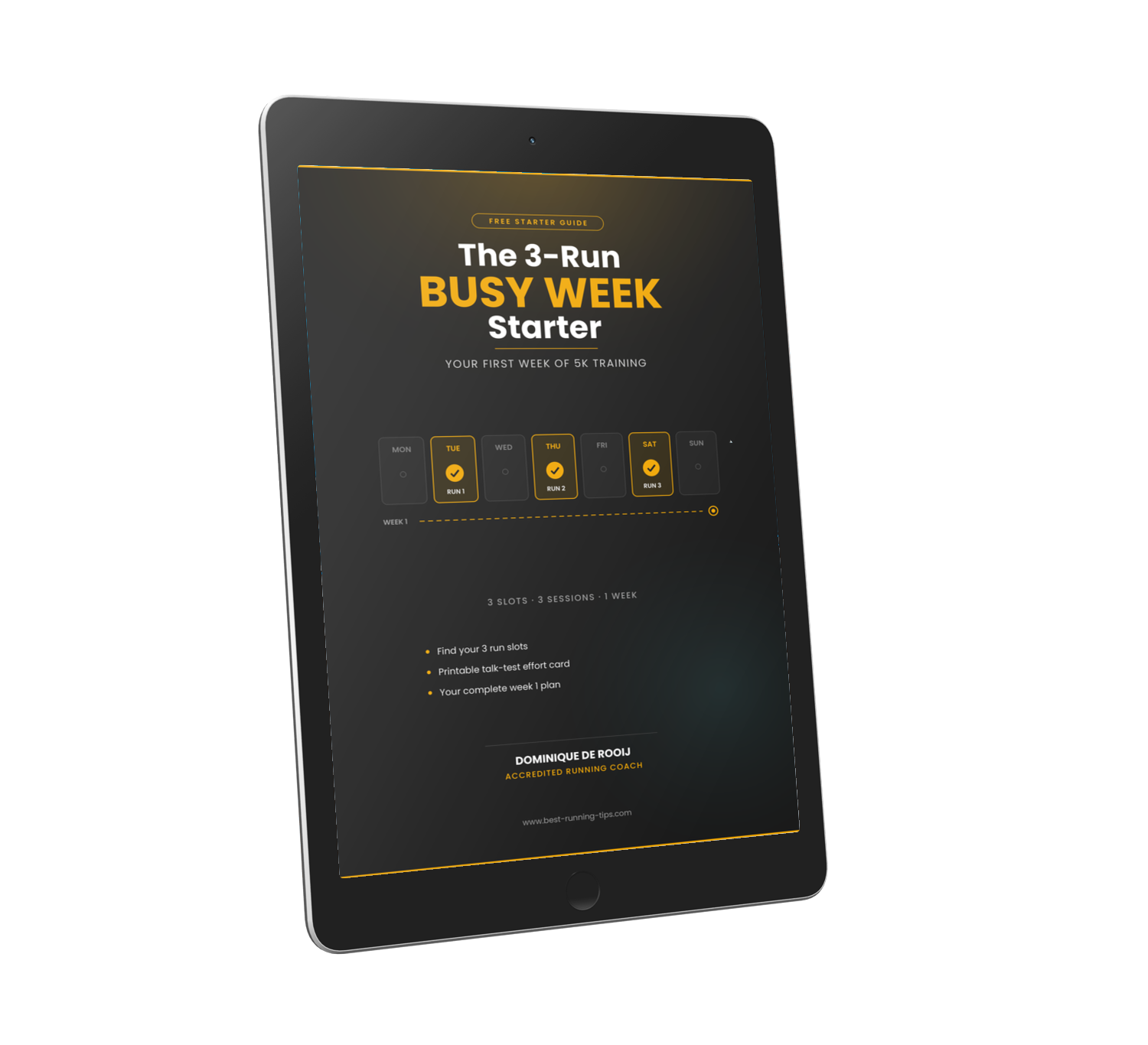
Most beginners don't quit for lack of motivation. They quit because their plan doesn't fit their life. The 3-Run Busy Week Starter plans your first week around the week you actually have.
- Find 3 run slots you can actually keep
- The talk test: the simple way to stop running too fast
- Your complete week 1 plan: 3 run/walk sessions, about 20 minutes each
I'll email you a link to confirm your address, then send the guide plus a short email every few days to help you through week 1. Unsubscribe any time. Privacy policy.
What's New?
-
Cut 90 Seconds Off Your 1.5 Mile Run for the Army Test
Cutting 90 seconds off a 1.5 mile run in 3-4 weeks for the Army test: Dom breaks down realistic pacing to reduce 10:32 toward sub-9:00 for Paras selection. -
Training for a 1.5 Mile Run - How to Qualify For Your Test
Coach Dom's 3-step plan for 1.5 mile run training: build aerobic base, add strides, then tempo and pace work to hit your test time. -
Improve Your 1.5 Mile Running Time to 10:30: Shin Splints
From 12:59 to 10:30 for 1.5 miles: Coach Dom's shin-splint fix and training plan to improve your running time in 2-3 months.