Common Beginner Injury Warning Signs (and What to Actually Do About Them)
You've noticed something — a tight band along the shin, an ache behind the kneecap, a stab of heel pain the second you got out of bed. You want one answer: which injury is this, and what do I do about it today. Shin splints top the list of what beginners actually have when they message me about a new ache; runner's knee, plantar fasciitis, iliotibial (IT) band pain, and Achilles tenderness make up the other four. Match your symptom against the comparison table below to find yours.I've coached new runners through this exact stretch for over twenty years, and these five account for nearly every message I get. The shared first response to all five is identical — back off for 2 to 3 days, and never run through a symptom that's sharp or getting worse as you go. This page's job is narrow and practical: match your symptom to the injury it fits, then give you the immediate step.
If you're not even sure this is an injury rather than ordinary new-runner soreness, start with the general soreness-vs-injury test instead — everything below assumes you've already cleared that hurdle.
Common Beginner Injuries and Their Early Warning Signs
Let's put the five side by side, because the differences between them matter more than the similarities. Match your symptom's location and behaviour against the table below.| Injury | Where you feel it | Early warning sign | Immediate action |
|---|---|---|---|
| Shin splints | Along the shin bone | A band of tenderness along the bone — not a deep muscle ache — usually worse at the start of a run | Back off 2–3 days, then shorten your stride slightly when you return |
| Runner's knee | Around or behind the kneecap | A dull ache that's worse on stairs or downhills | Back off 2–3 days, then cut downhill and stair work when you return |
| Plantar fasciitis | Heel, first steps after rest | Sharp heel pain in the first steps after waking or sitting, easing as you warm up, then returning after rest | Back off 2–3 days, ease into your first steps each morning, avoid barefoot walking on hard floors |
| IT band pain | Outer knee | Pain that shows up at a consistent distance or time into the run, rather than randomly | Back off 2–3 days, then reduce hill work before building mileage back up |
| Achilles tenderness | Back of the heel | Stiffness or tenderness at the back of the heel, worse first thing in the morning | Back off 2–3 days, avoid hill sprints and calf-heavy strength work until it eases |
Notice what's constant. Every single "immediate action" starts the same way — back off for 2 to 3 days. What changes is the one adjustment on top of that, and that's where most beginners go wrong: they either skip the pull-back entirely, or they pull back and change nothing else. Both keep the injury coming back.
Runner's knee and shin splints in particular often trace back to the same root cause — how your foot and knee track through each stride. If either of those is your pattern, form changes for runner's knee or shin splints covers the specific adjustments worth making.
Could Your Shoes or Gait Be the Cause?
Here's something worth knowing — your shoes and your gait can directly cause shin splints, plantar fasciitis, and IT band pain, not just make an existing injury worse. Worn-out cushioning, typically somewhere between 300 and 500 miles, stops absorbing impact the way it did when the shoe was new. A shoe that doesn't suit your gait pattern loads the same tissue awkwardly, run after run.Run a quick self-check before assuming it's purely a training-load problem. Three things to look at: how many miles are actually on the shoe, whether the outsole is wearing unevenly on one side, and whether your symptoms started shortly after switching to a new pair.
You don't need a gait analysis to get started, and most beginners never need one at all. It's worth booking one if you've had shin or knee pain more than once, or your self-check above points straight at your shoes — otherwise, it's a solution looking for a problem. For fit and shoe-buying basics generally, that's covered in the Guide's own footwear guidance.
The Quick Call: Pull Back, Modify, or Stop
You don't need the full decision tree for every twinge. Here's the one-line version: if it improves as the run goes on and fades within a day, pull back and modify. If it's sharp, localised, or gets worse as you run, stop and treat it as an injury, not soreness.That's the quick call — enough for most days. When you want the full picture, calibrated specifically to a beginner's baseline soreness, the full self-triage checklist walks through it in more depth.
When It's More Than Self-Care
Three signs mean this has moved past anything you should be managing alone: pain that's changed your gait or left you limping, pinpoint pain over a bone rather than a general ache, or symptoms that haven't improved after a full week of reduced load.Any one of those three, and it's time for when to see a doctor — that page covers the full red-flag criteria and which type of provider to see.
Getting Back to Running After a Scare
How long you need before running normally again depends entirely on which injury this was and how severe it got. There's no single timeline that fits all five.Recovery timelines and returning to running covers the comparison table, the readiness test, and a graduated return for each injury, so you come back at the right pace rather than guessing.
Frequently Asked Questions
What are the first signs of runner's knee I should watch for?
A dull ache around or behind the kneecap that shows up on stairs or downhills before it shows up on flat ground.
Is heel pain in the morning always plantar fasciitis?
Not always, but sharp first-step heel pain that eases as you warm up and returns after rest is the classic pattern.
Could my shoes be causing my injury symptoms?
Yes, for shin splints, plantar fasciitis, and IT band pain specifically. Check shoe mileage and wear pattern before assuming it's a training-load problem alone.
Can I keep running through mild shin pain, or should I stop?
Mild and improving during the run, back off and shorten your stride. Sharp or worsening, stop and treat it as shin splints, not soreness.
How do I know if this is the same injury I read about here or something else?
Match the location and behaviour — during-run vs. after-run, morning vs. all-day — against the comparison table above. If it doesn't match cleanly, use the full self-triage checklist instead.
Most beginner injuries follow one of these five patterns, and most respond to the same first move — back off, adjust one thing, and give it time. If you want to understand why new runners pick up these injuries more often than experienced ones in the first place, why new runners get injured more often covers the underlying pattern. And if none of this felt like your exact situation, the wider common beginner running injuries guide covers more ground.
As a coach, these are the same five patterns and the same first moves I use with my own clients. Listen to your body, act early, and you'll spend far more time running than sidelined. :)
Some Other Pages You May Like
About the author
Dominique de Rooij (Dom)
Advanced Running Coach certified by Athletics Australia with 20 years of writing about running and over a decade coaching runners — from first-timers to marathoners. Dom's beginner programs have guided thousands of runners and been praised above plans from Jeff Galloway, Hal Higdon, and Runner's World. Now over 50, Dom still loves trail running, parkrun, and the coffee after.
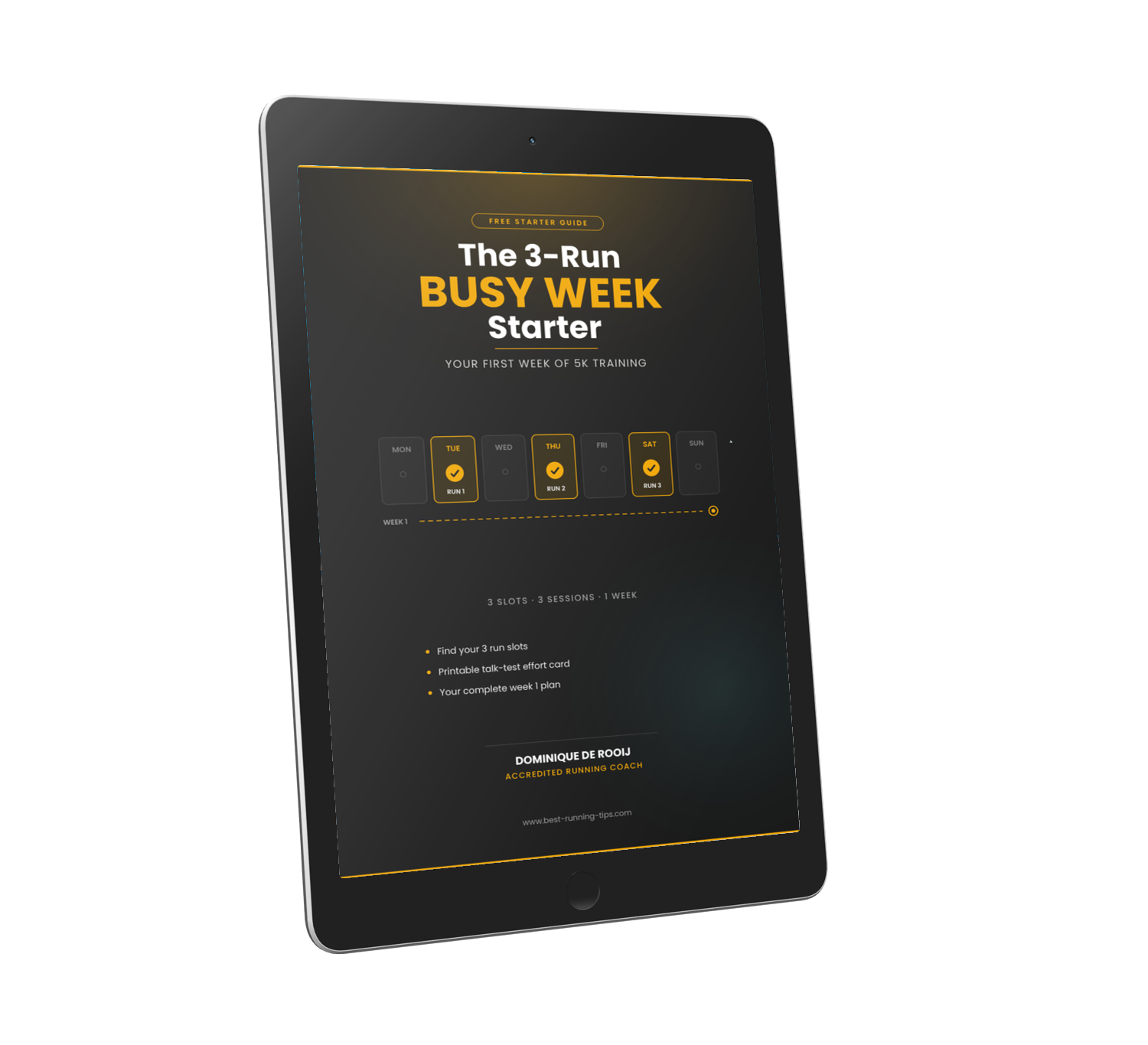
Free beginner guide • From Coach Dom
Start Running This Week, Even If Your Week Is Already Full
Most beginners don't quit for lack of motivation. They quit because their plan doesn't fit their life. The 3-Run Busy Week Starter plans your first week around the week you actually have.
- Find 3 run slots you can actually keep
- The talk test: the simple way to stop running too fast
- Your complete week 1 plan: 3 run/walk sessions, about 20 minutes each
You'll get the guide plus a short email every few days to help you through week 1. Unsubscribe any time. Privacy policy.
What's New?
-
Personalized Running Coaching - BRT | Run Smarter, Race Better
 Get a personalized running program built around your current fitness, goals, and schedule - not a generic app template. Choose from BRT Silver, Gold, or Platinum coaching with Dom, accredited running…
 -
Sample 4-Day Marathon Training Week: Base to Taper
A full 4-day-a-week marathon training schedule, phase by phase - base, build, peak, and taper - with named workouts and weekly mileage. -
Marathon Taper for a 10-12 Week Training Cycle
How to taper correctly on a compressed 10-12 week marathon plan - the right taper length, why standard advice doesn't fit, and the week-by-week structure.
