Setting the Right First Running Goals for Beginners
Let's face it — "run more" isn't a goal. A real first running goal is specific and time-bound, and it comes in one of three types: time-based, distance-based, or frequency-based. Default to a time-based goal — running continuously for a set number of minutes — until that feels comfortable, then move to distance.Vague goals fail for a simple reason: there's no way to know when they're met, no way to track progress toward them, and they're the easiest kind of goal in the world to quietly abandon.
I've watched dozens of new runners set themselves up to fail with a goal like "get fitter" or "run more this year." The fix isn't complicated — it just needs to be specific.
Time-Based vs. Distance-Based Goals: Which to Start With
If you're a true beginner, default to a time-based goal — something like running continuously for 10 minutes. Time-based goals remove pace anxiety entirely. You're not trying to hit a number per kilometre, you're just trying to keep moving for a set stretch. That makes them achievable regardless of your fitness background, which is exactly what a first goal needs to be.Switch to a distance-based goal only once continuous running for 15 to 20 minutes feels comfortable. Not before. A distance goal — running or run/walking a 5K, say — implicitly demands a pace or effort level you can't yet judge as a brand-new runner. Chase distance too early, and you'll either burn out in the first kilometre or walk far more of it than you planned to.
There's a third option worth naming: a frequency-based goal, built around how many times you run per week rather than how long or how far. This is the right default if your actual limiter isn't endurance or breathlessness — it's consistency. If you keep starting and stopping, a goal like "run three times a week for four straight weeks" will serve you better than any time or distance target.
I've coached new runners through this exact decision point more times than I can count, and the ones who default to time — not distance — are consistently the ones who stick with it past week two. Removing the pace question removes most of the anxiety with it. This page is the deep dive on that decision — for the fuller framework of all three milestone types, head back to the complete beginner running guide.
Matching Your First Goal to Your Actual Starting Fitness
Goals shouldn't be universal, because your starting point isn't universal either. Match your first goal to where you're actually starting from, not to a generic "week one" template:| Starting Point | Your First Goal |
|---|---|
| Starting from zero activity | Run/walk 3x a week for 2 weeks — no duration target yet |
| Returning after a long layoff | Rebuild to a prior comfortable duration — not a new personal record (PR) |
| Already walking regularly | Convert straight to a 10-minute continuous-running goal |
If you're significantly overweight, older, or very deconditioned, don't lock in a timeline yet. Calibrate first against matching your plan to your starting fitness — your progression speed genuinely differs by starting point, and skipping this step is how a niggle turns into a real setback.
Using SMART Goals for Running (A Real Example)
SMART goals are only useful once you've seen one worked through. Here's a full example, built the way I'd set it with a real beginner athlete:- Specific — run continuously, without walking
- Measurable — for 10 minutes
- Achievable — starting from run/walk intervals you're already comfortable holding for 5 minutes
- Relevant — tied to your actual reason for starting, whether that's health, a race on the calendar, or something else entirely
- Time-bound — within 4 weeks
That's the full goal: run continuously for 10 minutes, within 4 weeks, building from 5-minute run/walk intervals you can already manage. Specific, measurable, and honest about where you're starting from.
The same structure works for a distance-based goal too — it isn't time-goal-specific. "Run/walk a 5K within 8 weeks, building from where I'm training now" hits all five components just as cleanly.
A Simple Milestone Timeline: Mile One to First 5K
How far apart should your goals actually sit? Here's a realistic sequence for an average true beginner, built from years of coaching runners through exactly this stretch — not a borrowed generic schedule:| Milestone | Typical Week Range |
|---|---|
| First continuous 10 minutes | Weeks 2–4 |
| First continuous mile | Weeks 4–6 |
| First 5K (run/walk) | Weeks 6–10 |
| First continuous 5K | Weeks 10–16 |
Treat these as typical ranges, not a guarantee — your own timeline will shift earlier or later depending on your starting fitness and how consistent you manage to be. What matters more than the exact weeks is the spacing itself. Space your milestones too close together — weekly, say — and you'll spend most of your first two months feeling like you're falling short of a goal, rather than making progress toward one.
If you want a structured week-by-week path through this exact progression rather than building your own, a structured plan toward your first 5K goal walks you through it session by session.
A Basic Goal-Tracking Template You Can Copy
You don't need an app for this — a simple table does the job. Copy this one and fill it in as you go:| Week | Planned Session | Actual Result | How It Felt |
|---|---|---|---|
| 1 | e.g. Run/walk, 3x this week | Too easy / Right / Too hard | |
| 2 | |||
| 3 | |||
| 4 |
There's one decision this table should drive: if two consecutive weeks read "too hard," that's your trigger to adjust the goal's timeline — not to push through and hope it clicks. Two "too easy" weeks in a row is useful information too. It might mean you're ready to move faster than the plan assumes.
Adjusting Goals When Life or Fitness Gets in the Way
Missing a goal doesn't mean abandoning it. It means adjusting the timeline. That's the direct rule, and it's worth holding onto the first time life gets in the way — because it will.There are two different reasons a goal gets missed, and they call for two different fixes. If you're simply behind schedule — a busy fortnight, a cold, a missed week — keep the same target and push the date back. Nothing about the goal itself was wrong, you just need more time to get there. But if the goal was miscalibrated from the start — you set a 10-minute continuous-running goal when you were really still building from zero — drop back a starting-fitness band and re-set it using the framework above, rather than grinding toward a target that was never realistic for where you began.
Frequently Asked Questions
What's a realistic first running goal for someone starting from zero?
If you're starting from zero activity, your first goal isn't a duration target at all — it's running or run/walking three times a week for two weeks, consistently, before you set anything more specific.
Is running a full 5K without walking a good first goal?
Not as a starting goal, no — it's a later milestone, realistically around weeks 10 to 16. As a first target it's too far out to sustain motivation.
How do I turn "run more" into a specific, measurable goal?
Run it through the SMART framework above — specific, measurable, achievable, relevant, and time-bound. The worked example shows exactly how.
What's a good goal timeline for going from couch to first 5K?
Roughly six to ten weeks for a run/walk 5K, per the milestone timeline above.
Should beginners set a race as their first goal, or something smaller?
Something smaller. A race works better as your second or third milestone, once you've already met a baseline duration goal.
A goal only works if it's paired with a plan to actually hit it. Once you've picked yours, see structuring the week around your goal for how to lay out the days that get you there.
Some Other Pages You May Like
About the author

Dominique de Rooij (Dom)
Advanced Running Coach certified by Athletics Australia with 20 years of writing about running and over a decade coaching runners — from first-timers to marathoners. Dom's beginner programs have guided thousands of runners and been praised above plans from Jeff Galloway, Hal Higdon, and Runner's World. Now over 50, Dom still loves trail running, parkrun, and the coffee after.
Free beginner guide • From Coach Dom
Start Running This Week, Even If Your Week Is Already Full
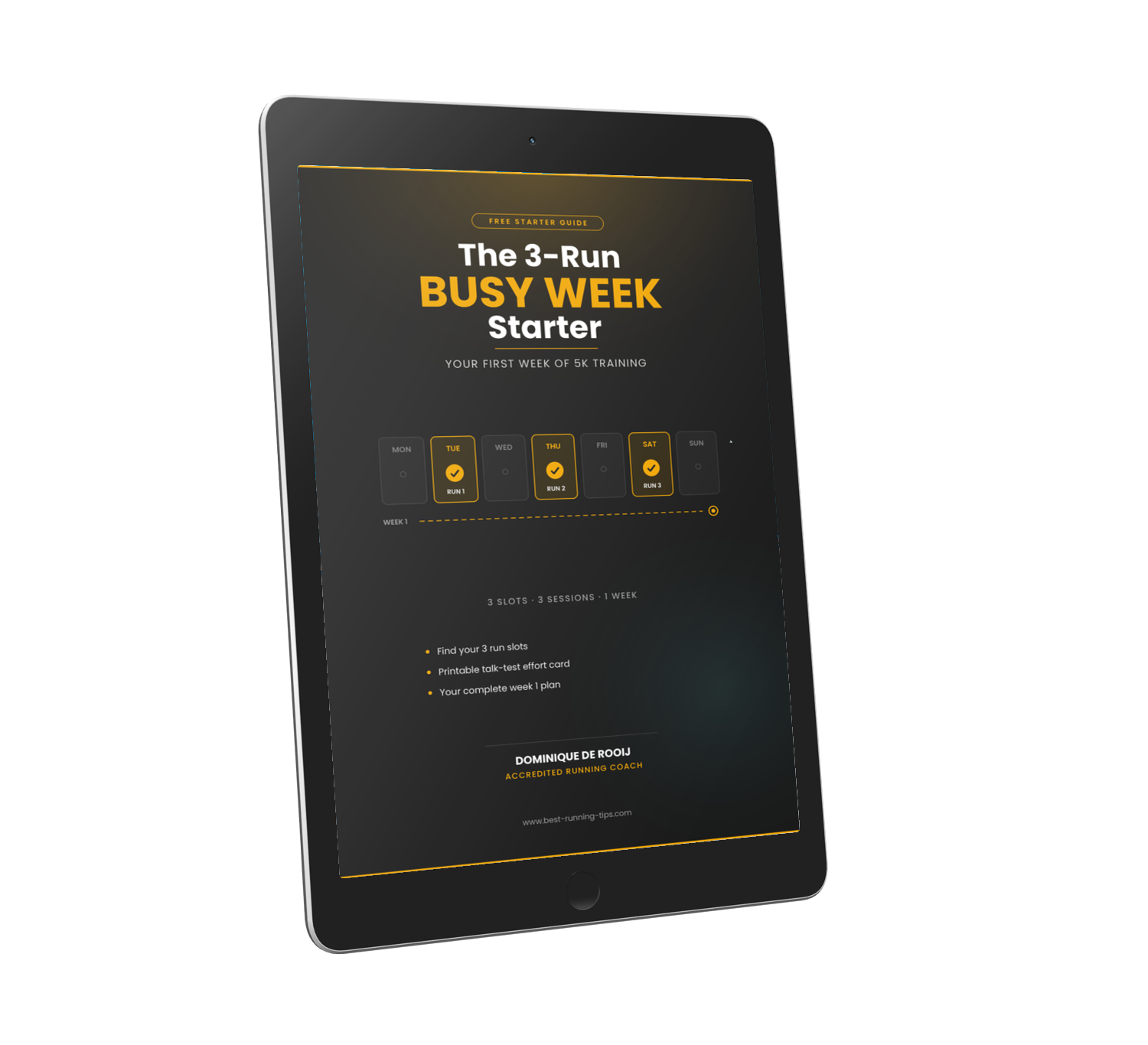
Most beginners don't quit for lack of motivation. They quit because their plan doesn't fit their life. The 3-Run Busy Week Starter plans your first week around the week you actually have.
- Find 3 run slots you can actually keep
- The talk test: the simple way to stop running too fast
- Your complete week 1 plan: 3 run/walk sessions, about 20 minutes each
You'll get the guide plus a short email every few days to help you through week 1. Unsubscribe any time. Privacy policy.
What's New?
-
Personalized Running Coaching - BRT | Run Smarter, Race Better
 Get a personalized running program built around your current fitness, goals, and schedule - not a generic app template. Choose from BRT Silver, Gold, or Platinum coaching with Dom, accredited running…
 -
Sample 4-Day Marathon Training Week: Base to Taper
A full 4-day-a-week marathon training schedule, phase by phase - base, build, peak, and taper - with named workouts and weekly mileage. -
Marathon Taper for a 10-12 Week Training Cycle
How to taper correctly on a compressed 10-12 week marathon plan - the right taper length, why standard advice doesn't fit, and the week-by-week structure.
