Running for Beginners: The Complete Starter Framework
To start running as a beginner, follow four parts: begin with a run/walk structure (alternating short runs with walking), pick a weekly schedule you will actually keep, run by feel rather than to a target pace, and build your mileage up gradually. Below: the four-part framework, how progression differs between outdoor and treadmill running, a weekly schedule for 3, 4 or 5 days, what pace to run, what rest really means, and the path from your first run to your first race.
A wall of generic tips will not get a beginner past week three, but a plan with an order to it will. I have coached beginners through exactly this progression for over twenty years, and I will show you the order that keeps you running.
The 4-Part Beginner Framework

I don't hand beginners a generic tip list. I give them a framework — four parts, in order, that between them cover everything a new runner needs to get right.
1. Run/Walk First. Almost nobody can run non-stop from a standing start, and trying to is the single fastest way to burn out in week one. A run/walk structure lets you build the fitness to run continuously without the early discouragement.
2. Pick Your Schedule. Three, four, or five days a week — the right number is whichever one fits your actual week, not the one that sounds most committed. More on this below.
3. Run by Feel. Forget a target pace for now. The talk test tells you everything you need to know about whether today's effort is right.
4. Build Gradually and Recover. Mileage goes up slowly, and rest days are doing real work even though nothing seems to be happening on them.
Each part gets its own section below, and two of them — the run/walk method and the weekly schedule — already have a fuller, structured version on this site: the named Couch to 5K plan and a structured run/walk program. I won't re-explain either one in full here — just where they fit in the bigger picture.
Outdoor vs. Treadmill: How Beginner Progression Differs
Here's something worth knowing: outdoor and treadmill running are not interchangeable for a beginner, and the difference matters more than you might expect.
A treadmill's fixed belt speed removes the skill of pacing by feel — the machine paces you, not the other way around — but in exchange, it controls the weather, the incline, and the footing under your feet. Outdoor running does the opposite. You build real terrain and traffic awareness and genuine pacing judgement, but you take on those variables — wind, hills, uneven ground — as part of the deal.
My honest recommendation: most beginners should start on whichever is more accessible, and use the other as a backup for bad weather or a scheduling gap, rather than treating them as competing methods. They're not rivals. They're two tools for the same job. For the full breakdown of what actually changes between them, see treadmill running for beginners.
Pick Your Weekly Schedule: 3, 4, or 5 Days
Here's a simple schedule template you can pick based on your week:
3 days a week is the minimum for visible progress. Space the runs out with a full rest day between each one, and this cadence still works. If you're starting with three days, my free 3-Run Busy Week Starter has a worksheet to choose your three run slots, plus a complete first week.
4 days a week is the balanced default most beginners should aim for. It's enough consistency to build fitness without leaving you constantly sore or short on recovery.
5 days a week gets you there faster — but only if you add at least one dedicated strength session to offset the added injury risk. Running five days without that extra support is where I see beginners start picking up niggles.
Beware going beyond five days as a true beginner. It rarely helps at this stage, and it raises your injury risk instead. For day-by-day templates at each of these cadences, see the full beginner running schedule breakdown.
What Pace Should You Actually Run?

You'll often be told to run at "easy pace" or "conversational pace." Here's a number to go with it. Here's mine.
The talk test is the rule: if you can hold a full sentence out loud while running, you're at the right effort. If you can't, slow down.
In direct coaching, I see most true beginners landing somewhere around 12-15 minutes per mile in their first weeks. That's normal — not slow, whatever your watch or your pride might be telling you. Most beginners self-select a pace faster than their actual easy effort, and the talk test is what corrects it.
The most common failure pattern I see: starting faster than talk-test pace, running out of breath within a few minutes, and quitting the workout early — not because the runner lacks fitness, but because the pace was wrong from the first step. For a fuller breakdown by fitness level, see pace benchmarks for beginner runners.
Recovery: What "Rest" Actually Means
A true rest day means no running. Light activity like walking is fine — rest doesn't mean the couch, it means no training load on your legs.
Whichever schedule you picked above, build in at least one weekly rest day, non-negotiable. It's not dead time. It's when the adaptation from your runs actually happens.
One overtraining flag worth checking directly with beginner athletes I coach: your rest heart rate noticeably higher than normal, or a heaviness in your legs that doesn't ease within a day. Either one means back off, not push through. For the full recovery protocol, see recovery for beginner runners.
From Your First Run to Your First Race

"Get out the door" is the first step. Here's what comes after. Here's the staged path I take beginners through.
First comes a month of consistency — showing up on your chosen schedule, run/walk structure intact, pace by feel. Then your first continuous 5K, run without walk breaks. From there, an optional 10K if that appeals to you. Beyond that is genuinely optional territory, not a requirement.
Here's a correction I make with beginner athletes over and over: rushing straight from "I just started" to a half or full marathon is the single most common beginner mistake on this page. It skips the base that everything after it depends on, and it's where I see the most injuries and the most burnout.
For the full route map, see the first run to first race roadmap. To get through this first stage with a structured plan behind you, use the Couch to 5K plan or a structured run/walk program — both are built for exactly this.
Frequently Asked Questions
Is treadmill running as good as running outside for beginners?
Both work. Treadmill running trades the skill of pacing by feel for control over weather, terrain, and footing, while outdoor running builds real pacing judgement but adds those variables back in. See the Outdoor vs. Treadmill section above.
What pace, in minutes per mile, counts as easy for a beginner?
Most true beginners land somewhere around 12-15 minutes per mile in their first weeks, and that's entirely normal. Use the talk test over a watch to check you're at the right effort.
Should I run every day or take rest days?
Take at least one full rest day a week, and more than one if you're running five days a week. Rest days are where the fitness from your runs actually gets banked.
What's the best way to warm up before a run?
A few minutes of brisk walking or easy jogging to raise your heart rate gradually before you settle into pace. The full warm-up mechanics are covered on the beginner running tips roundup.
Do I need a smartwatch to track my runs?
No. A talk test and a basic log of your runs are enough to start with — a watch is a nice-to-have, not a requirement.
This isn't a rigid plan you either follow perfectly or fail at. It's a framework — run/walk first, pick a schedule you'll keep, run by feel, build gradually and recover. Get those four things right and the rest, including your first race, takes care of itself.
For first-run safety and logistics before you head out the door, see first-run safety and logistics. If you'd rather scan a roundup of best practices than read a framework, the full beginner tips roundup covers the same ground in a different format. And if you want a complete start-to-finish walkthrough instead of this framework overview, a complete start-to-finish walkthrough is the more structured alternative.
More Pages on This Topic
Some Other Pages You May Like
About the author

Dominique de Rooij (Dom)
Advanced Running Coach certified by Athletics Australia with 20 years of writing about running and over a decade coaching runners — from first-timers to marathoners. Dom's beginner programs have guided thousands of runners and been praised above plans from Jeff Galloway, Hal Higdon, and Runner's World. Now over 50, Dom still loves trail running, parkrun, and the coffee after.
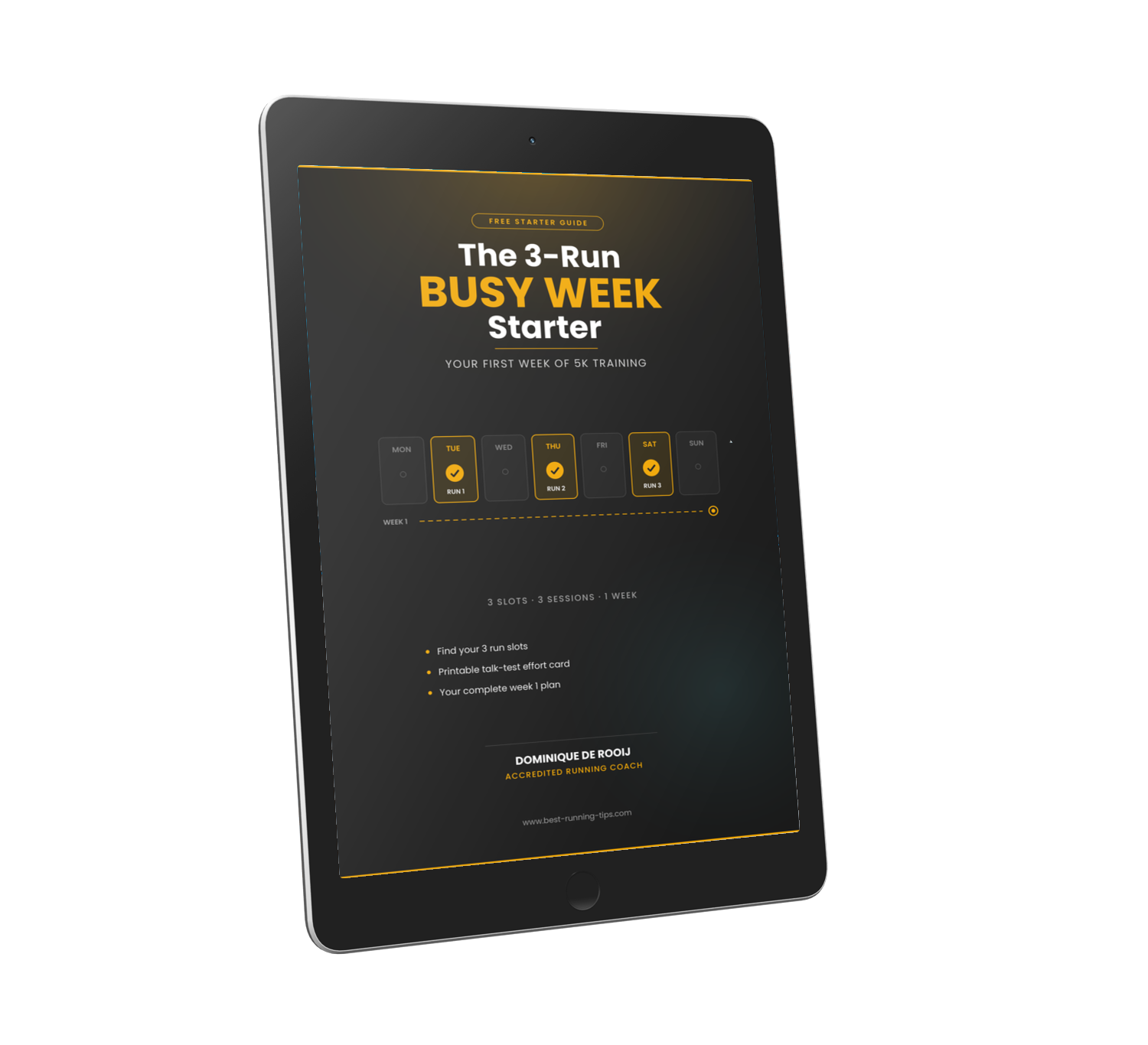
Free beginner guide • From Coach Dom
Start Running This Week, Even If Your Week Is Already Full
Most beginners don't quit for lack of motivation. They quit because their plan doesn't fit their life. The 3-Run Busy Week Starter plans your first week around the week you actually have.
- Find 3 run slots you can actually keep
- The talk test: the simple way to stop running too fast
- Your complete week 1 plan: 3 run/walk sessions, about 20 minutes each
I'll email you a link to confirm your address, then send the guide plus a short email every few days to help you through week 1. Unsubscribe any time. Privacy policy.
What's New?
-
Cut 90 Seconds Off Your 1.5 Mile Run for the Army Test
Cutting 90 seconds off a 1.5 mile run in 3-4 weeks for the Army test: Dom breaks down realistic pacing to reduce 10:32 toward sub-9:00 for Paras selection. -
Training for a 1.5 Mile Run - How to Qualify For Your Test
Coach Dom's 3-step plan for 1.5 mile run training: build aerobic base, add strides, then tempo and pace work to hit your test time. -
Improve Your 1.5 Mile Running Time to 10:30: Shin Splints
From 12:59 to 10:30 for 1.5 miles: Coach Dom's shin-splint fix and training plan to improve your running time in 2-3 months.