First-Month Running Schedules by Starting Fitness Level
Let's face it — one "beginner" plan can't suit every new runner, because they don't all start from the same place.
Sedentary starters, already-active starters, and ex-athletes with a strong cardio base but no running conditioning all need a different week one. The deciding factor isn't how fit you are — it's how conditioned your joints and tendons are for impact, which cardio fitness alone doesn't fix. We're not all starting from the same place. Work out which one you are below, then go straight to your own schedule.
I've coached all three types of beginner for over 20 years, and it's the ex-athlete case that catches people out most often — not because they're unfit, but because their fitness lies to them about what week one should feel like.
Find Your Starting Tier: A Quick Self-Assessment
Answer these three questions honestly, and you'll land in one of the three tiers below.- Is your current weekly routine largely sedentary, with little regular exercise beyond everyday activity?
- Have you done regular impact or cardio exercise — walking, cycling, gym sessions, or team sport — in the last six months?
- Do you have any running-specific injury history, or a strong cardio background from another sport with little or no running behind it?
Sitting between two tiers? Default down, not up. A week that's a notch too easy costs you a few gentle days. A week that's a notch too hard costs you a niggle you didn't need.
Month One Schedule: Sedentary Starters
If question two was a "no" for you, go straight to Program 1, for sedentary starters. No adjustment needed — start exactly at week 1. Program 1 is Best Running Tips' original run/walk build, taking you from nothing to 15 minutes of non-stop running in 8 weeks, and week 1 is deliberately gentle: short walk-run intervals, nothing more.Run 2 days in your first week, not the usual 3. That's one extra rest day than the other two tiers get, and it's there specifically for weeks 1 and 2 — a sedentary starting point means your whole body is adapting to regular exercise for the first time, not just your running-specific tissue. From week 3, move onto Program 1's standard 3-day cadence.
Stick to the schedule as written. It's the gentlest of the three tiers, and that's the point — you're building the habit and the base together, not just the fitness.
Month One Schedule: Some Fitness Base (Walking, Light Activity)
Already moving regularly — walking, cycling, or the gym — but new to running specifically? Start at Program 1 around week 3 or 4, not week 1. Program 1's own guidance explicitly welcomes readers jumping in later if the early weeks look too easy — see how to jump into a program partway through. for the general rule.Run 2 to 3 days a week from the start, and skip the first two weeks' walking-only phase — your cardio system doesn't need it. But don't skip straight to Program 2, for the some-fitness-base tier. just yet. Program 2 is genuinely where this tier lands eventually, once Program 1's remaining running-specific conditioning is in place — arriving there in week 1 skips work your joints and tendons still need, even if your lungs are ready for it.
Week 3 or 4 will still feel like real effort. That's correct. Existing fitness shortens the walking-only phase; it doesn't remove the adaptation still ahead of you.
Month One Schedule: Ex-Athletes and High Cardio Base, Low Running Base
This is the tier that needs the most careful planning, and it's the one I see get injured most often — not because they're unfit, but because they're fit in the wrong way for running specifically.Here's the core issue: your heart is ready for more than your tendons and bones are, and running is the one form of cardio where that gap actually matters. Cycling and swimming load your cardiovascular system hard without loading your joints and connective tissue anywhere near as much. Running does both at once, and the tissue side adapts far more slowly than the cardio side does.
Start with run/walk intervals in week 1, the same as everyone else — not continuous running from day one, whatever your fitness might otherwise justify. From there, compress your aerobic progression faster than Program 1 or Program 2 would — your cardio can genuinely handle it — but hold your impact progression at the same beginner pace as the other two tiers. In practice, that means your run segments can lengthen a little quicker week to week, but your total running days and your week-to-week mileage jump should stay conservative, matching a standard beginner build rather than your actual fitness.
I've coached ex-cyclists, ex-swimmers, and former team-sport athletes through exactly this pattern, and it plays out the same way almost every time: their cardio doesn't gas out first, so nothing warns them to hold back the way breathlessness would for a true beginner. A former club cyclist I coached could hold a five-minute run comfortably by day three — and that's exactly the reader I'd tell to slow down, not speed up. The niggle shows up in week two or three, once the tissue load has quietly stacked past what week one's fitness level would suggest.
Don't skip ahead the way your fitness might tempt you to. That's the single biggest mistake this tier makes.
Adjusting Your Schedule Mid-Month if It's Too Easy or Too Hard
Picked the wrong tier? It happens, and it's fixable without restarting the month.Found week 2 too easy as a sedentary starter? Jump straight to the some-fitness-base week you'd have started at — you don't need to repeat what you've already outgrown. Getting sore as an ex-athlete? Drop down to some-fitness-base pacing for a week, but keep your own tier's running frequency rather than cutting sessions — the fix is gentler progression, not less running.
This is about a wrong starting tier specifically, not what to do about missed days, not a wrong-tier start. — that's a different problem with its own rule, and it's worth keeping the two separate in your head.
Here's how I'd actually decide this if you emailed me: I'd ask how the session felt against the talk test, whether anything hurt rather than just felt like effort, and how the next day went — not just how today's run felt in isolation. Get those three answers honest, and the right adjustment is usually obvious.
Strength and Mobility Support for Month One
Running isn't the only thing worth doing in month one. A little strength and mobility work — three exercises are enough — goes a long way toward keeping you running through months two and three as well.Calf raises build the lower-leg strength that absorbs impact with every stride — two sets of 15, most days, is plenty. Single-leg balance work, even 30 seconds a side while you brush your teeth, trains the stability your ankles and hips need under repeated single-leg loading, which running is, whether it feels like it or not. Hip-focused mobility — a simple standing hip circle or lunge-and-reach — keeps your stride length honest as your legs fatigue.
Sedentary starters get the most out of all three, since general loading tolerance is exactly what's missing. Ex-athletes should treat calf raises and single-leg balance work as close to compulsory — your tendons are the part of you that hasn't caught up yet, and this is how you help them along.
Warning Signs You've Started Too Aggressively
Three signals apply to every tier, regardless of your starting fitness.Sharp, localised pain — in one specific spot, rather than general muscle tiredness — is different from ordinary soreness and shouldn't be pushed through. Pain that doesn't ease within the first 10 minutes of a session, rather than warming up and fading, is a second signal. And pain that's worse the next day than it was during the run itself is the third — normal muscle soreness peaks and then improves; a genuine niggle often does the opposite.
Any one of these three, on its own, means drop back a tier for the rest of the week. Two together, and I'd drop back for the rest of the month.
I don't know your medical history, so treat this list as a general guide, not a replacement for a proper assessment if something feels seriously wrong. For the full first-month injury list., including what's normal and what isn't for each of the four common issues in month one, see the dedicated page.
What to Expect Going Into Month Two
Here's the good news: if month one goes to plan, all three tiers converge toward a similar starting point for month two, whichever tier you began in. The gap between you narrows every week, not widens.For what month two looks like for every tier., see the full second-month schedule.
Frequently Asked Questions
How many rest days do I need in the first month if I'm sedentary vs. already active?
Sedentary starters get an extra rest day in weeks 1 and 2 — 2 running days instead of 3. The other two tiers follow Program 1 or 2's standard rest-day spacing from the start.
Should ex-athletes still start with walk/run intervals, or can they run continuously from day one?
Walk/run intervals still apply in week 1. The limiter for this tier is tissue adaptation, not cardio capacity, and intervals protect the tissue side regardless of how fit your heart and lungs already are.
What's a realistic mileage or time target by the end of month one for each fitness level?
Roughly matching Program 1 or 2's own week-4 numbers for your tier — see the schedule sections above for specifics, since the target depends on which tier you started in.
What symptoms mean I should drop back a tier mid-month?
The same three signals as the warning signs section — sharp localised pain, pain that doesn't settle in the first 10 minutes, and pain that's worse the next day.
How does age interact with starting fitness level when picking a first-month schedule?
Age modestly shifts how much recovery you need within your tier, but it doesn't change which tier you pick — that's still down to your activity history and running-specific conditioning, not your age.
Work out your tier honestly, even if the ex-athlete case bruises the ego a little, and let the schedule do what it's designed to do. That's the sensible way into a first month that actually holds up into month two.
Some Other Pages You May Like
About the author

Dominique de Rooij (Dom)
Advanced Running Coach certified by Athletics Australia with 20 years of writing about running and over a decade coaching runners — from first-timers to marathoners. Dom's beginner programs have guided thousands of runners and been praised above plans from Jeff Galloway, Hal Higdon, and Runner's World. Now over 50, Dom still loves trail running, parkrun, and the coffee after.
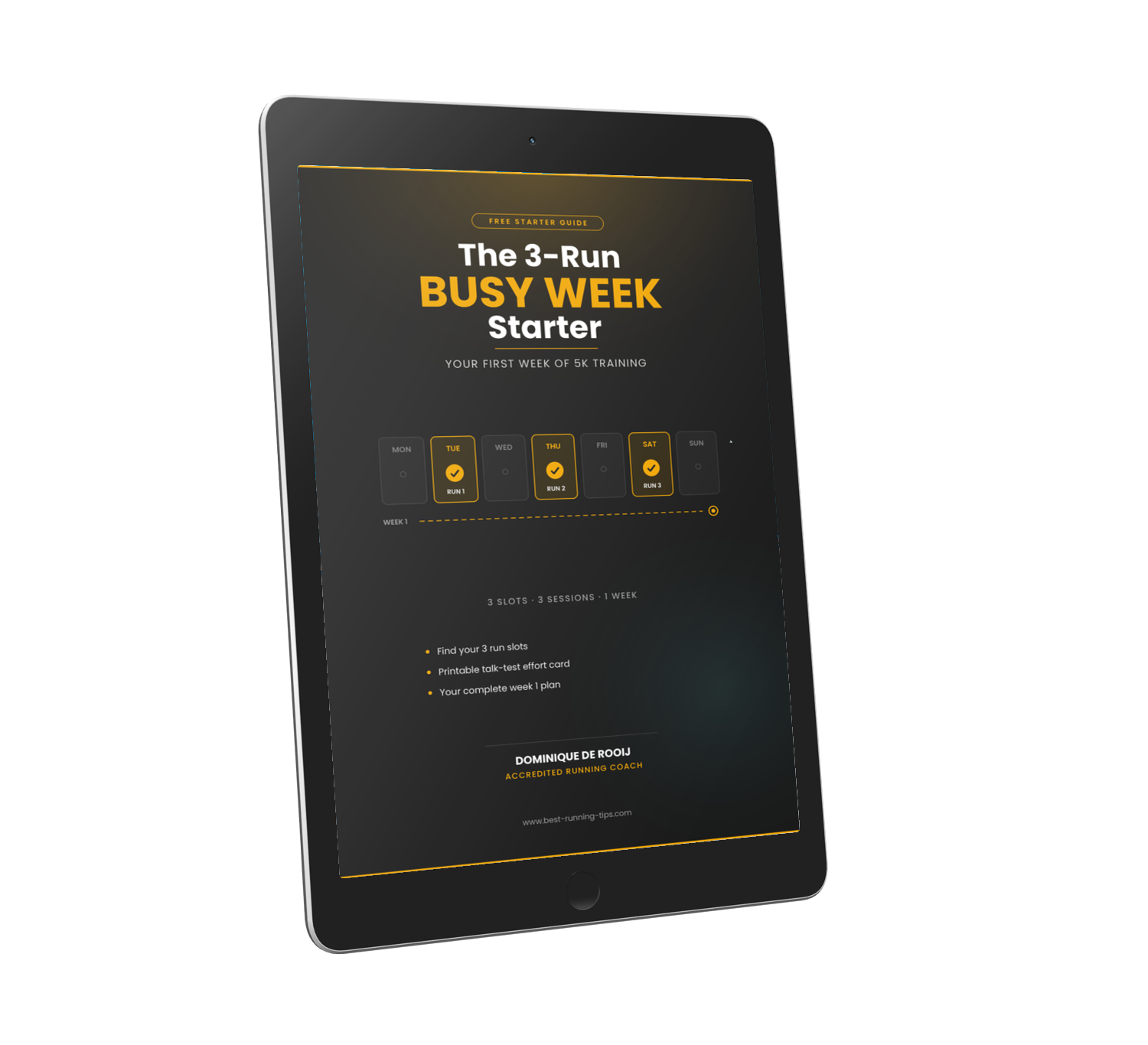
Free beginner guide • From Coach Dom
Start Running This Week, Even If Your Week Is Already Full
Most beginners don't quit for lack of motivation. They quit because their plan doesn't fit their life. The 3-Run Busy Week Starter plans your first week around the week you actually have.
- Find 3 run slots you can actually keep
- The talk test: the simple way to stop running too fast
- Your complete week 1 plan: 3 run/walk sessions, about 20 minutes each
You'll get the guide plus a short email every few days to help you through week 1. Unsubscribe any time. Privacy policy.
What's New?
-
Personalized Running Coaching - BRT | Run Smarter, Race Better
 Get a personalized running program built around your current fitness, goals, and schedule - not a generic app template. Choose from BRT Silver, Gold, or Platinum coaching with Dom, accredited running…
 -
Sample 4-Day Marathon Training Week: Base to Taper
A full 4-day-a-week marathon training schedule, phase by phase - base, build, peak, and taper - with named workouts and weekly mileage. -
Marathon Taper for a 10-12 Week Training Cycle
How to taper correctly on a compressed 10-12 week marathon plan - the right taper length, why standard advice doesn't fit, and the week-by-week structure.