Daniels Running Formula Book Review - The Running Training Book You Have Got to Have
If you were allowed to have one running book only I would probably recommend you to get Daniels Running Formula.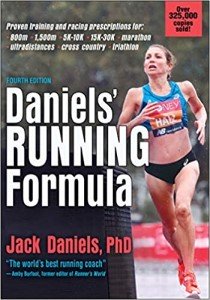
I love this book.
Why?
In a nutshell... this book teaches you:
He gives good advice whether you are training for a 1500 metre-race, a marathon, or anything in between.
With this book in your hands, you can design an 18 week 10K-program, a 12 week 5K-program, a 15 week half marathon-program and so on.
And thanks to the book, you know why you do it that way.
Daniels offers the template for your running program, and you know how to fill in the blanks.
That's the single biggest reason why this book is always by the side of my bed.

In short, top-coach Jack Daniels overdelivers in this outstanding book. After reading his book you will know a lot more about how you can improve your running by setting up a good running program.
You will not know everything there is to know; there is no information in the book about stretching, a runners' diet and running economy for example. But Daniels' Running Formula will help you make your running training so much more effective and, if you will, more intelligent.
Who Should Read This Book?
I am tempted to say: every runner.
When you are a casual runner, and you are happy with the running programs you find on the net, then I'd say this book might be lost on you.
But if you want to improve your performance, understand why a running program is set up a certain way, why you do the types of runs you do and how you can maximize performance with the least amount of discomfort, then Daniels Running Formula is definitely the book to get.
Contents
In Chapter 1 Jack Daniels introduces ten training principles.
These principles are not ground-breaking.
But they lay the foundation for Daniels' approach.
Because the training principles are of a general nature Daniels' Running Formula caters for a large crowd.
Not only elite-runners, not only newbies, but every runner out there.
Chapter 2 lays out the components of running performance.
Daniels identifies six components; a few of them are:
Then these components are translated into different types of running training (easy runs, long runs, threshold running etc.). Jack Daniels emphasises that every time you go on a run, you need to know which body system you are training and what for.

Chapter 3 introduces Daniels' Running Formula.
Daniels uses VDOT, a reference number based on recent race times or time trials.
It defines your current abilities and the paces you should be training at.
Daniels says "When you know your VDOT, you can eliminate a great deal of guesswork from training, and avoid overtraining."
I like that he puts a lot of emphasis on preventing injuries.
Throughout the whole book you can find his "better safe than sorry"-approach.
Chapter 3 contains two important graphs.
One graph gets you to establish your VDOT based on race times. The second graph uses your VDOT to establish how fast to do the different types of running training identified in Chapter 2.
In Chapter 4 to 7 Daniels explains the types of running training thoroughly. Knowing how fast to do a certain type of running training which you learnt in Chapter 3 is really only half the picture.
Daniels explains how he wants you to build up your mileage, how much rest to take in between intervals and so on. There is much valuable information in these chapters.
I highly recommend re-reading these chapters (heck, you should read the whole book at least a dozen times!) a few times so that you pick up on all he is saying here.
And again, as said before, he often helps you focus on preventing injuries. Sub-headings like "Don't do too much too fast" and "Don't push yourself past the proper intensity" say it all.
Another incredibly valuable chapter is Chapter 8.
Many, many runners out there do the same type of running training every week again. Chapter 8 explains that, when training for a specific event, your training needs to go through separate phases. Daniels identifies four phases:
Daniels says that in an ideal world each phase would be six weeks in length. So twenty-four weeks in total leading up to your key event. He recognizes however that in reality, many runners do not use a 24-week running program.
So that's why he gives you an overview which shows you how long each phase should be if you use a shorter number of weeks. How convenient !
Chapter 9 is focused on what happens when injuries do happen or when you do have to take time of running. It also answers the question of how to get back to your level of running training following a setback.

If I'd have to say anything negative about this book, then it would be that Chapter 10, "Utilizing your training environment", is a bit unnecessary. He explains how to deal with flat terrain, hills, wind and altitude et cetera. Nothing wrong with that, but the book would not have been any worse without this chapter, that's all.
Chapter 11 is about preparing for competition, such as defining your goals, deciding how many races and which races to do, preparing for your race, your race-day routine, ideas for a pre-race warming up and so on.
I especially like the parts where Daniels talks about the vigours of the race and that there will be moments when you will not be feeling all that great: "I remind my runners that if they find themselves feeling lousy as they run alongside a group of other runners, they should realize that those around them must be feeling at least as terrible or they would be ahead of my runners."
He explains what to do in moments like those. One tactic which might seem funny is "When struggling... speed up". This one was an eye-opener for me and has helped me quite a few times since.
Chapter 12 to 14 give you the 24-week program templates for any race from 1.500 metres to a marathon. With the knowledge gained in the previous chapters you can add your own twist to these programs and develop your own running schedule.
Conclusion
It will teach you not only how to run and how fast to run.
The
book will also help you build up your knowledge of
running. Pretty much upto a
point where you'll be pretty comfortable creating your own running
programs from scratch.
Click here for more information about Daniels' Running Formula
Running Book Reviews


Helpful
Resources
-
Beginner Running Tips
Are you a beginning runner? Then this is your best starting point. Many tips and running programs on offer, dedicated to you.
-
Running for Weight Loss
Aiming to lose a few pounds? Get into the Running for Weight Loss section for tips and advice.
-
Running Training
The Running Training section of the site has got the most articles. It is constantly getting updated with new tips and information. A must-visit if you are serious about improving your running performance.
-
5k Running Tips
The 5k is a great distance to run and train for. The great thing is that you can do it quite often and see big improvements.
-
10k Running Tips
The 10k is a real challenge. You need to run fast for an uncomfortably long time! Check out this section if you are strong of mind and legs!
-
Marathon Running Tips
The marathon is a massive challenge. Proper training is so important! Make sure to check out this section if you have got your mind set on the marathon!