Torn ACL Should I Run or Not?
I am a 270 pound male who has a torn anterior cruciate ligament (ACL) in my knee, and I was wondering if you think its ok to run or should I just stick to walking.
My doctor says my knee is ok to do what I want as long as I dont do anything to twist it the wrong way, what should I do?
Answer by Dom: I'm a running coach, not a doctor, so if yours has said you can walk and run, I'd go with his advice — and start slowly. At 270 pounds (about 122 kg) every step puts a lot of load through your knee, so the plan below is deliberately cautious.
- What your doctor's green light really means
- Walk first, then run/walk
- Strengthen everything around the knee
- Surfaces, warning signs and when to go back
What your doctor's green light really means
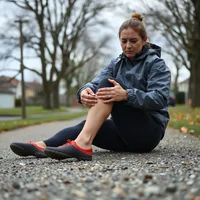
The anterior cruciate ligament (ACL) is a major ligament that stabilises your knee, especially against twisting and sudden changes of direction. That's why your doctor said "nothing that twists it the wrong way".
Soccer, basketball and racquetball are out of the question, all three are full of cutting, pivoting and landing awkwardly. Running is different. You can do it just running straight ahead, so it's a "safe" activity as long as you keep it that way.
Your weight is not a reason to avoid running. It is a reason to build up gradually, because your body needs time to adapt to the impact. The trick is patience — not intensity.
One more thing: a torn ACL doesn't always feel unstable. Some people get away with it for years, others feel the knee wobble on the first uneven step. You don't know which group you're in until you test it gently, which is exactly why the early weeks should be easy walking and short jogs, not a big first run.
Walk first, then run/walk
I'd recommend starting with walking only. Aim for 30 minutes, four or five days a week, for two to four weeks. If your knee feels good the next day (no swelling, no extra stiffness), you're ready for the next step.
A good choice for you would probably be a run/walk programme. Try this: jog gently for 1 minute, walk for 3 minutes, and repeat six times. Do it three times a week on non-consecutive days, so your knee gets a day off in between.
Then progress slowly. Lengthen the jogging bit by 30 seconds or so every week or two, and take a consolidation week, repeating the same session, whenever the knee feels grumbly. Keep the pace easy. If you can't chat, you're going too fast.
Have a look at some of the beginner running programs on my site or create your own based on the same logic. Just stretch the walking sections if you need to — there's no prize for rushing.
Don't worry if progress feels slow. A sensible build-up over three or four months beats a rushed one that ends with a swollen knee and six weeks on the sofa. Your mileage will come — your joints just need longer than your lungs to catch up.
Strengthen everything around the knee

Make sure everything around your knees is as strong as possible, so the muscles in there help your knee function properly. That means ankles, lower legs and upper legs, calves, quadriceps (front of the thigh), hamstrings (back of the thigh) and glutes (buttocks).
The hamstrings matter most with a torn ACL, as they help hold the shin bone in place when the ligament can't.
Two or three short sessions a week are enough. Good starters:
- Glute bridges: 2 sets of 12
- Calf raises: 2 sets of 15
- Wall sits: 3 holds of 20–30 seconds
- Step-ups on a low step: 2 sets of 10 per leg
Keep the knee tracking over your toes, and stop if anything hurts. Mild muscle soreness the next day is normal — sharp or pinching knee pain is not. If you can, get a physiotherapist to check your technique — and ask whether a knee brace would be useful for you.
Surfaces, warning signs and when to go back

Pick flat, even, straight routes. A running track, a treadmill or a quiet paved path is ideal. Avoid trails, cambered roads, sharp turns and steep downhills. They all twist the knee. Good cushioned shoes help too, and replace them every 500 miles (800 km) or so.
Grass and soft paths are kinder than concrete, but only if they're flat. A lumpy field is a twisting risk — treat it like a trail.
Listen to your body. These are signals to stop running and see your doctor or physio:
- The knee gives way or buckles
- It locks or catches
- It swells during or after a run
- Pain that gets worse rather than easing off
A knee that gives way is the real danger with a torn ACL. Twisting on it can damage the cartilage (meniscus) inside the joint. So when you get knee pain again, don't run through it. Go back and talk to your doctor.
I hope this helps. Best of luck with the knee — go steady, and enjoy being back on your feet.
Kind regards,
Dom
Some Other Pages You May Like
About the author

Dominique de Rooij (Dom)
Advanced Running Coach certified by Athletics Australia with 20 years of writing about running and over a decade coaching runners — from first-timers to marathoners. Dom's beginner programs have guided thousands of runners and been praised above plans from Jeff Galloway, Hal Higdon, and Runner's World. Now over 50, Dom still loves trail running, parkrun, and the coffee after.
Free weekly coaching • Join 3,500+ runners
Train Smarter, Not Just Harder
Get your free guide when you join the BRT Coaching Letter
No spam, ever. Unsubscribe in one click, any time.
What's New?
-
Cut 90 Seconds Off Your 1.5 Mile Run for the Army Test
Cutting 90 seconds off a 1.5 mile run in 3-4 weeks for the Army test: Dom breaks down realistic pacing to reduce 10:32 toward sub-9:00 for Paras selection. -
Improve Your 1.5 Mile Running Time to 10:30: Shin Splints
From 12:59 to 10:30 for 1.5 miles: Coach Dom's shin-splint fix and training plan to improve your running time in 2-3 months. -
Training for a 1.5 Mile Run - How to Qualify For Your Test
Coach Dom's 3-step plan for 1.5 mile run training: build aerobic base, add strides, then tempo and pace work to hit your test time.