Swollen Calf After Running (One Leg): Causes & Red Flags
A calf that swells on one side only after running, when a deep vein thrombosis (DVT, a blood clot in a deep leg vein) test has come back clear, usually points to one of two things: May-Thurner syndrome (a rare squeeze on a vein in the left side of the pelvis, more common in younger women) or straightforward overuse from a jump in mileage or intensity. Either way, one-sided swelling that keeps coming back still deserves medical follow-up, even after a clear first check. Below: what May-Thurner syndrome is and why it almost always affects the left leg, how to tell a circulation problem from a muscle strain, what to do next, and the red flags that mean you should see a doctor.The risk runs both ways: dismiss swelling that is really a circulation problem and it can get worse, or panic over what turns out to be one hard week of training. This page is written for readers who have already had a clot properly investigated, and it is no substitute for that check, so if you haven't had one yet, do that first and come back to this afterwards.
May-Thurner Syndrome: What It Is and Why It's Almost Always the Left Leg
Reader story: Claire, Kent
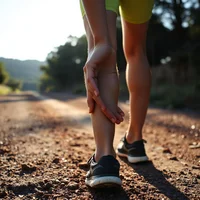
One reader, Claire from Kent, wrote to me with a pattern that didn't fit any of the usual running injuries I see. She ran three times a week, about half an hour at a time, and the day after every run her left calf muscle would swell — sometimes lasting days if she stayed active, easing to a single day if she rested properly. It wasn't painful, she said, just heavy and uncomfortable. It had been going on for three months.She'd already been to hospital once. They gave her a DVT injection and ran blood tests. The results came back clear. Then she ran again — just 20 minutes — and the same left-calf swelling turned up, lasting two days.
Why just the left leg, she asked me. It's a fair question, and honestly, this didn't sound like a standard running injury to me either. I had to go looking beyond the usual causes, and what I found was May-Thurner syndrome.
May-Thurner syndrome is compression of the left iliac vein, squeezed between the right iliac artery and your fifth lumbar vertebra. Because of where those structures sit, it almost always affects the left leg — right-sided cases are reported but very rare. It's more common in women, mostly between the ages of 20 and 40, and the symptoms typically worsen with exercise, which fits Claire's pattern closely.
I want to be honest about what this explanation is and isn't. It sounds consistent with what Claire described, and it's worth asking a doctor about directly if your pattern matches — but it isn't a diagnosis I can hand out from a website. May-Thurner syndrome is confirmed with vein imaging (a venogram, CT or MR venography, or intravascular ultrasound), not a blood test, which is exactly the test that came back clear for Claire and wouldn't have ruled this out either way.
Compression tights or compression stockings may ease the symptoms in the meantime. They're not a substitute for a proper diagnostic workup, and if this sounds like your pattern, that workup is the real next step — not a pair of flight socks.
Vascular vs. Muscular: Telling a Circulation Issue From a Strain or Overuse Swelling
Vascular-pattern signals: swelling that's consistently one-sided, skin that pits or indents when you press it and takes a moment to spring back, swelling that recurs predictably after exercise and resolves with rest, and no obvious mechanical trigger — no single hard session or new pair of shoes you can point to.
Overuse-pattern signals: swelling tied to a specific hard session or a jump in mileage, improvement with rest that holds once you drop your training volume, and sometimes a sharp onset or a "pop" if there's an actual muscle tear involved.
Nigel's case, from Monmouth, sits right on that line — and it's worth walking through, because plenty of readers will recognise themselves in it. He'd been running and cycling for 20 years, training for the Snowdon marathon, and for five or six weeks his legs had felt heavy, with cramp-like tightness through his hamstrings and calves. He pushed on through hard hill and speed sessions, but with very few longer distance runs mixed in — a training pattern worth noticing in its own right.
Then came a 23-mile long run. Ten miles in, his left calf started burning. He couldn't stretch it out, dropped to walking pace, and by the next day the calf had swollen and reddened enough that walking was painful, with indentable, pitting swelling where pressing the skin left a visible mark. He went to hospital, was treated for suspected DVT, and the blood tests came back negative. The pain, the swelling, and the loss of movement didn't go away.
Nigel was also carrying real pressure: a marathon booked for a specific date, and a completely understandable urge to get reassurance so he could keep training rather than lose more time. That's a bind plenty of readers here will recognise. But his training pattern — heavy quality work, low distance volume, then a sudden jump to 23 miles — is a genuine, plausible contributing factor for repetitive strain, and it can sit alongside an unanswered vascular question rather than replacing it. Both things can be true at once. That's exactly why the medical workup has to come first, whichever explanation turns out to be right.
| Pattern | Likely explanation | What to do |
|---|---|---|
| One-sided, pitting/indentable swelling, recurs predictably after exercise, no clear trigger | Possible vascular cause, e.g. May-Thurner syndrome | Get a medical review; ask specifically about vein compression if DVT is already ruled out |
| Swelling tied to a specific hard session or mileage jump, improves with rest | Overuse / repetitive strain | Rest, reduce training load, massage — still get checked if it's one-sided and persistent |
| Any new one-sided swelling, redness, warmth or severe pain | Needs urgent medical assessment | See a doctor immediately, regardless of prior test results |
| Swelling with breathlessness or chest pain | Possible pulmonary embolism | Emergency — seek immediate medical care |
What to Do If This Sounds Like You
Get it medically evaluated first — vein imaging (such as a venogram) if May-Thurner syndrome is suspected — before you resume your normal training. Don't push through visible one-sided swelling because you've had one clear test in the past; a negative result at one point in time doesn't rule out everything indefinitely.
Compression garments can help manage symptoms in the meantime, but treat them as symptom management, not a fix. They ease discomfort. They don't address whatever's actually causing the swelling.
Once you're cleared to run again, come back conservatively. Watch closely for any recurrence, and resist the pull to jump straight back to your prior volume or intensity — especially if, like Nigel, you've got a race on the calendar and the date is doing the pushing rather than your body. A race date is not a medical clearance.
When to See a Doctor (Red Flags)

Get checked again, without delay, if your swelling is worsening, spreading, or comes with calf pain severe enough to affect your walking.
Treat this as a genuine emergency, not a "book an appointment" situation: any breathlessness or chest pain alongside leg swelling can mean a pulmonary embolism. Call emergency services. Don't wait to see if it passes.
I want to be completely clear about where my role in this stops. I can help you understand your training load and manage a sensible return to running. A new one-sided swelling, or a suspected vascular condition, is a medical decision, full stop — not a coaching one, and not something this page, however detailed, is qualified to resolve for you.
If your swelling turns out to be muscular rather than vascular, see my calf pain triage by location for the fuller picture. If you've also got numbness alongside your symptoms, that's covered in numbness alongside leg symptoms. And for the complete picture on when any running symptom warrants a proper check, see the full list of running injury red flags.
Frequently Asked Questions
Why is only my left calf swollen after running?
Left-leg-only swelling that gets worse with exercise can point to May-Thurner syndrome, a rare vein compression that almost always affects the left leg — though overuse and other causes are possible too. If it's new or recurring, get it checked medically either way.
Can I keep running if I have May-Thurner syndrome?
Only once it's properly diagnosed and you've had medical guidance. Compression garments may help manage symptoms, but this isn't something to self-manage around a diagnosis you don't actually have yet.
Is one-sided calf swelling always a blood clot?
No — but it needs to be treated as if it might be until it's properly ruled out. DVT, May-Thurner syndrome, and overuse-related swelling can all look similar in the early stages.
My DVT blood tests came back negative but my calf is still swelling after runs — what now?
A negative test rules out a clot at that specific moment — it doesn't rule out every vascular cause. Ask your doctor specifically about vein compression conditions like May-Thurner syndrome, especially if the pattern is one-sided and tied to exercise.
Most of what lands on my desk about calf swelling turns out to be manageable once it's properly worked up — but the working-up has to come first, every time.
Get checked, be patient with your return, and don't let a race date make the decision for you.
Some Other Pages You May Like
About the author

Dominique de Rooij (Dom)
Advanced Running Coach certified by Athletics Australia with 20 years of writing about running and over a decade coaching runners — from first-timers to marathoners. Dom's beginner programs have guided thousands of runners and been praised above plans from Jeff Galloway, Hal Higdon, and Runner's World. Now over 50, Dom still loves trail running, parkrun, and the coffee after.
Free weekly coaching • Join 3,500+ runners
Train Smarter, Not Just Harder
Get your free guide when you join the BRT Coaching Letter
No spam, ever. Unsubscribe in one click, any time.
What's New?
-
Cut 90 Seconds Off Your 1.5 Mile Run for the Army Test
Cutting 90 seconds off a 1.5 mile run in 3-4 weeks for the Army test: Dom breaks down realistic pacing to reduce 10:32 toward sub-9:00 for Paras selection. -
Improve Your 1.5 Mile Running Time to 10:30: Shin Splints
From 12:59 to 10:30 for 1.5 miles: Coach Dom's shin-splint fix and training plan to improve your running time in 2-3 months. -
Training for a 1.5 Mile Run - How to Qualify For Your Test
Coach Dom's 3-step plan for 1.5 mile run training: build aerobic base, add strides, then tempo and pace work to hit your test time.