Running While Sick: When to Run, Rest & Get Back Safely
Running while sick comes down to one rule: if your symptoms sit above the neck only (a runny nose, sneezing, a mild sore throat, nasal congestion) and you have no fever, a gentle, easier-than-usual run is generally fine. If you have a fever, body aches, chest congestion or unusual fatigue, rest instead, because running raises your body temperature further and no fitness benefit is worth that setback. Below: whether exercise makes you more likely to get sick, how to get back into running afterwards, stomach and digestion problems, sneezing and a runny nose after running, running with asthma, and red flags that mean see a doctor.Let's face it, ask five runners whether to run when they're feeling off and you'll get five different answers. The research is more reassuring than most people expect: studies that deliberately infected volunteers with a rhinovirus (the virus behind a large share of common colds) found no measurable drop in lung function or exercise performance from a mild cold alone. Those studies were small, so treat them as reassuring rather than conclusive. but it's not a green light to push your training while you're unwell.
Does Exercise Make You More Likely to Get Sick?
Reader story: Kathy
One reader, Kathy, found herself stuck in a rut: running 3, 4, or 5 times a week comfortably, but getting sick every time she tried to push beyond that. If that sounds familiar, you're not imagining a pattern.Moderate, balanced training tends to support immune function, not suppress it. The trouble tends to start with a sudden jump in load, especially alongside poor sleep, stress or under-eating: heavy training periods are linked with more frequent colds in some studies. The older idea of a short "open window" after a hard session, when you're wide open to infection, is now contested, and the evidence that it actually raises your infection risk is weak.
The actionable takeaway: build your mileage gradually rather than in sudden jumps, and treat frequent illness after a spike as a signal to build more gradually — not as bad luck.
Getting Back Into Running After Being Sick
There's no perfectly precise formula here, but there is a safe rule of thumb: take roughly as much time rebuilding to your normal mileage as you took off sick. Don't restart at zero — a few weeks off doesn't erase meaningful fitness — but don't jump straight back to your pre-illness volume either.Reader story: Fiona
Here's what that looked like in practice for one reader, Fiona, who'd been running 5-6 miles a day before six weeks off with a viral flu. Her first run back was 2.5 miles, and it felt manageable, if tiring. From there, the progression was: repeat 2.5 miles a few times, then move to 3 miles for 3-4 days, then 3.5 miles for 3-4 days, and so on — a step-based build rather than a strict weekly percentage.You'll sometimes hear this framed as the ten percent rule — increase your weekly mileage by no more than ten percent. I'm honestly not a big fan of it as a standalone approach; see my page on increasing mileage safely for my full reasoning. A step-based build, where you repeat a distance until it feels easy before adding more, gives you better feedback on how your body's actually coping than a fixed percentage ever will.
GI Issues and Running: The Trots, Digestion, and Vomiting
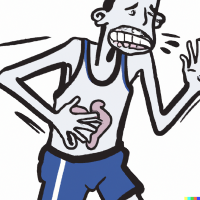
A few practical changes make a real difference: avoid caffeine in the hours before running, check whether lactose is a personal trigger, and don't eat a large meal close to run time — particularly high-fibre foods, which can stimulate the colon. Because the exact cause varies from runner to runner, keeping a brief food-and-symptom journal is worth the effort. It's often the fastest way to spot your own pattern.

The most common contributors are running faster than your current fitness supports, poor pre-run fuelling, and individual gastrointestinal (GI) sensitivity — not a sign of something seriously wrong in most cases. If it's a new or worsening pattern, or it's genuinely troubling you, that's worth a doctor's opinion regardless.

Sneezing and a Runny Nose After Running

The usual contributors are environmental triggers like pollen, dust, cold or dry air, and a vasomotor response — your nose simply reacting to the exertion itself, the same way it might react to a change in temperature.
Running With Asthma
Asthma deserves its own approach rather than a single generic tip, since severity and triggers vary so much from person to person.Keep your pace conversational — able to talk while you run — and take longer warm-ups and cool-downs to ease the transition for your airways. Stop and walk if you feel dizzy or have difficulty breathing. And know your own triggers: cold or dry air, pollen, and wind are common ones.
This is general guidance, not a substitute for an asthma action plan from your own doctor. Severity and triggers are individual, and that plan is the one that actually matters.
When to See a Doctor (Red Flags)
A few signs mean this has moved beyond the above-the-neck rule of thumb and into a genuine clinical judgement call:- A fever — don't run at all until it's fully resolved
- Chest congestion, chest pain, or symptoms generally below the neck
- Difficulty breathing or dizziness that doesn't resolve with rest, particularly relevant if you're managing asthma
- Vomiting or GI symptoms that are severe, persistent, or come with fever, signs of dehydration, or blood
- Any new or worsening symptom pattern that doesn't fit what's described on this page
See also red-flag symptoms across running injuries for the wider picture beyond illness specifically.
Frequently Asked Questions
Should I run if I have a fever?
No — rest until the fever resolves. Running raises your body temperature further and offers no fitness benefit worth the setback.
How long should I take to get back to my normal mileage after being sick?
Roughly as long as you were sick, rebuilt step by step rather than jumping straight back — see the return-to-running section above for a worked example.
Why do I always seem to get sick right after I increase my mileage?
Heavy training periods and sudden jumps in load, especially alongside poor sleep, stress or under-eating, are linked with more frequent colds, although how big a role the exercise itself plays is still debated. Building mileage more gradually is the sensible fix, not bad luck.
Why do I sometimes vomit during or after a hard run?
Most often it's running faster than your current fitness supports, poor pre-run fuelling, or individual GI sensitivity, rather than a sign of something seriously wrong — see the GI section above for what to actually adjust.
Can I run if I have asthma?
Yes, for most people, with adjustments — conversational pace, longer warm-ups and cool-downs, and awareness of personal triggers. Build an actual plan with your doctor, since severity varies.
Whatever's brought you to this page, the same principle holds: match your response to what's actually going on, not to guilt about missed training. Most illness-related setbacks cost you far less time than pushing through them would.
Some Other Pages You May Like
About the author

Dominique de Rooij (Dom)
Advanced Running Coach certified by Athletics Australia with 20 years of writing about running and over a decade coaching runners — from first-timers to marathoners. Dom's beginner programs have guided thousands of runners and been praised above plans from Jeff Galloway, Hal Higdon, and Runner's World. Now over 50, Dom still loves trail running, parkrun, and the coffee after.
Free weekly coaching • Join 3,500+ runners
Train Smarter, Not Just Harder
Get your free guide when you join the BRT Coaching Letter
No spam, ever. Unsubscribe in one click, any time.
What's New?
-
Cut 90 Seconds Off Your 1.5 Mile Run for the Army Test
Cutting 90 seconds off a 1.5 mile run in 3-4 weeks for the Army test: Dom breaks down realistic pacing to reduce 10:32 toward sub-9:00 for Paras selection. -
Improve Your 1.5 Mile Running Time to 10:30: Shin Splints
From 12:59 to 10:30 for 1.5 miles: Coach Dom's shin-splint fix and training plan to improve your running time in 2-3 months. -
Training for a 1.5 Mile Run - How to Qualify For Your Test
Coach Dom's 3-step plan for 1.5 mile run training: build aerobic base, add strides, then tempo and pace work to hit your test time.