Your First Month of Running: A Week-by-Week Beginner Plan
Run two to three days a week in your first month, with a rest day between sessions, and let your run/walk intervals (short runs separated by walking) grow roughly every week. Most first-month runners are still taking walk breaks by week four, which is normal, not a failure. Below: a week-by-week roadmap for weeks one to four, what pace to run, how the month changes depending on your starting fitness, what to do if you miss a day, common injuries, what to do when you feel stuck, and what comes after your first month.
A plan only helps if you can picture what day one and week four actually feel like, because that is where most beginners quietly give up. I've coached beginners through exactly this build for over 20 years, and this page is the calendar version of it: not the run/walk method itself, which lives on the program hub, but what each week really asks of you.
Your Week-by-Week Roadmap (Weeks 1–4)

| Week | Days/Week | Run:Walk Pattern | Session Time (Day 1 / 2 / 3) | How It Should Feel |
|---|---|---|---|---|
| Week 1 | 3 | Day 1: 6-minute brisk walk, no running yet. Day 2: 6-minute walk, then a 1-minute run. Day 3: 8-minute walk, then a 1-minute run. | 6 / 7 / 9 minutes across the three sessions (22 minutes this week, 2 of them running) | The walk should feel easy throughout. That first 1-minute run should feel barely faster than your walk — a true talk-test effort, not a push. |
| Week 2 | 3 | Day 1: two rounds of 4-minute walk plus 1-minute run. Day 2: 8-minute walk, then a 2-minute run. Day 3: two rounds of 5-minute walk plus 2-minute run. | 10 / 10 / 14 minutes (34 this week, 8 of them running) | The 1-minute run segments should feel comfortable by now. Running for 2 minutes at a stretch might still take some getting used to — that's expected, not a warning sign. |
| Week 3 | 3 | Day 1: 7-minute walk, then a 3-minute run. Day 2: two rounds of 4-minute walk plus 2-minute run. Day 3: 3-minute walk, 3-minute run, then 5-minute walk, 2-minute run. | 10 / 12 / 13 minutes (35 this week, 12 of them running) | Some sessions this week will genuinely feel harder than last week — that's the build doing its job. If 3 minutes doesn't come together on the first try, repeat the session before moving on. |
| Week 4 | 3 | Day 1: two rounds of 3-minute walk plus 3-minute run. Day 2: 4-minute walk, 3-minute run, then 5-minute walk, 2-minute run. Day 3: 3-minute walk, 3-minute run, then 4-minute walk, 4-minute run. | 12 / 14 / 14 minutes (40 this week, 18 of them running) | Progress should still feel earned, not automatic. Repeating a week here is completely normal — plenty of runners do, and it doesn't put you behind. |
This is Program 1's shape specifically — 8 weeks to 15 minutes of non-stop running. Starting Program 2 (20 minutes in 10 weeks) or Program 3 (30 minutes in 12 weeks) instead? The same build-up logic applies — jump to the corresponding week of your own program rather than following the numbers above line by line.
What Pace Should You Actually Run?

Use the talk test instead. If you can hold a full conversation during your run segment, you're at the right effort. Needing to gasp for air between sentences means you're running too hard for this stage — slow down, even if that feels uncomfortably slow.
Chasing a pace number this early is counterproductive. Your fitness hasn't caught up to any number yet, and trying to hit one just risks turning a manageable session into a struggle.
For the full pace breakdown, including what to do if you can't hold a conversation even walking, see the full pace breakdown.
Free beginner guide - From Coach Dom
Plan Your First Week Around Your Real Week
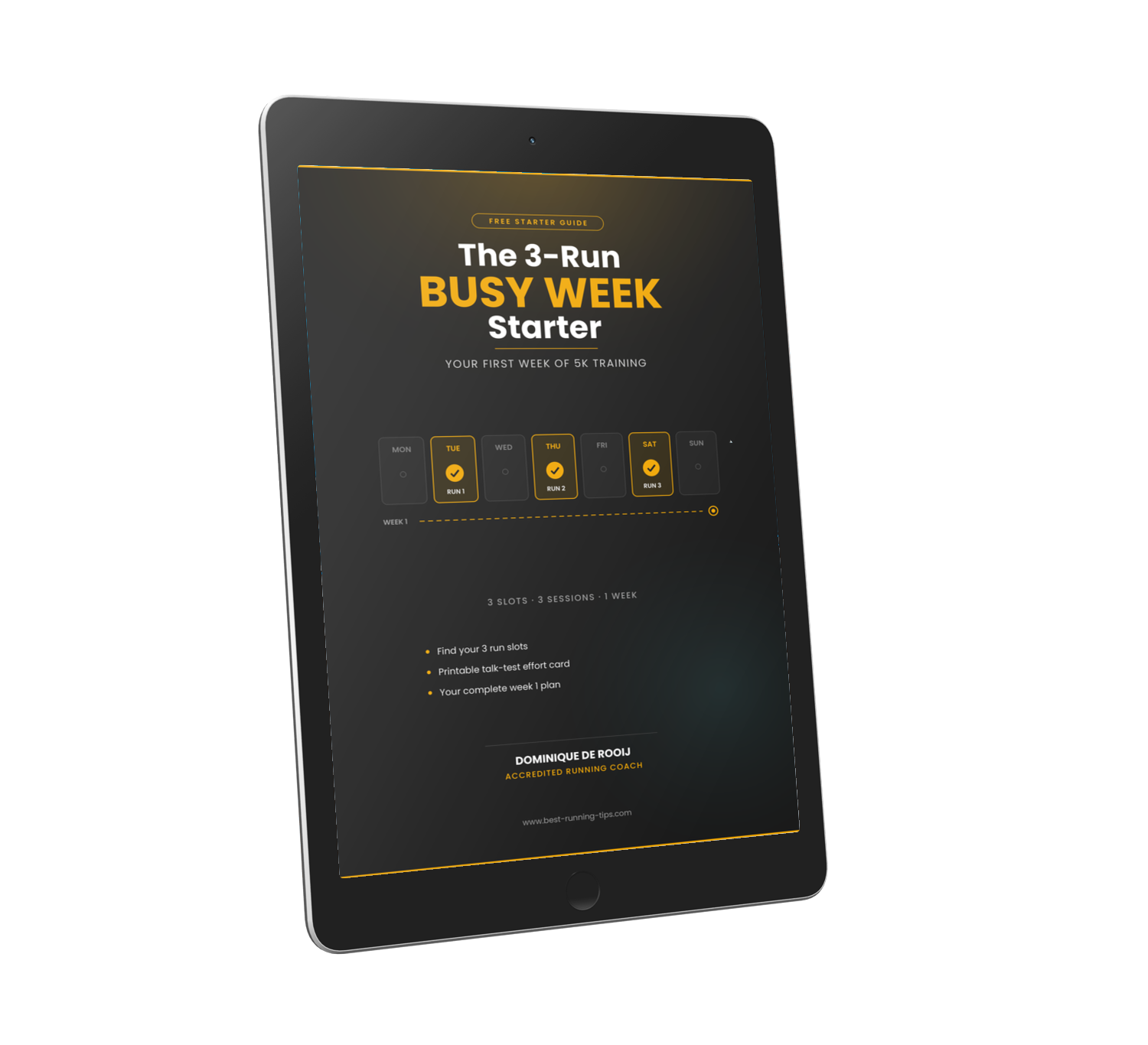
The 3-Run Busy Week Starter helps you find three run slots you can keep, then gives you a complete week 1 plan: three run/walk sessions, about 20 minutes each.
Get the Free Starter →Free guide. Just your email address.
First Month Looks Different Depending on Where You're Starting
Let's face it — a first-month plan can't assume everyone starts from the same point, because they don't. Where you begin genuinely depends on your current fitness, not just your enthusiasm.If you're sedentary, with little regular exercise beforehand, expect week one to feel exactly as gentle as it's designed to — mostly walking, with barely a minute of running mixed in. If you've got some existing fitness already, from regular walking, cycling, or gym work, week one may feel almost too easy — that's fine, let the build-up carry you rather than skipping ahead. And if you're an ex-athlete returning after time off, your cardiovascular fitness may come back faster than your joints and tendons can tolerate the mileage, so the run/walk structure still matters, even if it feels slow for where you used to be.
For the full tiered schedules by starting fitness level, see tiered schedules by starting fitness level.
If You Miss a Day or Fall Behind
Missing a single session isn't the crisis it feels like. Miss one day, and you simply pick up where you left off at your next scheduled session — don't try to make it up by doubling a session.Fall behind across several scattered days, not just one, and the rule changes: repeat the week you're on rather than pushing ahead underprepared. It's a far better outcome than continuing on fitness you haven't actually built yet.
For a run of missed or inconsistent days, not just one, see what to do if you fall behind. And for general guidance on rest days and adjusting your schedule, see more on rest days and program adjustments.
Common First-Month Injuries to Watch For
In your first month, the injury list is short — and it's a different list to the one you'll see later in your running life. Four things show up consistently: blisters, shin splints, side stitches, and DOMS (delayed-onset muscle soreness).Why these four, and not iliotibial (IT) band syndrome or patellofemoral pain? Those two do affect new runners — patellofemoral pain was the second most common injury in a large study of novice runners over their first year — but in my experience they tend to show up after the first month, once your load has built up.
For the full detail on each of these four, including what's a normal ache and what's a stop-running signal, see common first-month injuries explained.
When You Feel Stuck

It shows up in one of three ways — your pace creeps up before your fitness is ready for it, your running frequency creeps down from three sessions to one, or you're still needing walk breaks and start reading that as failure rather than the plan working exactly as designed.
If any of that sounds like you, this page walks through what to actually change.
What Comes After Your First Month
Finishing week four isn't the finish line — it's a decision point. You'll either repeat month one because the build still feels hard, or move into month two because it's started to feel manageable.Neither is the wrong answer, and repeating isn't falling behind. It's making sure month two starts on a base that can actually hold it.
Month two builds on exactly this — longer run segments, fewer walk breaks, and the same gradual approach that's got you this far. For the full month-two schedule, see your second month schedule.
Which Best Running Tips Program Should You Actually Follow?
This page is the calendar. The program hub is the method — go there to choose between Program 1, 2, and 3 based on your current ability.Frequently Asked Questions
How many days a week should I run in my first month?
2–3, with a rest day between sessions; more than that raises injury risk before your body has adapted.
What pace should I run during my first month of training?
Talk-test effort, not a target pace; see the dedicated pace section above for specifics.
Is it normal to still need walk breaks after a month of running?
Yes — most first-month finishers are still using walk breaks in week 4; that's the intervals working as designed, not a failure to progress.
Should I repeat a week if it felt too hard?
Yes, and it's the expected, non-failure option — repeat rather than push into week 5 underprepared.
Pick up at whichever week you're actually at, not where you think you should be, and let the calendar do the rest. That's the sensible way through a first month — and it's the one that actually sticks.
More Pages on This Topic
Some Other Pages You May Like
About the author

Dominique de Rooij (Dom)
Advanced Running Coach certified by Athletics Australia with 20 years of writing about running and over a decade coaching runners — from first-timers to marathoners. Dom's beginner programs have guided thousands of runners and been praised above plans from Jeff Galloway, Hal Higdon, and Runner's World. Now over 50, Dom still loves trail running, parkrun, and the coffee after.
Free beginner guide • From Coach Dom
Start Running This Week, Even If Your Week Is Already Full
Most beginners don't quit for lack of motivation. They quit because their plan doesn't fit their life. The 3-Run Busy Week Starter plans your first week around the week you actually have.
- Find 3 run slots you can actually keep
- The talk test: the simple way to stop running too fast
- Your complete week 1 plan: 3 run/walk sessions, about 20 minutes each
I'll email you a link to confirm your address, then send the guide plus a short email every few days to help you through week 1. Unsubscribe any time. Privacy policy.
What's New?
-
Cut 90 Seconds Off Your 1.5 Mile Run for the Army Test
Cutting 90 seconds off a 1.5 mile run in 3-4 weeks for the Army test: Dom breaks down realistic pacing to reduce 10:32 toward sub-9:00 for Paras selection. -
Training for a 1.5 Mile Run - How to Qualify For Your Test
Coach Dom's 3-step plan for 1.5 mile run training: build aerobic base, add strides, then tempo and pace work to hit your test time. -
Improve Your 1.5 Mile Running Time to 10:30: Shin Splints
From 12:59 to 10:30 for 1.5 miles: Coach Dom's shin-splint fix and training plan to improve your running time in 2-3 months.