From Your First Run to Your First Race: The Beginner Roadmap
Let's face it — there's plenty of guidance on how to start, and on how to train for a specific distance. The bit in between is what matters here, and it's exactly what strands most new runners around week 4 to week 8. Here's the direct answer: from a standing start, expect 8-10 weeks of build-up before a comfortable first 5K, and a few weeks longer again for a 10K.
I've coached beginners through this exact stretch for over 20 years, and the shape of the roadmap is always the same: run/walk foundation, then continuous running, then picking a race, then training toward it, then race week itself. This page is the map connecting those stages — it doesn't replace Best Running Tips' program pages, it tells you which one to open next.
Where You're Starting From: A Quick Fitness Check
Not everyone reading this starts at zero, so place yourself on the roadmap before reading on. If you've never run before, start at the beginning — the foundation stage below is built for you. If you can already run/walk in short bursts, you're partway through that same foundation stage already. And if you can already run 10-15 minutes continuously, skip ahead to the continuous-running stage — re-reading foundation content built for absolute beginners will only slow you down.Three starting points, one roadmap. Find yours and jump in there.
Weeks 1-4: The Run/Walk Foundation
The first month has one job: build your tolerance to intermittent running. Not speed. Not distance. Just teaching your body that running, in short bursts, is something it can now do repeatedly.In practice, that means alternating short running intervals with walking breaks, with the running portion growing a little most weeks and the walking portion shrinking to match. You don't need to build this structure yourself — Best Running Tips' Couch to 5K plan and a structured run/walk program already lay out the session-by-session detail. This page won't repeat it; those pages own it.
Weeks 5-8: Building Continuous Running
This is the stretch where most beginners quit. Here's what's actually happening: your walk breaks are shrinking, not disappearing outright, and the target shifts from "complete the interval" to holding 20-30 minutes of continuous running.I see the same pattern again and again with the runners I coach — week 6 to week 8 is a statistically common dropout window, and it's not because fitness has stalled. It's because progress feels slower here than it did in weeks 1-4, where every single session was a visible, countable win. That feeling is misleading you. Fitness is still building; it's just less obvious week to week.
Here's the one thing worth holding onto: this stage is the hard middle, not a sign something's wrong. Push through it and running gets noticeably easier on the other side — that's not encouragement for its own sake, it's simply how the adaptation curve works.
Choosing Your First Race Distance
Forget "pick something realistic" — here's an actual rule. If you can comfortably run for 20-30 minutes continuously, a 5K is the right first race. If you're already running 30-40 minutes continuously, a 10K is realistic as your first race without needing a separate 5K-building stage first.I set that 30-40 minute threshold deliberately — go shorter and you're racing a distance you haven't earned yet; go longer and you're waiting past the point you're ready. A half marathon as a genuine first race sits in a different risk and commitment category entirely, and it's outside this page's scope. And if continuous running still isn't your thing, that's fine — racing with run/walk intervals is a completely legitimate way to cover either distance.
Committing: When to Register and How to Plan Backward
Register once you can comfortably run or run/walk for 15-20 minutes — not before, and not much later either. That gives you 8-10 weeks of training runway between signing up and race day, which is enough time without the pressure of a rushed build-up.Work the logistics in this order, and registration stops being an afterthought bolted onto a plan already in progress: register for the race first, then book shoes and any gear with enough time to break them in properly, then build your remaining training weeks around the fixed date on your calendar.
Handling Setbacks and Missed Weeks
Missed training is the norm for this stage, not the exception. Here's the rule I use with the beginners I coach: miss under a week, and you simply resume where you left off. Miss two weeks or more, and you drop back one stage on the roadmap — you don't restart from zero.The reassurance here is a coaching judgement, not a generic pep talk: early fitness losses are mostly re-earned in one to two sessions, because the cardiovascular adaptation you've built doesn't vanish as fast as it feels like it does. Missing training time costs you far less of your race timeline than beginners fear.
Race Week and Race Day Basics
Race week has one job: protect the fitness you've already built. Taper your volume down, and don't try anything new — new shoes, new food, a new pacing strategy — for the first time on race day itself. Rehearse all of it beforehand, in training.That's the short version. For the full execution detail — start-corral positioning, walk-break timing under actual race conditions, and troubleshooting on the day — the full race-day execution playbook owns that content properly, so I won't re-explain it here.
Common Beginner Mistakes Along the Way
Four mistakes account for most of the trouble I see on this roadmap. Check yourself against each one, whichever stage you're currently on:Progressing volume too fast. More on avoiding that in Best Running Tips' injury-prevention guidance rather than repeating it here.
Skipping rest days because progress feels slow. Rest days are where the adaptation actually happens — cutting them doesn't speed anything up.
Choosing a race distance based on ambition rather than the fitness check above. Ambition is a fine reason to sign up eventually. It's a poor way to pick your first distance.
Registering too early or too late relative to the backward-planning rule. Both extremes create pressure the roadmap is specifically designed to avoid.
Frequently Asked Questions
How many days a week should a brand-new runner train?
Three days a week with rest days between sessions, consistent with Best Running Tips' core beginner program structure. See the full schedule breakdown for the day-by-day detail.
What if I can only run 60 seconds at a time right now?
That's a normal week-one starting point on this roadmap, not a sign you're behind schedule. Start at Weeks 1-4: The Run/Walk Foundation above.
Should I run every day when starting out, or take rest days?
Take rest days — they're part of the plan, not optional. Adaptation happens during recovery, not during the run itself. See why rest days matter for the full answer.
What's a realistic first-race finish time expectation for a true beginner?
Frame it around finishing, not time — comparing your first-race finish time to an experienced runner's is the wrong benchmark for a genuine first race.
How do I know if I'm progressing too fast and risking injury?
Watch your weekly volume increase and any niggle that doesn't ease within a day or two — both are signs to back off. See Best Running Tips' injury-prevention and warning-signs guidance for the full detail.
Eight to ten weeks, five stages, one map. Run the foundation, build toward continuous running, choose your distance honestly, register on the backward-planning rule, and treat any missed week as a detour rather than a dead end. Once you've crossed that first finish line, your next steps after this first race picks up exactly where this page leaves off.
Some Other Pages You May Like
About the author

Dominique de Rooij (Dom)
Advanced Running Coach certified by Athletics Australia with 20 years of writing about running and over a decade coaching runners — from first-timers to marathoners. Dom's beginner programs have guided thousands of runners and been praised above plans from Jeff Galloway, Hal Higdon, and Runner's World. Now over 50, Dom still loves trail running, parkrun, and the coffee after.
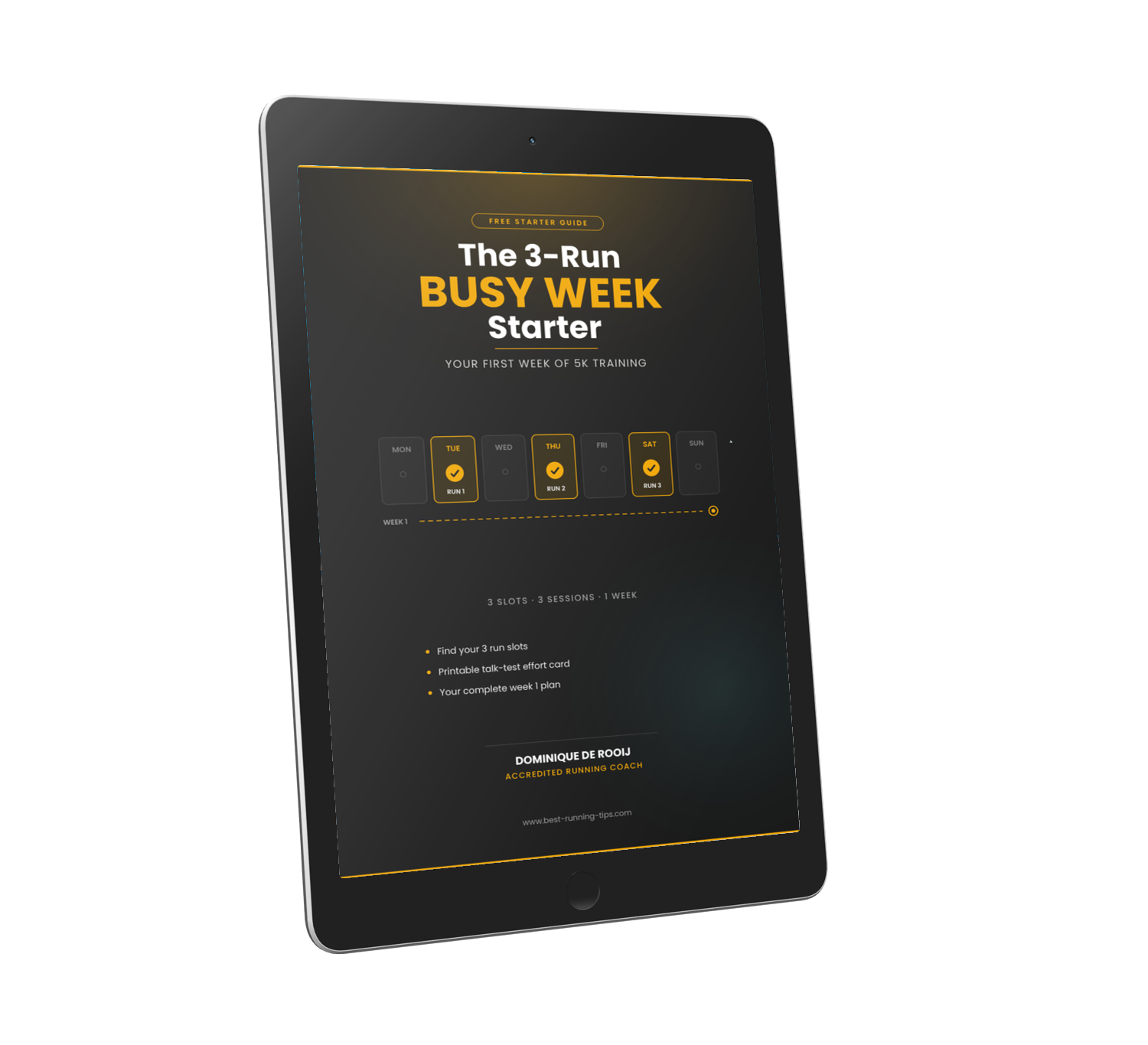
Free beginner guide • From Coach Dom
Start Running This Week, Even If Your Week Is Already Full
Most beginners don't quit for lack of motivation. They quit because their plan doesn't fit their life. The 3-Run Busy Week Starter plans your first week around the week you actually have.
- Find 3 run slots you can actually keep
- The talk test: the simple way to stop running too fast
- Your complete week 1 plan: 3 run/walk sessions, about 20 minutes each
You'll get the guide plus a short email every few days to help you through week 1. Unsubscribe any time. Privacy policy.
What's New?
-
Personalized Running Coaching - BRT | Run Smarter, Race Better
 Get a personalized running program built around your current fitness, goals, and schedule - not a generic app template. Choose from BRT Silver, Gold, or Platinum coaching with Dom, accredited running…
 -
Sample 4-Day Marathon Training Week: Base to Taper
A full 4-day-a-week marathon training schedule, phase by phase - base, build, peak, and taper - with named workouts and weekly mileage. -
Marathon Taper for a 10-12 Week Training Cycle
How to taper correctly on a compressed 10-12 week marathon plan - the right taper length, why standard advice doesn't fit, and the week-by-week structure.
