Why Does My Calf Strain Keep Coming Back? Grading, Red Flags & Return Protocol
A calf strain keeps coming back when your calf's strength and elasticity were never fully rebuilt before you returned to full loading, usually for the exact explosive movement that tore it the first time, such as a hop, a stair or a sprint start. Fix that loading gap, not just the pain. Below: how to grade your strain before planning a comeback, red flags that mean it is not just a strain, why "just stretch more" is not the whole fix, and a return protocol built around why it keeps happening.Rest and stretching make the pain go away, which is exactly why the problem feels solved right up until the next sudden hop. In my experience coaching runners through this, repeat tears often don't show up during a normal training run; they show up on one explosive movement your calf was never retrained for. Christina's story below shows how that plays out.
Reader story: Christina, San Diego
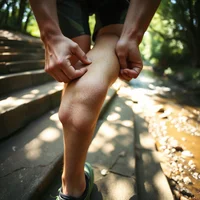
Christina, a runner from San Diego, is a good example. She'd been running consistently for around 20 years, usually 3.5 to 5 miles depending on the day. Her first calf strain happened when she hopped up onto a kerb at the beach — a sudden pulling sensation in her left calf that meant she couldn't keep running on it. Her orthopaedist recommended calf stretching. She rested for roughly three weeks, built her mileage back up to normal, and the pain settled. About a month and a half later, at a party, she hopped up in place — and felt that exact same pulling sensation, in the same calf.Notice what didn't change: both strains happened on an explosive hop, not during one of her regular runs. A few weeks of rest and some general stretching resolve pain — they don't rebuild the strength and elasticity deficit that let the fibres tear in the first place, and they definitely don't prepare your calf for a sudden, unplanned load like a hop off a kerb. That gap is exactly why the same movement caught Christina out twice.
Grade It Before You Plan a Comeback
| Grade | What it feels like | What it means for your comeback |
|---|---|---|
| Grade I | Fibre overstretch or micro-tear — tightness or a dull ache, you can usually keep running on it, no real loss of strength | Often safe to self-manage with the protocol below |
| Grade II | Partial tear — sudden sharp pain or a "pull," noticeable strength loss, walking is uncomfortable, bruising often appears 2-3 days later | Needs a clinical assessment before you start a structured return |
| Grade III | Complete rupture — sudden severe pain, often described as being "kicked" or hearing a pop, unable to bear weight, sometimes a visible or palpable gap in the muscle | Needs a clinical assessment before you start a structured return |
Grade I is usually one you can manage yourself with the protocol further down this page. Grade II or III needs a proper clinical assessment first — don't self-diagnose your way past either of those.
Red Flags: When It's Not Just a Strain
This is the section I want you to actually read, not skim past. See a doctor if you notice any of the following:- Swelling that keeps increasing in the days after the injury, rather than peaking and starting to settle
- Bruising that's spreading or getting worse, not fading
- Inability to bear any weight on the leg at all
- Suspected Achilles or musculotendinous-junction involvement — a distinct pop or snap with sudden weakness, rather than a pull
One more distinction worth making: calf swelling that comes with warmth, redness, or tenderness that doesn't track with a specific strain moment warrants ruling out a clot, not just a muscle injury. I've covered that distinction properly on my when calf swelling means something other than a strain page, rather than repeating it here.
Grading a strain and building a return programme around it is exactly my territory. Any one of the red flags above is a doctor's call, not mine — that's not me being overly cautious, that's just where coaching advice genuinely stops being useful.
Why "Just Stretch More" Isn't the Whole Fix
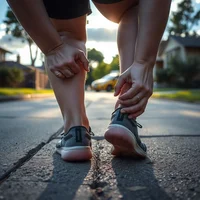
Think of your calf muscle like a rubber band, the same way I explained it to Christina the first time. Stretch it a little too far and it develops small tears — that's what a strain actually is. Regular stretching keeps that rubber band more pliable, and it's still worth doing. Next time you go to touch your toes, feel where the tension actually sits. It should be in the back of your legs, not your lower back.
But flexibility is only half the picture. What flexibility work doesn't build is calf and soleus strength — specifically eccentric loading capacity, the muscle's ability to absorb load while it's lengthening under tension. That's the piece missing from "stretch more," and it's a key piece in preventing a repeat tear.
Here's why it matters for Christina's pattern specifically: an explosive, unplanned push-off or hop — a kerb, a step up at a party — loads your calf faster and harder than steady-state running ever does. That's why she could handle her normal 3.5 to 5 mile runs without any trouble and still re-injure herself on a single hop. Steady running never tested the capacity that hop demanded. An under-warmed-up calf makes that gap worse still. Going straight from standing to an explosive push-off, with no warm-up at all, asks a cold, under-prepared muscle to absorb a load it was never trained for.
A Return Protocol Built Around Why It Keeps Coming Back

| Phase | What it looks like | Move on when |
|---|---|---|
| Phase 0 | Protected loading — pain-free walking and normal daily activity, plus isometric calf holds. No running yet. | Walking and daily activity are completely pain-free, and single-leg heel raises are pain-free too |
| Phase 1 | Add eccentric calf raises and light walk-run intervals | Your walk-run intervals are entirely pain-free |
| Phase 2 | Build continuous easy running volume. Keep hopping, bounding, and sprint-style movements out entirely. | You've rebuilt your normal easy-running volume, pain-free |
| Phase 3 | Reintroduce the trigger movement deliberately — controlled hopping and plyometric drills, built up progressively — before you go anywhere near an unplanned real-world version of it | Controlled hopping is pain-free across a full working set, not just once |
Skipping straight back to normal training the moment symptoms resolve is a common route to a third strain. For Christina, that would mean going straight back to full mileage without ever practising a controlled hop again — leaving her exposed to the exact same trigger, for a third time. Phase 3 exists precisely to close that gap.
For the wider framework this sits inside, see my general return-to-running framework after any injury. And if you want a sense of how this timeline compares to other injuries, my realistic healing timelines by injury type page covers that in full.
Frequently Asked Questions
Why does my calf strain keep coming back?
Because the pain resolving isn't the same as the underlying strength and elasticity deficit being fixed. A proper protocol targets the capacity gap and the specific trigger movement, not just rest and generic stretching.
How do I know if my calf strain is serious?
Grade it. A dull ache with no strength loss (Grade I) is very different from sudden sharp pain with weight-bearing difficulty (Grade II) or an inability to bear weight at all (Grade III).
When should I see a doctor about a repeat calf strain instead of managing it myself?
See a doctor if swelling is increasing rather than settling, bruising is spreading, you can't bear weight at all, or you felt a distinct pop with sudden weakness suggesting the Achilles or musculotendinous junction.
Is stretching enough to stop a calf strain from recurring?
No. Stretching addresses flexibility, not the strength and load-tolerance deficit that lets an explosive movement, like a hop or a sudden push-off, re-tear the same tissue.
A calf strain that keeps coming back is your body telling you the first fix was incomplete, not that you're unlucky or accident-prone. Grade it properly, know your red flags, build the eccentric strength that stretching alone can't give you, and follow the protocol through to Phase 3 — not just until the pain goes away. For the fuller picture on calf pain generally, head back to my calf pain: causes and self-checks page.
Some Other Pages You May Like
About the author

Dominique de Rooij (Dom)
Advanced Running Coach certified by Athletics Australia with 20 years of writing about running and over a decade coaching runners — from first-timers to marathoners. Dom's beginner programs have guided thousands of runners and been praised above plans from Jeff Galloway, Hal Higdon, and Runner's World. Now over 50, Dom still loves trail running, parkrun, and the coffee after.
Free weekly coaching • Join 3,500+ runners
Train Smarter, Not Just Harder
Get your free guide when you join the BRT Coaching Letter
No spam, ever. Unsubscribe in one click, any time.
What's New?
-
Cut 90 Seconds Off Your 1.5 Mile Run for the Army Test
Cutting 90 seconds off a 1.5 mile run in 3-4 weeks for the Army test: Dom breaks down realistic pacing to reduce 10:32 toward sub-9:00 for Paras selection. -
Improve Your 1.5 Mile Running Time to 10:30: Shin Splints
From 12:59 to 10:30 for 1.5 miles: Coach Dom's shin-splint fix and training plan to improve your running time in 2-3 months. -
Training for a 1.5 Mile Run - How to Qualify For Your Test
Coach Dom's 3-step plan for 1.5 mile run training: build aerobic base, add strides, then tempo and pace work to hit your test time.