Pain on the Inside of My Right Knee
In June I ran a 10K race and about a week after the race I started to experience a lot of pain in my knee.
I tried to run for the next 2 months and I couldn't. I couldn't even walk.After getting new sneakers and icing and heating my knee for the past two months I am seeing some progress. I can run a slow jog on the treadmill for 2 miles but there is still pain in the right side. I can not do a stretch where you stand on your left leg and pull your right foot towards your bottom without it hurting.
If I sit to long the knee feels like it is freezing in that position and it hurts to stretch it out. At night lying in bed is when it hurts the most. I want to get back to my running and I don't know what to do to get my knee better.
– Sherri, Monticello, NY (USA)
Answer by Dom: Hi Sherri,
Thanks for your question about your knee pain. Two months of pain, a knee that "freezes" after sitting and pain that wakes you at night — that is more than a simple niggle, and I'd get it assessed before you push the running any further.
Here is what I'd do, in this order:
- Get the knee assessed — and know what to tell the doctor
- Why your night pain and "freezing" knee worry me
- Strengthen everything around it
- A sensible way back to running
1. Get the knee assessed — and know what to tell the doctor

The knee is a pretty complicated part of your body. We runners often get issues with our knees because our legs are not fully straight, not fully aligned. Somebody once used the comparison of a train that is not quite running on the track. If you do that for long, you get injuries.
However, depending on whether the pain is a few inches to the left, to the right or to the side, your pain can be named something completely else than what I think it may be. Pain on the inside of the knee has several possible sources, and I can't tell you which one is yours from a distance.
Therefore, especially if the pain does not go away with a bit of rest and ice, it is really the best to go get medical advice. When you go see a doctor, make sure you make clear that you have already rested, that you have applied ice, that you have bought new shoes, etc. New shoes are fine, by the way — but they are not the whole story.
Make a simple "pain map" first. Point to the sore spot with one finger. Is it right on the joint line (the gap you can feel at the side of the knee), or a hand's width below the knee? Note when it hurts, what eases it, and keep a short log for a week. A doctor or physio will also check for swelling, locking, giving way, and whether you can fully straighten and bend the knee.
Go urgently if your knee is locked and you can't straighten it, if it swells a lot after a twist, if it gives way under you, if it is red, hot and swollen with a fever, or if your calf is swollen and painful.
2. Why your night pain and "freezing" knee worry me

Overuse niggles usually ease with rest. Yours has dragged on for two months. You describe the knee getting stuck after sitting and hurting when you stretch it out, plus the worst pain at night in bed.
A catching or locking feeling can sometimes point to something inside the joint, and night pain deserves proper assessment. I'm not saying that's what you have — I'm saying it's a reason not to wait.
Until you are seen, be kind to it. Avoid deep squats and sitting cross-legged. Get up and move every 30 minutes if you sit for long. Skip that standing heel-to-bottom stretch, as it hurts. Don't force it.
There are certain conditions that may even require surgery to make sure "the train can run on the tracks". I am not saying you will have to go down that route, but it is really best to go have it looked at by a professional and get the right treatment to make your knee injury go away.
3. Strengthen everything around it
When I was a teenager I was a fanatical soccer player and I had some knee problems as well, sounding quite like the issues you have. My team doctor at the time told me to strengthen my upper legs (quadriceps) with the simple explanation that my knee was a bit dodgy and to compensate for that I needed to strengthen everything around it. So you may want to give that a try.
Your quadriceps are the big muscle group on the front of your thigh. Add your hips and bottom muscles and you have the support team for your knee. Do these three exercises, once a day or every other day, 2–3 sets of 10–12 repetitions each:
- Straight-leg raises: lie on your back, bend one knee, tighten the thigh of the straight leg and lift it to the height of the bent knee. Lower slowly.
- Glute bridges: lie on your back, feet flat, and lift your hips until shoulders, hips and knees form a line. Squeeze, pause, lower.
- Side-lying leg lifts: lie on your side, top leg straight, and lift it slowly to about 45 degrees.
One rule: they must be pain-free. If an exercise hurts the knee, stop it and tell your physio. Check with the doctor first, given your night pain.
4. A sensible way back to running
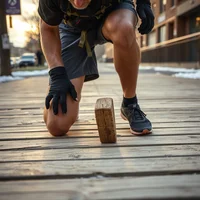
You jogged 2 miles (3.2 km) on the treadmill and still had pain. My advice is to pause running until you've been seen. If you do jog in the meantime, use a strict rule: pain no more than 2 out of 10 on the effort scale, and no worse the next morning. If it fails either test, stop. Walking, cycling and swimming keep your fitness ticking over without pounding the pavement.
Once you're cleared, build up slowly:
- Weeks 1–2: 5 rounds of 1 minute easy jog, 2 minutes walk, every other day.
- Weeks 2–3: lengthen the jog and shorten the walk, as long as the knee stays quiet the next morning.
- Weeks 3–4: reach 20 minutes of continuous easy running.
Stick to flat, soft surfaces and take a small step up in cadence (your steps per minute) — a touch quicker, shorter steps. Replace your shoes about every 600–800 km (370–500 miles).
Sherri, you've been patient for two months and I know you want to get back to your running. Get the knee looked at, build the strength, and you'll be back on the track sooner than you think.
Best of luck.
Kind regards,
Dom
Some Other Pages You May Like
About the author

Dominique de Rooij (Dom)
Advanced Running Coach certified by Athletics Australia with 20 years of writing about running and over a decade coaching runners — from first-timers to marathoners. Dom's beginner programs have guided thousands of runners and been praised above plans from Jeff Galloway, Hal Higdon, and Runner's World. Now over 50, Dom still loves trail running, parkrun, and the coffee after.
Free weekly coaching • Join 3,500+ runners
Train Smarter, Not Just Harder
Get your free guide when you join the BRT Coaching Letter
No spam, ever. Unsubscribe in one click, any time.
What's New?
-
Cut 90 Seconds Off Your 1.5 Mile Run for the Army Test
Cutting 90 seconds off a 1.5 mile run in 3-4 weeks for the Army test: Dom breaks down realistic pacing to reduce 10:32 toward sub-9:00 for Paras selection. -
Improve Your 1.5 Mile Running Time to 10:30: Shin Splints
From 12:59 to 10:30 for 1.5 miles: Coach Dom's shin-splint fix and training plan to improve your running time in 2-3 months. -
Training for a 1.5 Mile Run - How to Qualify For Your Test
Coach Dom's 3-step plan for 1.5 mile run training: build aerobic base, add strides, then tempo and pace work to hit your test time.