Tired Legs After Running: Normal or Need Strength?
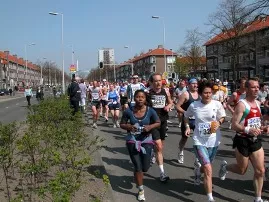
If you keep resting and the heaviness keeps coming back, you've probably been treating the wrong problem. Rest repairs soreness, but it doesn't build strength, and that gap is where runners lose months. The next few sections help you work out which of the two you're dealing with.
Why Your Legs Feel Tired or Sore After a Run
That tiredness has a name: DOMS, or delayed-onset muscle soreness. It comes from tiny micro-tears and inflammation in the muscle fibres caused by eccentric loading — the lengthening contraction your quads make every time your foot lands — not lactic acid, which clears from your muscles within an hour of finishing.DOMS typically builds over the first day after a run, peaks somewhere between 24 and 72 hours, and then fades over the following days. After an unusually hard or unfamiliar effort it can linger for up to a week.
You'll notice it most in the early weeks of a training block, or straight after you've bumped up your mileage — exactly the pattern one reader described after going from 1.5 miles to 3 miles, four or five times a week, in his first two months of running. New load, new soreness. It settles down as your legs adapt.
Normal Soreness vs. Warning Signs Worth Paying Attention To
Most of what you're feeling is normal. Some of it isn't. Here's how to tell the difference at a glance:| Normal | Warning Sign |
|---|---|
| Dull, symmetrical ache in both legs | Sharp pain, or pain on just one side |
| Improves within a couple of days | Hasn't improved after a full week |
| Eases off once you've warmed up | Gets worse as the run goes on, rather than easing off |
| No swelling | Any swelling |
| Random — tied to a harder session or a jump in mileage | Shows up at the same point in every run — say, always by kilometre 4 |
Anything in the warning column is worth a trip to a physio rather than just resting it off.
When "Tired Legs" Is Actually a Strength Plateau
Sometimes what feels like tired legs isn't soreness at all — it's a plateau wearing a soreness costume. If your legs feel persistently heavy or weak no matter how much you rest, and your pace hasn't budged in weeks despite consistent training, mileage alone has probably stopped being what's holding you back.Here's a defensible coaching call I'll make plainly: for a runner who keeps adding kilometres without adding speed work or strength work, the fix is rarely more running. It's less junk mileage and more quality — tempo runs and interval runs — plus dedicated leg-strength work. More of the same rarely breaks a plateau. Different does.
Building Real Leg Strength Without Adding Running Volume

The first is swapping some easy mileage for quality sessions — tempo runs and interval runs ask more of your legs than slow, steady mileage does — intervals especially, because they demand more force and faster leg turnover. The second is dedicated off-run strength stimulus: plyometrics and resistance work aimed squarely at the muscles easy running under-loads.
The thing is, mileage alone plateaus leg strength because it never asks your muscles to fire fast. Interval runs and the plyometric or cross-training work below do exactly that instead.
After years of answering reader letters on this Helpline, I've noticed a pattern: almost every runner who plateaus describes the same thing before they ever ask about strength directly — steady or rising mileage, with nothing done about strength. If that sounds like you, this is the piece that's missing.
Want the complete picture? See a full running-specific strength training program for a plan that covers far more ground than the single protocol below.
A Cross-Training Interval Session That Builds Leg Strength Fast
High-resistance, out-of-the-saddle bike intervals are a low-impact way to load the same muscles that easy-pace running never really challenges — particularly useful if you've plateaued on mileage alone and simply running more isn't an option, or isn't working.Below is the exact session I gave a reader in exactly that position. For the fuller range of cross-training options and how much you need, see cross-training for runners.
Real Reader Story: Ian's Plateau, Newcastle NSW
Ian wrote in after eight months of consistent running. He'd plateaued early — running up to 20km, but at a slow pace, "barely more than a shuffle" in his own words. He described real difficulty raising his legs, and mentioned a medial-ligament niggle from a squash injury that had already pushed him onto the bike more than usual.Here's the session I gave him — about twenty minutes, no gym required:
- 2 minutes of easy riding to warm up.
- 4 x 20 seconds all-out, with 40 seconds recovery between each.
- 1 minute all-out, with 2 minutes recovery.
- 2 x 4 minutes at high resistance, out of the saddle, with 2 minutes recovery between.
When to See a Professional Instead of Training Through It
Ordinary DOMS never needs a professional — give it a couple of days and it sorts itself out. But stop self-managing and book in with a physio or sports doctor if you notice any of the following:Pain that's sharp, localised, or one-sided. Soreness or heaviness that hasn't improved after a full week of easy running or rest. Any swelling at all.
That's not a hedge dressed up as caution. It's a short list, and most readers will never need it.
Frequently Asked Questions
Is DOMS the same thing as an injury?
No — DOMS is expected muscle adaptation that peaks around 24-72 hours and fades over the following days; an injury tends to be sharper, one-sided, or gets worse rather than better over that time.
How long should sore legs last after a run?
Typically a few days for ordinary post-run soreness, and up to about a week after an unusually hard or unfamiliar effort; longer than that, especially without a corresponding jump in training volume, is worth paying attention to.
Why do my legs feel heavy even on easy runs, without real soreness?
Persistent heaviness without classic soreness more often points to a strength or fatigue-management issue than DOMS — see the strength-plateau section above.
Can building leg strength fix a running plateau?
Often, yes — a plateau that mileage alone won't move usually responds to quality running sessions and dedicated strength or resistance work rather than more easy kilometres.
Do I need a gym to build running-specific leg strength?
No — bodyweight, plyometric, and cross-training-based options, like the bike interval session above, can build meaningful leg strength without any equipment beyond a bike or bodyweight; see strength-training-for-runners.html for a full program either way.
A bit of soreness the day after a hard effort means your legs are adapting — nothing to fix there. A plateau that won't shift no matter how much you rest is a different problem, and it usually responds better to a smarter session than another few kilometres. Work out which one you're dealing with, then go and do something about it. For the full doubles, strength and cross-training picture this page sits inside, see the full doubles, strength & cross-training framework.
Some Other Pages You May Like
About the author

Dominique de Rooij (Dom)
Advanced Running Coach certified by Athletics Australia with 20 years of writing about running and over a decade coaching runners, from first races to marathons. Dom created PlanMyRace, a training plan generator for any race from 1500m to the marathon. Now over 50, Dom still loves trail running, parkrun, and the coffee after.
Stop Guessing.
Train for Your Best Race.
PlanMyRace builds a personalised, week-by-week training plan for any race from 1500m to the marathon, around your race date, your current fitness and the week you actually have.
Get My Free Plan →No credit card needed. Your full first week is free.
What's New?
-
Cut 90 Seconds Off Your 1.5 Mile Run for the Army Test
Cutting 90 seconds off a 1.5 mile run in 3-4 weeks for the Army test: Dom breaks down realistic pacing to reduce 10:32 toward sub-9:00 for Paras selection. -
Improve Your 1.5 Mile Running Time to 10:30: Shin Splints
From 12:59 to 10:30 for 1.5 miles: Coach Dom's shin-splint fix and training plan to improve your running time in 2-3 months. -
Training for a 1.5 Mile Run - How to Qualify For Your Test
Coach Dom's 3-step plan for 1.5 mile run training: build aerobic base, add strides, then tempo and pace work to hit your test time.