Run/Walk Race-Day Strategy Pacing & Walk Breaks
Let's face it — the single biggest race-day mistake run-walk runners make is skipping their first scheduled walk break because they feel great at the start. Take it anyway. Adrenaline and crowd energy mask how hard you're actually working in that opening mile, so trust your plan over how you feel and start the clock at the gun.I've coached run-walk athletes on race mornings from local 5Ks to their first marathon, and it's always the same test: whether they trust their training plan more than their adrenaline. This page covers race-day execution only — for how your ratio and timeline should have changed before race day, that's a separate guide.
Setting Up Your Race-Day Plan: Ratio, Timer, and Start Position
Your race-day plan should be settled well before you reach the start line — not improvised once the gun goes. Three things to lock in beforehand: your ratio, your timer, and your position in the corral.Stick to the ratio you actually trained with. Race day is not the moment to try a tighter interval you haven't practised — that's the adrenaline mistake this whole page is about, just wearing a different disguise. If you're still unsure what ratio to race at, unsure what ratio to race at? start here.
Set and test your interval timer or watch alarm the night before, not on race morning. A dead battery or a fumbled setting five minutes before the gun is stress you don't need.
Position yourself further back in the start corral than your pace alone would suggest. Line up where continuous runners at your pace start, and your walk breaks will force you to weave across faster traffic in a crowded first mile — a corral or two back gives you room to walk without becoming an obstacle.
The First Mile: Why You Must Take the First Walk Break Even If You Feel Great
Here's the physiology behind the opening rule. Adrenaline and race-day crowd energy suppress how hard a pace feels — you feel like you're cruising, when you're actually running faster than your easy training effort. That gap between how a pace feels and what it costs you is exactly why so many run-walk runners blow straight past their first scheduled break.Start your run-walk clock at the gun — not "whenever it feels right." Take the first break on schedule, even if you feel like you could run straight through it. Treat it as a calibration check, not a concession. It's the moment you find out whether the pace you're holding actually matches the effort you trained at, before that mismatch costs you later in the race.
Walk Break Execution: Posture, Fuelling, and Aid Station Etiquette
Race-day walk breaks need slightly different mechanics to the ones you practised alone on a quiet training route, simply because you're now doing them in a crowd.Coming out of a run into a walk, ease down over two or three strides rather than stopping dead — a sudden full stop in a moving field is how you get run into from behind. Moving back into the run, build your pace up progressively rather than sprinting off the walk. It's easier on your legs, and easier for runners around you to react to.
Should you walk through every aid station, or only your scheduled breaks? Stick to your scheduled breaks, unless one happens to line up with an aid station. Walking every station on top of your planned breaks quietly drifts your ratio off plan over the course of a race, and that drift adds up over a longer distance.
Taking on fluid or a gel during a walk break is the easiest way to fuel without losing time — take it in the first few steps of the break, so you're not still fumbling with a cup or gel packet when it's time to restart. For more on fuelling around your race, including recovering well after race day, that guide covers the fuller picture.
Mid-Race Adjustments: When and How to Change Your Ratio
Give yourself permission now, before the race, to adjust if you need to: it is never too late to become more conservative with your ratio — only too late to safely become less conservative.Specific triggers that justify shifting to more walking and less running include a genuine heat spike you didn't train in, unexpected fatigue that sets in before halfway, or an early warning niggle that feels like it's building rather than settling. Any of those, and dialling back your ratio is the sensible move, not a failure.
What doesn't justify a change: ordinary second-half tiredness, or simply enjoying the race less than you'd hoped. Stay the course you trained for through normal discomfort, and save the ratio change for the triggers above.
Troubleshooting Common Race-Day Surprises
Here's the on-the-spot fix for each surprise that actually comes up on race day.| Race-Day Surprise | On-the-Spot Fix |
|---|---|
| Watch or timer dies mid-race | Fall back to counting steps, or use a fixed landmark — every lamppost or mile marker — as your new interval. |
| Losing track of your intervals | Don't guess. Reset to a simple round-number ratio, like run 4, walk 1, and carry on from there. |
| Gastrointestinal (GI) distress during a walk break | Extend the walk. Don't force the restart until you genuinely feel able to run again. |
| Unexpected heat | Shift to a more conservative ratio per the triggers above, and prioritise fluid at every aid station, not just your scheduled breaks. |
Handling the Mental Side: What to Tell Yourself When You Want to Skip a Break
The hardest walk break to take isn't the first one — it's the one that lands right as spectators are cheering, or just as you're being passed by someone you'd been running alongside. That's the exact moment your ego tells you to skip it.Here's the script I give athletes for that moment: you are not losing time by walking, you're setting up the pass that comes later. Every runner who blows past you now, running continuously past their own sustainable effort, is someone you're likely to catch again in the second half. Your walk break isn't a concession to them — it's the strategy that lets you finish stronger than they do.
And to answer the question directly: no, nobody who has raced more than once thinks less of you for walking on schedule. Experienced racers know exactly what a run-walk break is for. It's usually only the runners who haven't tried pacing a race this way themselves who assume walking means struggling.
Distance-Specific Notes: 5K/10K vs. Half and Full Marathon Race Day
Race-day execution isn't identical across every distance you might be racing.In a 5K or 10K, walk breaks feel like they cost you disproportionately more time — in a race that might only take 25 to 60 minutes, stopping to walk at all can feel like giving away a result you can't get back. The counter-argument holds anyway: even, controlled pacing beats a fast start followed by a fade at every distance, short races included. A short race magnifies the temptation to skip breaks. It doesn't strengthen the case against taking them.
In a half marathon or marathon, your biggest extra consideration is coordinating fuelling with your walk breaks across a much longer field of aid stations. You'll pass far more of them, so lining up your scheduled breaks with at least some stations, without letting it drift your ratio, makes fuelling far easier than trying to eat and drink mid-run.
For how your ratio and build-up should actually differ by distance in training, rather than on race day itself, see how your ratio and timeline should have changed before race day.
Frequently Asked Questions
How do I handle walk breaks at crowded aid stations without losing time or causing a collision?
Walk through an aid station only if it happens to coincide with a scheduled break. Otherwise, take fluid on the move and keep walking on your own schedule rather than at every station.
What should I do if I lose track of my run-walk timer or my watch dies mid-race?
Fall back to counting steps or using a fixed landmark, like every lamppost or mile marker, as your new interval. If you've lost count entirely, reset to a simple round-number ratio rather than guessing.
Will people think I'm not a "real" runner if I walk during a race?
No — not among anyone who has raced more than once. Experienced racers know exactly what a scheduled walk break is for, and it's usually the strategy that lets you pass other runners later in the race.
Where should I position myself at the start line if I'm using run-walk intervals?
Start further back in the corral than your pace alone would suggest. It gives you room to take your walk breaks without weaving across faster continuous runners in a crowded first mile.
How late in the race can I still switch to a more conservative ratio if I'm struggling?
At any point. Becoming more conservative is always available, however late in the race — it's becoming less conservative mid-race that isn't a safe move.
Trust the plan you already built, take your breaks on schedule, and treat any adjustment as a deliberate choice, not a panic reaction. That's how run-walk racing is supposed to work — not despite the walking, but because of it.
Some Other Pages You May Like
About the author

Dominique de Rooij (Dom)
Advanced Running Coach certified by Athletics Australia with 20 years of writing about running and over a decade coaching runners — from first-timers to marathoners. Dom's beginner programs have guided thousands of runners and been praised above plans from Jeff Galloway, Hal Higdon, and Runner's World. Now over 50, Dom still loves trail running, parkrun, and the coffee after.
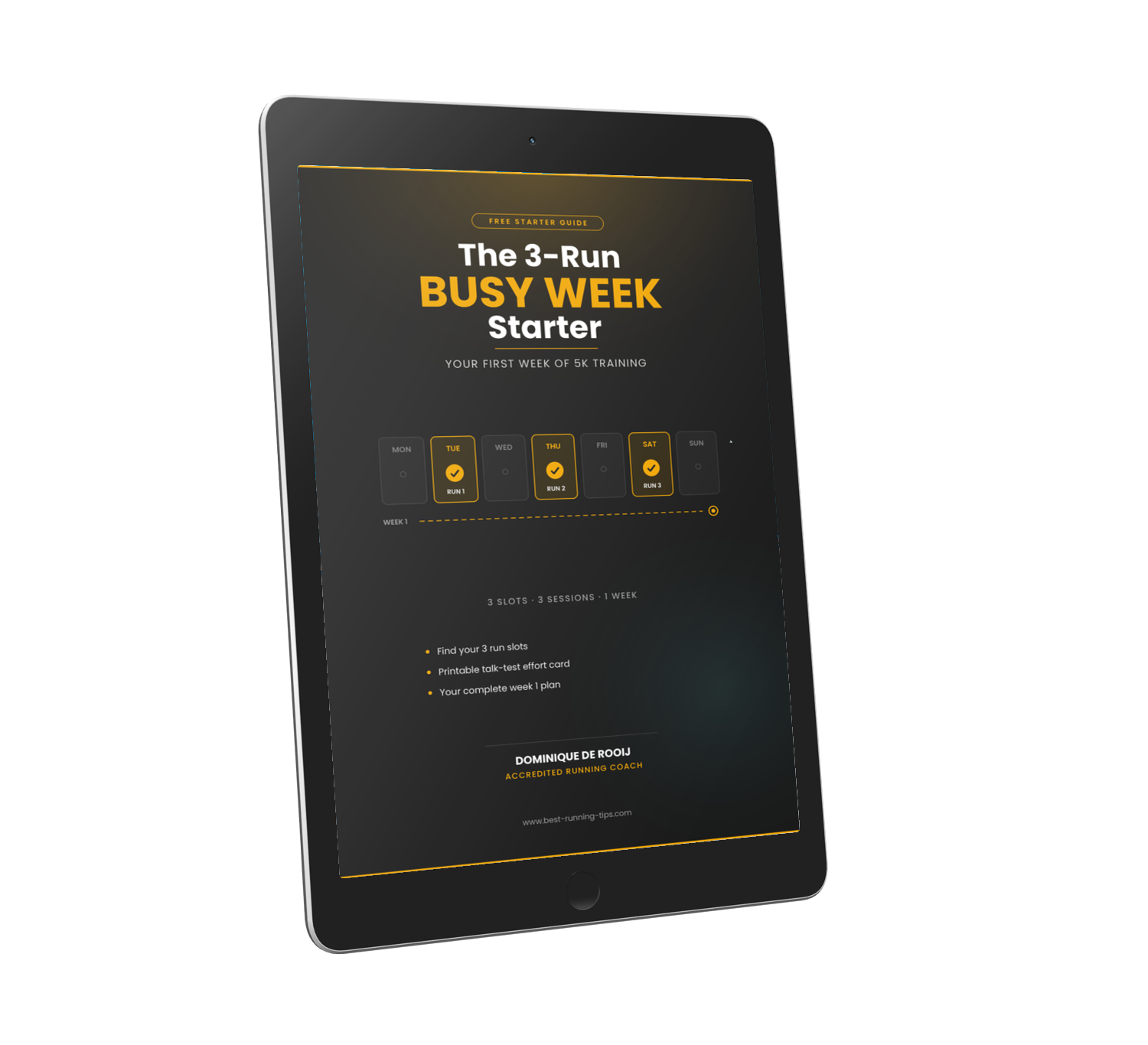
Free beginner guide • From Coach Dom
Start Running This Week, Even If Your Week Is Already Full
Most beginners don't quit for lack of motivation. They quit because their plan doesn't fit their life. The 3-Run Busy Week Starter plans your first week around the week you actually have.
- Find 3 run slots you can actually keep
- The talk test: the simple way to stop running too fast
- Your complete week 1 plan: 3 run/walk sessions, about 20 minutes each
You'll get the guide plus a short email every few days to help you through week 1. Unsubscribe any time. Privacy policy.
What's New?
-
Personalized Running Coaching - BRT | Run Smarter, Race Better
 Get a personalized running program built around your current fitness, goals, and schedule - not a generic app template. Choose from BRT Silver, Gold, or Platinum coaching with Dom, accredited running…
 -
Sample 4-Day Marathon Training Week: Base to Taper
A full 4-day-a-week marathon training schedule, phase by phase - base, build, peak, and taper - with named workouts and weekly mileage. -
Marathon Taper for a 10-12 Week Training Cycle
How to taper correctly on a compressed 10-12 week marathon plan - the right taper length, why standard advice doesn't fit, and the week-by-week structure.
