Confidence-Building Milestones for Your First Three Months
Meaningful running milestones aren't just distance or pace — they split into two kinds: performance milestones (what you can physically do) and non-performance milestones (how running starts to feel). A realistic first three months runs roughly: weeks 1–4 building the habit, month 2 an endurance shift, month 3 running starting to feel like yours — no fixed timeline, tied to consistency, not the calendar.Why Milestones Matter More Than Speed for New Runners
Let's face it — measuring progress only in minutes per mile or miles per week is exactly why so many beginners feel like they're failing even when they're doing everything right. Early confidence doesn't hold up when it's pegged to a number you're comparing against someone else's pace or someone else's mileage. It holds up when it's pegged to your own completed evidence — a run you finished, an effort you held, a week you got through exactly as planned. I explain the mechanism behind this — self-efficacy, in a word — over on why confidence is a skill, not a trait. Everything on this page is the concrete, week-by-week version of that idea: proof points you can check yourself against, not another vague "set small goals" pep talk.Month 1: Building the Habit — What Counts as a Win
Week one isn't about distance. It's about showing up for every session you scheduled, even the ones you don't feel like doing. That's the whole win — non-stop effort matters less here than consistency does. In week two, you're tolerating the discomfort of starting: heavy legs in the first five minutes, the urge to check your watch, the voice that says this is harder than it should be. Getting through that discomfort, run after run, is what's actually being built. By week three or four, look for your first run/walk interval completed without stopping early — not because it was easy, but because you didn't quit on it. A completed session is the week 1–2 win. Not pace. Not distance. Just: did you do the thing you said you'd do. Here's what I actually watch for in a new runner's first two weeks of coaching them: not how they run, but whether they show up. Pace sorts itself out over time. Showing up doesn't sort itself out on its own — it has to be built, one session at a time. For the fuller week-by-week training detail behind this month, see what your first four weeks of running should actually look like. And if staying consistent is the harder part for you than the running itself, a couple of simple sports psychology techniques for staying consistent go a long way.Month 2: The Endurance Shift — Running Continuously
Somewhere around month two, something shifts — running that felt like a fight in week one starts to feel like something you can sustain. This isn't willpower kicking in. It's your cardiovascular system getting more efficient at its job: your heart pumps more blood per beat, more oxygen reaches your working muscles for the same effort, and your body starts building what I call your aerobic base — the underlying engine that makes easy running feel easy. You'll likely notice your breathing settling into a rhythm instead of feeling ragged and unpredictable. That's not a coincidence — it's the same adaptation showing up somewhere you can actually feel it, breath by breath. Beware treating this as a guarantee for a specific week. This is a general pattern that holds for most consistent beginners, not a deadline you've failed if week eight arrives and continuous running still feels hard. The adaptation is real. The exact week it shows up for you isn't fixed.Month 3: When Running Starts to Feel Like Yours
Month three is where something less physical and more personal tends to show up. You stop planning your route out loud before you leave the house — you just go, because you know the loop now. Your running gear stops feeling like a costume you're wearing to convince yourself you're "a runner" and starts feeling like what you wear on a Tuesday. And every so often you finish a run you actually want to talk about — not because it was fast, but because it happened. That's consolidation, not a new skill. Month 1 built the habit. Month 2 built the endurance. Month 3 is where the two settle into something that feels less like an experiment and more like yours.Milestones Beyond Distance and Pace
Distance and pace are the obvious milestones, but they're not the only ones. Here's what they leave out — the milestones that don't show up on a watch at all:- Craving instead of dreading — the first time you catch yourself looking forward to a run instead of talking yourself into it.
- Skipping a treat without feeling deprived — the first time you pass on a planned indulgence because the run already gave you what you needed.
- Correcting your own form — shoulders down, stride shortened — without anyone telling you to.
- Answering without hesitating — the first time someone asks if you're "a runner" and you don't pause before saying yes.
If You're Behind the "Typical" Timeline, Look for This Instead
Here's the thing — the week and month markers above describe a common pattern, not a deadline. If week eight arrives and you're not running continuously yet, that doesn't mean you're behind in any way that matters. It means the calendar isn't a great yardstick for you specifically, and you need different markers to check yourself against. Watch these instead: are you completing your planned sessions week after week, even if the sessions themselves haven't changed much? Is the same run starting to feel a little less effortful at the same pace, even by a small margin? Is your recovery time between runs shortening — legs feeling ready a day sooner than they used to? Any one of these moving in the right direction is progress, even with zero change to your pace or your longest continuous run. And if what's actually knocked you off this timeline is a specific setback rather than a slower natural pace, that's a different problem with its own answer — see what to do if a setback knocks you off this timeline.A Simple Milestone Checklist for Your First 12 Weeks
Use this as a reference, not a test — a way to notice progress you might otherwise miss, not a pass/fail schedule. Tick items off as they actually arrive for you, in whatever order that turns out to be.| Week / Month Window | Milestone | Category |
|---|---|---|
| Week 1 | Showed up for every scheduled session | Performance |
| Week 2 | Tolerated the discomfort of starting without quitting on a session | Non-performance |
| Weeks 3–4 | Completed a full week exactly as planned | Performance |
| Month 2 (~Weeks 5–8) | Ran continuously for your target time or distance | Performance |
| Month 2 | Noticed your breathing settle into a steady rhythm | Non-performance |
| Month 3 (~Weeks 9–12) | Stopped planning your route out loud before you leave | Non-performance |
| Month 3 | Gear stopped feeling like a costume | Non-performance |
| Ongoing | Caught yourself craving a run instead of dreading it | Non-performance |
| Ongoing | Corrected your own form without being told | Non-performance |
| Ongoing | Answered "are you a runner?" without hesitating | Non-performance |
Frequently Asked Questions
What's a realistic first running milestone in week one or two?Showing up and completing the session you planned — that's the win, not distance or pace. Nothing else needs to happen yet.
Should my first 5K be a race or just a solo run?
Either is valid. A solo run removes race-day performance pressure from what's meant to be a confidence-building milestone.
How do I know I'm ready to call myself "a runner"?
Readiness isn't earned by hitting a threshold — it's a non-performance milestone in its own right, the moment you stop hesitating to say it.
What milestone should I aim for at the one-month mark versus three months?
At one month, aim for habit and completion. At three months, aim for identity and ease — they're different kinds of progress.
Does tracking milestones actually help with motivation, or is it a distraction?
It helps when it's tied to your own evidence, like the checklist above. It becomes a distraction the moment you use it to compare yourself to someone else.
Some Other Pages You May Like
About the author

Dominique de Rooij (Dom)
Advanced Running Coach certified by Athletics Australia with 20 years of writing about running and over a decade coaching runners — from first-timers to marathoners. Dom's beginner programs have guided thousands of runners and been praised above plans from Jeff Galloway, Hal Higdon, and Runner's World. Now over 50, Dom still loves trail running, parkrun, and the coffee after.
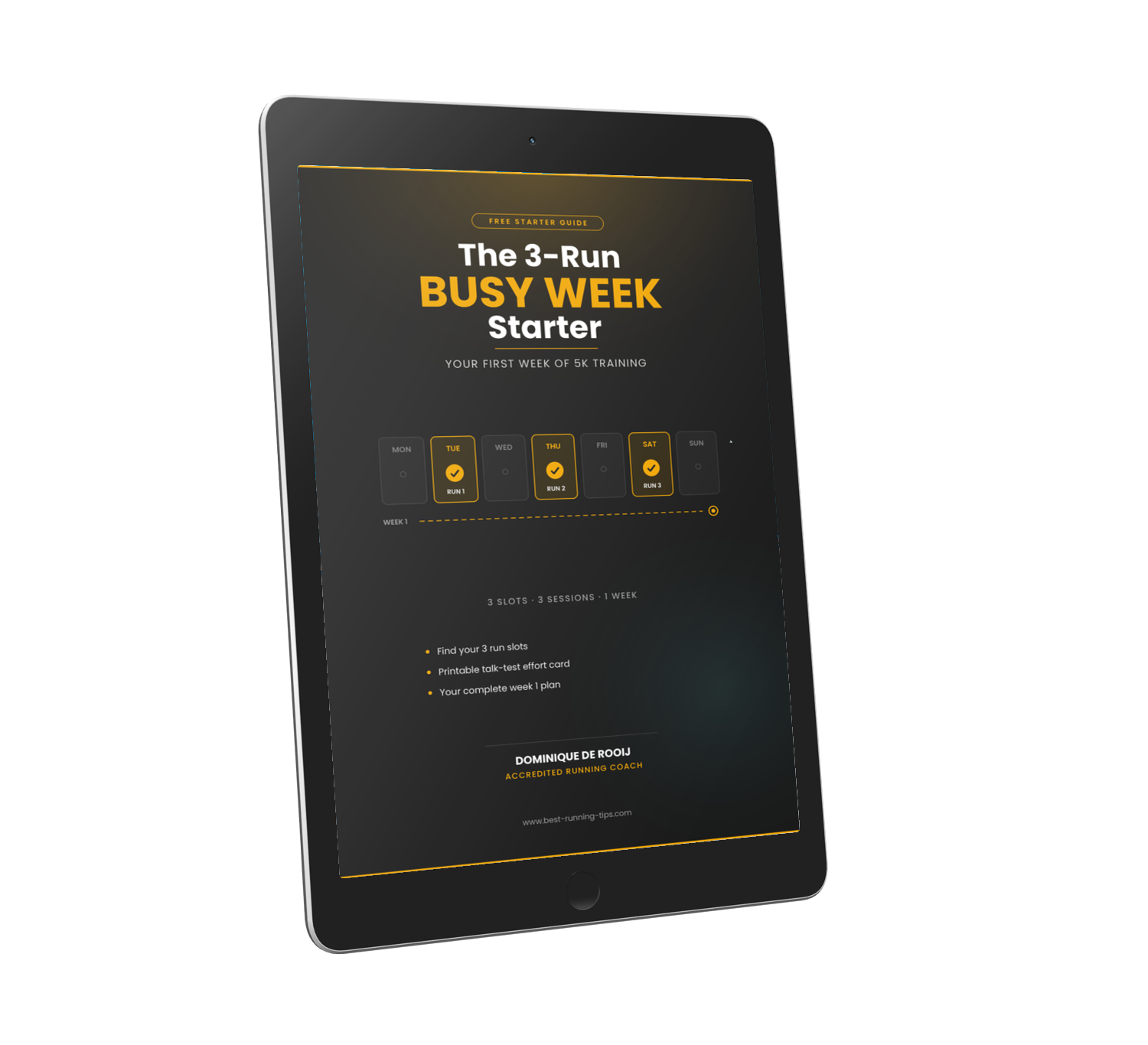
Free beginner guide • From Coach Dom
Start Running This Week, Even If Your Week Is Already Full
Most beginners don't quit for lack of motivation. They quit because their plan doesn't fit their life. The 3-Run Busy Week Starter plans your first week around the week you actually have.
- Find 3 run slots you can actually keep
- The talk test: the simple way to stop running too fast
- Your complete week 1 plan: 3 run/walk sessions, about 20 minutes each
You'll get the guide plus a short email every few days to help you through week 1. Unsubscribe any time. Privacy policy.
What's New?
-
Personalized Running Coaching - BRT | Run Smarter, Race Better
 Get a personalized running program built around your current fitness, goals, and schedule - not a generic app template. Choose from BRT Silver, Gold, or Platinum coaching with Dom, accredited running…
 -
Sample 4-Day Marathon Training Week: Base to Taper
A full 4-day-a-week marathon training schedule, phase by phase - base, build, peak, and taper - with named workouts and weekly mileage. -
Marathon Taper for a 10-12 Week Training Cycle
How to taper correctly on a compressed 10-12 week marathon plan - the right taper length, why standard advice doesn't fit, and the week-by-week structure.
