What Pace Should Beginners Run? An Effort-Based Guide for Month One

Effort-based coaching is exactly the standard I use with brand-new runners — not because pace doesn't matter eventually, but because in week one it simply can't tell you anything useful yet.
The Talk Test, Adapted for Run-Walk Intervals
The talk test needs adapting for run-walk training, so here's the version that actually works for month one.During your walk portions, you should be able to hold a full conversation without any strain. During your run portions, broken phrases are completely fine — you don't need full sentences while you're running. Gasping out single words is the line: that's your cue to slow down, or to take your next walk break a little early rather than push on.
Run the test separately on each part of your session. A walk that leaves you breathless is a problem. A run interval that leaves you speaking in short bursts is exactly where you're meant to be.
What Week 1 Should Feel Like vs. What Week 4 Should Feel Like
Effort guidance means little without knowing where you actually are in the build-up, so here's how the same talk test plays out at two very different points in your first month — using the same week-1 and week-4 figures as the program itself, so the two pages agree. If you haven't seen the day-by-day breakdown yet, head back to your full first-month schedule first.| Week | Run:Walk Pattern | Talk-Test Result | What Changes and Why |
|---|---|---|---|
| Week 1 | A 6-minute walk, then a 1-minute run. | Passes easily on both the walk and the run. | Your pace is largely irrelevant here. The run interval is short enough that effort barely rises above your walking effort. |
| Week 4 | Another minute added to your running segment, with walking trimmed to match. | Gets harder to pass midway through the run interval. | That's expected progression, not failure. A longer run interval should feel harder by its end — that's the build doing its job. |
If week four already feels comfortable throughout, that's a good sign — not a reason to worry you're going too slowly.
Why Your Pace Will Look "Slow" — And Why That's Correct

Reader story: Lisa, 49, Florida
Lisa, 49, from Florida, wrote to me three months into Couch to 5K, running about a 14-minute mile and covering 2.25 miles, three times a week. She was around 40 lbs overweight and, understandably, discouraged — she felt she "should" have been up to 3 miles by the three-month mark.My answer to Lisa was the same one I'd give you: build your distance through run/walk first, build your stamina and strength in other ways alongside it, and speed will follow on its own. Pace isn't something to chase directly this early — it's the last thing to move, not the first.
If your own pace looks a lot like Lisa's right now, that's not a sign anything's wrong. It's simply where fitness happens to be at this exact stage — and fitness, not effort, is what needs to catch up.
When Pace and Heart Rate Disagree: What to Trust

Reader story: Pau, Barcelona
Pau, a reader from Barcelona, was trying to hold to the run/walk intervals Pau was adapting from Beginners Running Program 3, but using a heart-rate monitor calculated by the Karvonen method: run until reaching 153bpm, then walk down to 140bpm, and repeat. That's Zone 1 training, in theory. After several months of this, three to four times a week, Pau was running more and walking less — but still wasn't managing more than 40% running time in a 30-minute session, and still hit 153bpm almost immediately whenever running resumed.The likely problem wasn't Pau's effort. It was the zones themselves. A theoretical, age-based max-heart-rate calculation is often miscalibrated for a beginner who hasn't been tested, which means the "limits" being trained to may not reflect real effort at all. My advice in cases like this: let effort and feel override the monitor in month one. If you do want to use a heart-rate monitor at all, train by Zone 2 rather than Zone 1 on its own — Zone 2 still qualifies as easy running, and it gives you a bit more room to work with. If you're curious about how heart rate ties into your pace as a new runner, it's worth a closer look alongside how your stride is settling in over these first few weeks.
Treadmill and Indoor Running: Judging Effort Without Pace Feedback

Set your starting speed conservatively, then use the talk test after two to three minutes to adjust it up or down. Don't pick a target mph number in advance and hold to it regardless of how it feels — let the talk test set the number for you, session by session.
One more thing worth knowing: both outdoor pace and hot weather distort perceived effort compared with a treadmill baseline. The same pace can feel noticeably harder outside, in the heat, or on a slight incline you didn't account for — so judge each session on its own effort, not by matching a treadmill number.
Signs You're Running Too Fast for Month One
"Just listen to your body" needs some teeth behind it, so here's what I actually watch for when coaching a brand-new run-walk client:- You can't complete a sentence during the run interval, even briefly — back off the next session rather than pushing through.
- Your walk breaks aren't bringing your heart rate and breathing back down before the next run interval starts — back off the next session rather than pushing through.
- You're sore well beyond normal next-day muscle soreness — back off the next session rather than pushing through.
When to Start Paying Attention to Pace Numbers at All
There's a clear exit point from effort-only mode, and it isn't a fixed number of weeks.Once you can comfortably run continuously for your full session length, pace becomes a genuinely useful secondary metric — not before. That's also exactly where once continuous running feels easy, here's what changes picks up, so head there next once you've reached that point.
And if you want something structured to fill the days between your run intervals while you build toward that point, build strength and stamina between run intervals is worth a look too.
Frequently Asked Questions
What pace should I run in my very first week of running?No target number — use the talk test on both the run and walk portions.
Should I trust my watch's pace reading or my heart rate more as a beginner?
Neither, over feel. Theoretical heart-rate zones are often miscalibrated for beginners, and pace lags fitness rather than leading it.
Why does my pace feel so much slower on a treadmill or in heat?
Both distort your perceived effort at the same pace. Judge by feel, not the number, in either condition.
Is it bad if my pace doesn't improve at all in the first month?
No — endurance and strength build first. Pace is typically the last thing to follow.
Should my pace be different for my longer weekend run versus my shorter weekday runs?
Your longer session should feel easier per interval, not faster. Slow down more, not less, as duration increases.
Some Other Pages You May Like
About the author

Dominique de Rooij (Dom)
Advanced Running Coach certified by Athletics Australia with 20 years of writing about running and over a decade coaching runners — from first-timers to marathoners. Dom's beginner programs have guided thousands of runners and been praised above plans from Jeff Galloway, Hal Higdon, and Runner's World. Now over 50, Dom still loves trail running, parkrun, and the coffee after.
Free beginner guide • From Coach Dom
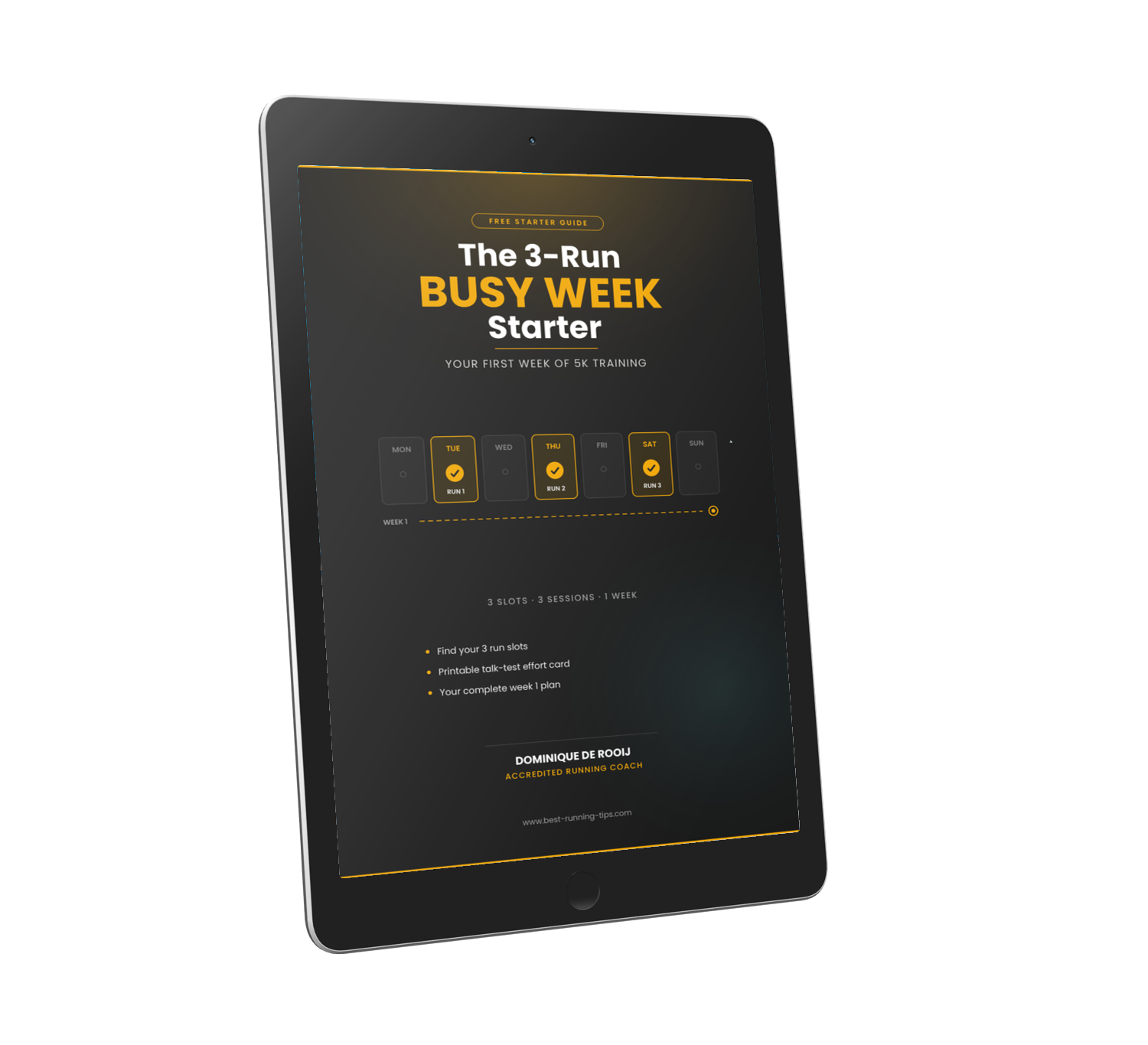
Start Running This Week, Even If Your Week Is Already Full
Most beginners don't quit for lack of motivation. They quit because their plan doesn't fit their life. The 3-Run Busy Week Starter plans your first week around the week you actually have.
- Find 3 run slots you can actually keep
- The talk test: the simple way to stop running too fast
- Your complete week 1 plan: 3 run/walk sessions, about 20 minutes each
You'll get the guide plus a short email every few days to help you through week 1. Unsubscribe any time. Privacy policy.
What's New?
-
Personalized Running Coaching - BRT | Run Smarter, Race Better
 Get a personalized running program built around your current fitness, goals, and schedule - not a generic app template. Choose from BRT Silver, Gold, or Platinum coaching with Dom, accredited running…
 -
Sample 4-Day Marathon Training Week: Base to Taper
A full 4-day-a-week marathon training schedule, phase by phase - base, build, peak, and taper - with named workouts and weekly mileage. -
Marathon Taper for a 10-12 Week Training Cycle
How to taper correctly on a compressed 10-12 week marathon plan - the right taper length, why standard advice doesn't fit, and the week-by-week structure.
