Common First-Month Running Injuries Shin Splints, Blisters, and Side Stitches
Let's face it — something is going to niggle in your first month, and that's normal, not a red flag. Four things show up consistently in weeks one to four: blisters and black toenails, shin splints, side stitches, and DOMS (delayed-onset muscle soreness) — not the later-stage overuse injuries like iliotibial (IT) band syndrome or patellofemoral pain, which need more mileage than you've built up yet.
I've coached new runners through their first month for over 20 years, and this exact list is what I get asked about most. Let's go through each one — what's happening, why it happens now and not later, and exactly what to do about it.
Why Your First Month Is a Uniquely Vulnerable Window
Here's the mechanism behind most beginner injuries, and it explains almost everything else on this page. Your heart and lungs adapt to aerobic load fast — your cardiovascular fitness genuinely improves within days to a couple of weeks. Your tendons, ligaments, and bones respond far more slowly, often taking months to catch up to the same load. That mismatch is exactly why your first month feels deceptively easy just as your legs are at their most vulnerable.Feeling capable of running further or faster is not the same signal as being structurally ready to. I see this catch out capable, motivated beginners more than any other single mistake — their fitness outpaces their conditioning, and they push into week two or three on legs that haven't caught up yet. It's exactly why the run/walk structure and rest days in your first-month schedule exist — not to hold you back, but to let your tissue close the gap your fitness has already opened. Tempted to push your pace early because a session felt easy? Read why pushing pace too early raises injury risk first.
Blisters and Black Toenails: The Shoe-Fit Fix That Prevents Most of This
Blisters and black toenails spike hard in month one, then mostly settle down. New shoes haven't broken in yet, and your feet haven't toughened to the repeated friction of regular running — so month one is when this is at its worst.The single highest-leverage fix is shoe fit, not toughness. Give yourself a thumb's-width of space in the toe box, get the width right for your foot, and break new shoes in gradually rather than wearing them straight into a long run. Two smaller fixes help too: moisture-wicking socks instead of cotton, and a lacing adjustment — a runner's loop at the top eyelet — if you're getting heel slip.
Shin Splints: What's Actually Happening and How to Train Around Them
Shin splints — properly, medial tibial stress syndrome — is inflammation along the shin bone from repetitive impact, before your bone and connective tissue have adapted to it. Beginners get them disproportionately because of a sudden jump in impact loading, and old or worn shoes or hard running surfaces make it worse.The fix isn't to push through it. Add more walk breaks, shorten the session, and ice the area afterwards — reducing impact is the actual treatment, not just symptom relief. Beware one distinction, though: if the pain is sharp, sits in one small spot, or is there even at rest, that's a stress-fracture flag, not a shin-splint flag, and it warrants seeing a professional rather than resting it out yourself.
Side Stitches: Why They Happen and the Quick Fix Mid-Run
A side stitch is usually a diaphragm spasm, often tied to shallow breathing, eating too close to your run, or running with poor posture. It's uncomfortable, not dangerous — worth saying plainly, because it can feel alarming the first time it happens.Mid-run, three things help: slow your pace, exhale forcefully on the foot-strike opposite the pain side, and press a hand firmly into the stitch itself. One important distinction: a stitch is not chest pain. Chest pain is a stop-and-seek-help signal, full stop — a stitch is not.
Normal Soreness vs. Real Injury: A Simple Decision Guide
Here's the triage rule I actually use with new runners, not a borrowed clinical checklist — three questions, in order.Ask yourself: does it ease up once you're warmed up, or get worse as you run? Is it symmetrical and general — both legs, a whole-body ache — or localised to one specific spot? And does it fade within 48 to 72 hours, or is it still there, or worse, at day four?
| Question | Normal adaptation (DOMS) | Possible injury |
|---|---|---|
| Eases with warm-up, or worsens as you run? | Eases within the first 10 minutes | Gets worse the longer you run |
| General or localised? | Symmetrical — both legs, whole-body ache | Localised to one specific spot |
| Fades within 48–72 hours? | Gone by day 2–3 | Still there, or worse, at day 4+ |
Three ticks in the middle column and you're looking at ordinary DOMS — normal adaptation, not an injury. Any tick in the right-hand column means move to the next section: rest, modify, or get it checked.
When to Rest, Modify, or See a Professional
Three tiers, and no vague "listen to your body" without them.Mild, general, and improving? Rest a day or two and reassess — that's usually enough. Persistent but manageable, or one-sided but not sharp? Modify rather than stop completely: swap a run day for walking, shorten your sessions, or add more walk breaks. Sharp or localised pain, pain at rest, pain that changes your gait, or anything not improving after a week of modification? See a doctor or physio — that's not a call to make on your own.
If an injury does force you off your programme altogether, don't panic about the schedule. See if an injury forces you to miss a day or more for how to pick it back up properly.
Staying Calm When Something Hurts for the First Time
A new ache, the first time you feel it, is a normal and expected part of adapting to a new activity — not a sign you're not cut out for this.The real risk isn't the ache. It's quitting out of fear of an ache that was never actually serious. That's the bigger threat to your goal, by some distance. Run it through the triage framework above instead of guessing, and you'll almost always know which camp you're in.
Once you've worked out what's going on, head back to your full first-month schedule.
Frequently Asked Questions
Is shin pain in my first few weeks normal, or a sign I'm doing too much?
General, warm-up-improving shin pain is typically normal adaptation. Sharp, localised pain, or pain that's there even at rest, is your signal to stop and assess rather than push through.
How do I tell normal muscle soreness (DOMS) from an actual injury?
DOMS is general and symmetrical, and it fades within 48 to 72 hours. An injury is localised, gets worse with activity, or is still there past day four.
Why do blisters happen more in the first month than later?
Your shoes haven't broken in yet and your feet haven't toughened to the friction of regular running. Proper shoe fit is the single biggest thing you can do to prevent it.
Should properly fitted running shoes really make this much difference in month one?
Yes — shoe fit is the highest-leverage fix you have, and it connects blisters, black toenails, and a good chunk of your shin splint risk as well.
When should I see a doctor versus just resting and adjusting my training?
Sharp or localised pain, pain at rest, or anything that hasn't improved after a week of modifying your training is your cue to get it checked rather than wait it out.
Most of what shows up in your first month is your body doing exactly what it should — adapting to a new load, a bit unevenly, and asking for patience rather than alarm. Learn the short list, run it through the triage framework when something niggles, and you'll spend far less time worrying and far more time running.
Some Other Pages You May Like
About the author

Dominique de Rooij (Dom)
Advanced Running Coach certified by Athletics Australia with 20 years of writing about running and over a decade coaching runners — from first-timers to marathoners. Dom's beginner programs have guided thousands of runners and been praised above plans from Jeff Galloway, Hal Higdon, and Runner's World. Now over 50, Dom still loves trail running, parkrun, and the coffee after.
Free beginner guide • From Coach Dom
Start Running This Week, Even If Your Week Is Already Full
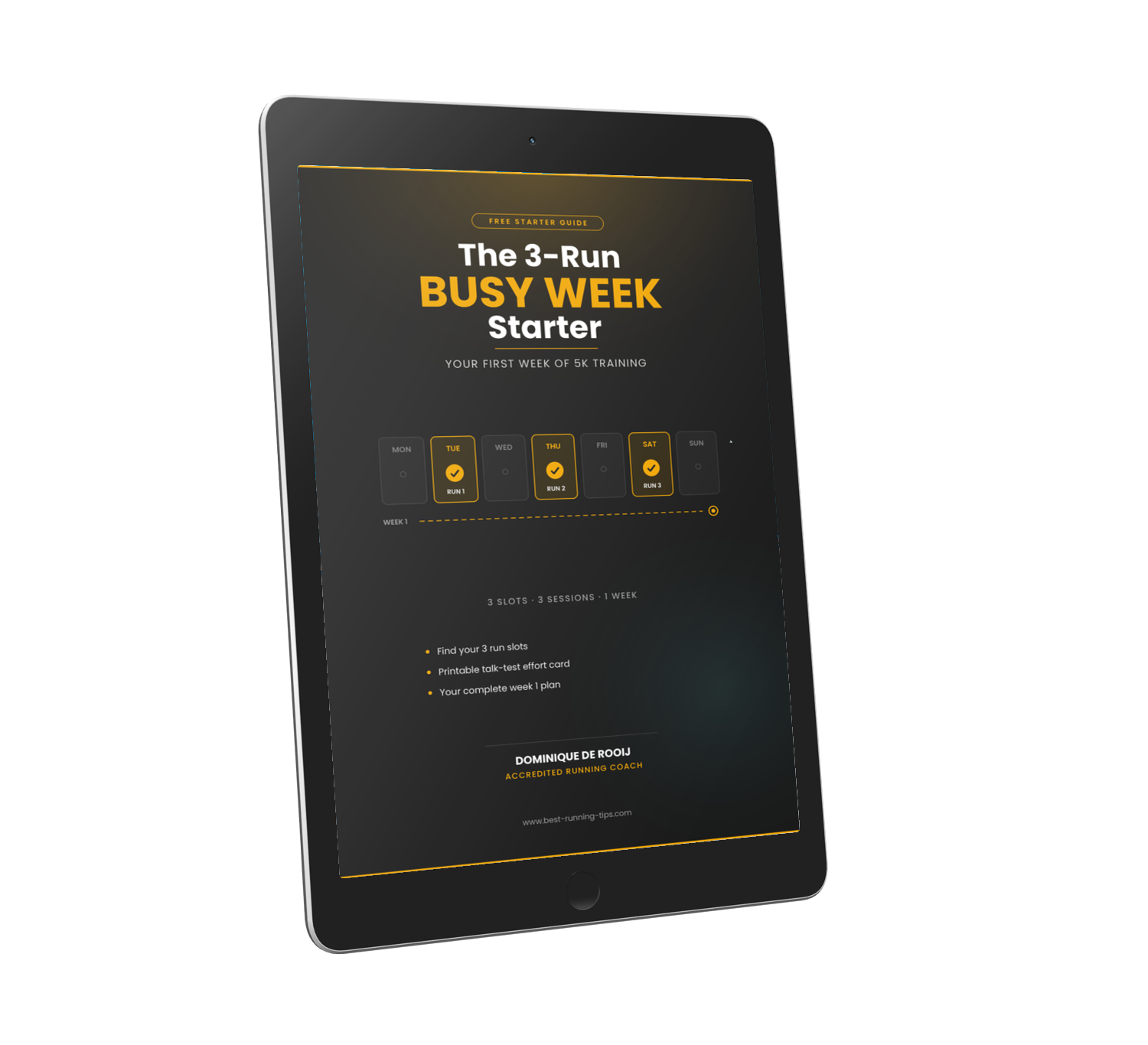
Most beginners don't quit for lack of motivation. They quit because their plan doesn't fit their life. The 3-Run Busy Week Starter plans your first week around the week you actually have.
- Find 3 run slots you can actually keep
- The talk test: the simple way to stop running too fast
- Your complete week 1 plan: 3 run/walk sessions, about 20 minutes each
You'll get the guide plus a short email every few days to help you through week 1. Unsubscribe any time. Privacy policy.
What's New?
-
Personalized Running Coaching - BRT | Run Smarter, Race Better
 Get a personalized running program built around your current fitness, goals, and schedule - not a generic app template. Choose from BRT Silver, Gold, or Platinum coaching with Dom, accredited running…
 -
Sample 4-Day Marathon Training Week: Base to Taper
A full 4-day-a-week marathon training schedule, phase by phase - base, build, peak, and taper - with named workouts and weekly mileage. -
Marathon Taper for a 10-12 Week Training Cycle
How to taper correctly on a compressed 10-12 week marathon plan - the right taper length, why standard advice doesn't fit, and the week-by-week structure.
