How Fast Should You Run Your Couch to 5K Intervals? The Talk-Test Pace Guide
Run each interval slow enough to speak an eight-to-ten-word sentence without gasping. Can't get it out in one breath? Slow down, don't stop — that's the fix. A single mph number won't do here; your starting fitness varies too much for one range to fit everyone. That's what the rest of this page sorts out.
I've coached hundreds of Couch to 5K beginners through exactly this question, and mph charts almost never help them — effort does. Here's the talk-test protocol I actually use with runners, the fitness-tiered pace ranges, and the walk-pace guidance that makes the intervals work.
The Talk Test: How to Actually Use It Mid-Interval
"You should be able to talk" is the standard advice — here's how to check it while you're actually running. Here's the fix: a specific, three-step self-test you can run mid-interval, not just a vague feeling.Step one: pick a short sentence, eight to ten words long. Mine is simple — "I am jogging at an easy pace right now." Step two: say it, out loud or in your head, mid-run. Step three: count whether you finished it in one breath. Managed it? Your effort is right. Had to break it into two gasped chunks? You're running harder than target — slow down.
This is the talk test, properly operationalised, and it replaces mph as Best Running Tips' primary pacing tool for Couch to 5K. Not a backup. Not a rough guide. The primary one — everything after this section is a sanity check against it, not the other way round.
I use a version of this with the beginners I coach directly, because "can you talk?" on its own is too vague for someone to self-police mid-interval, three weeks into a program, with no coach standing next to them. A concrete sentence and a breath count gives you something to actually check yourself against.
Your Jog Pace Range, by Starting Fitness
Effort comes first. But a rough pace band is still a useful sanity check — provided you treat it as exactly that, and not a target to chase. Here's how it breaks down by starting fitness:| Starting fitness | Outdoor pace band (per mile) | Per km (approx.) |
|---|---|---|
| Very deconditioned, or new to exercise altogether | 14–16 min/mile | ~8:45–9:55 min/km |
| Moderately active, but new to running specifically | 12–14 min/mile | ~7:30–8:45 min/km |
| Previously active, returning after a break | 10–12 min/mile | ~6:15–7:30 min/km |
Notice these are wide bands, not precise targets — deliberately so, because "new to running" covers a huge range of actual fitness. If your pace and the talk test ever disagree, believe the talk test. This table is built from coaching a real range of Couch to 5K-level beginners, and it's here to reassure you, not to set a bar.
Why Your Walk Pace Matters Just as Much
You walk during the recovery interval, but how fast you walk matters — walk pace is a genuine coaching lever, not an afterthought.A genuine brisk walk keeps your heart rate elevated enough to hold onto the aerobic benefit you just built during the run interval. Stroll instead, and your body treats each run interval like starting from cold again — which makes the whole session feel harder than it needs to.
Forget a bare mph number here too. Walk with real arm swing, at a pace you couldn't comfortably window-shop at. If you could stop and browse a shop window without breaking stride, you're walking too slowly for the recovery to do its job.
Treadmill Speed vs Outdoor Pace: The Conversion
Run the same effort on a treadmill and outdoors, and the treadmill will feel slightly easier at the identical number. There's no wind resistance, no camber, no terrain variation — the belt does some of the work outdoor pavement doesn't.The fix: start your treadmill speed around 0.2–0.3 mph below the outdoor-equivalent number, then adjust from there using the talk test — not the display. Here's that starting point for each tier:
| Starting fitness | Outdoor pace (per mile) | Outdoor-equivalent mph | Suggested treadmill start |
|---|---|---|---|
| Very deconditioned / new to exercise | 14–16 min/mile | ≈3.75–4.3 mph | 3.5–4.0 mph |
| Moderately active, new to running | 12–14 min/mile | ≈4.3–5.0 mph | 4.0–4.7 mph |
| Previously active, returning after a break | 10–12 min/mile | ≈5.0–6.0 mph | 4.7–5.7 mph |
Treat these as a starting point for your first session on the belt, then let the talk test do the rest of the adjusting — up or down.
When You're Ready to Pick Up the Pace
Here's a concrete trigger, not a vague "gradually increase": only increase your jog pace once your current pace passes the talk test comfortably for a full week of sessions. Not one good session — a full week of them.And here's the rule I'd genuinely beware ignoring: never increase your pace and your interval length in the same week. Pick one. This is exactly the kind of overuse niggle I see most often in beginners who try to build fitness on two fronts at once — and it's entirely avoidable.
If you're following Best Running Tips' own Couch to 5K plan, let the week you're on set the interval length, and let this section's rule set the pace. Progress on one axis at a time.
Can't Hit the Range? Here's What to Do
Run slower than the table above if that's what the talk test tells you to do. That range is a sanity check, not a floor — it was never meant to be a bar you have to clear.If pace difficulty is really a symptom of something bigger — the whole week feeling too hard, not just the speed — that's a different problem with its own fix. Here's what to do when a week feels too hard, rather than just the pace within it.
Frequently Asked Questions
Here's what beginners ask most about Couch to 5K pace.Should I run by pace (mph or min/mile) or by effort as a beginner?
Effort, always. Pace is only ever a sanity check against the fitness-tiered ranges above — never the primary tool.
Is it normal for my pace to vary a lot from session to session?
Yes. Fatigue, sleep, heat, and terrain all shift it — and none of that means the plan isn't working.
What if I genuinely can't hit the suggested pace ranges at all?
That's fine. Slow down further and rely on the talk test instead. If it's really the whole week that feels too hard, not just the pace, check the troubleshooting guide for that.
My heart rate feels really high even at a pace that passes the talk test — is that normal?
Often, yes — heart rate can run high for beginners independent of pace, for reasons that have nothing to do with how fast you're going. That's a distinct topic from interval pace, and I've covered it properly on how pace and heart rate relate for beginners.
So: forget the mph chart, run the talk test instead, and use the fitness-tiered ranges above as a sanity check, not a target. Get the pace right and the rest of Couch to 5K takes care of itself. Back to the full Couch to 5K plan to see where this fits into the twelve weeks.
Some Other Pages You May Like
About the author

Dominique de Rooij (Dom)
Advanced Running Coach certified by Athletics Australia with 20 years of writing about running and over a decade coaching runners — from first-timers to marathoners. Dom's beginner programs have guided thousands of runners and been praised above plans from Jeff Galloway, Hal Higdon, and Runner's World. Now over 50, Dom still loves trail running, parkrun, and the coffee after.
Free beginner guide • From Coach Dom
Start Running This Week, Even If Your Week Is Already Full
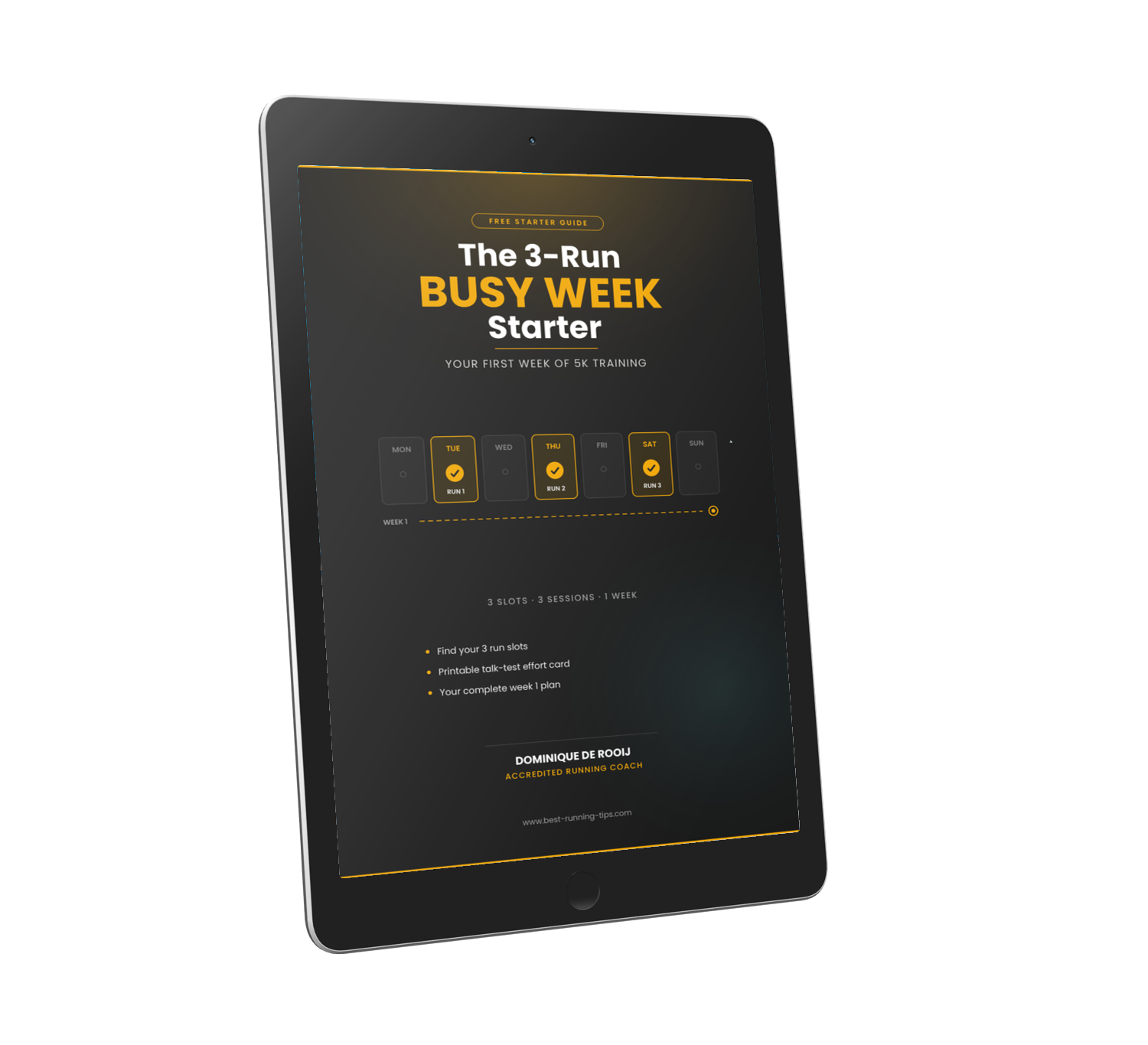
Most beginners don't quit for lack of motivation. They quit because their plan doesn't fit their life. The 3-Run Busy Week Starter plans your first week around the week you actually have.
- Find 3 run slots you can actually keep
- The talk test: the simple way to stop running too fast
- Your complete week 1 plan: 3 run/walk sessions, about 20 minutes each
You'll get the guide plus a short email every few days to help you through week 1. Unsubscribe any time. Privacy policy.
What's New?
-
Personalized Running Coaching - BRT | Run Smarter, Race Better
 Get a personalized running program built around your current fitness, goals, and schedule - not a generic app template. Choose from BRT Silver, Gold, or Platinum coaching with Dom, accredited running…
 -
Sample 4-Day Marathon Training Week: Base to Taper
A full 4-day-a-week marathon training schedule, phase by phase - base, build, peak, and taper - with named workouts and weekly mileage. -
Marathon Taper for a 10-12 Week Training Cycle
How to taper correctly on a compressed 10-12 week marathon plan - the right taper length, why standard advice doesn't fit, and the week-by-week structure.