Heart Rate Zone Training for Your First 10K or Half Marathon

How Heart Rate Fits Into a 10K or Half Marathon Build
Both schedules below are built the same way: large volumes of easy, aerobic running, with occasional harder efforts layered in as you progress. That matches the full reliability table's own verdict — heart rate monitoring is highly reliable for easy and long runs, which is most of what these programs ask of you.You don't need a monitor to follow either schedule. Plenty of runners get to their first 10K or half marathon on feel alone. But a monitor does make one thing easier — holding your easy-day pace honest. Most new runners I coach run their easy days 30-60 seconds per kilometre faster than they should. A zone alert is the quickest way to catch that and back off.
Establishing Your Heart Rate Zones
To determine your own heart rate zones, use one of two calculators on this site: the Karvonen Method calculator, which factors in your rest heart rate for a slightly more personalised range, and the Zoladz Method calculator, a simpler percentage-of-max-heart-rate approach. They land close together for most runners — use whichever one you've got the numbers for.In broad terms, these programs work across four heart rate zones:
- Zone 1 (Recovery) — below roughly 60% of max heart rate. Warm-ups, cool-downs, and very light effort.
- Zone 2 (Easy/Aerobic) — roughly 60-75% of max heart rate. Where the bulk of both schedules lives.
- Zone 3 (Threshold) — roughly 75-88% of max heart rate. The occasional harder effort woven into each program.
- Zone 4 (Hard) — above roughly 88% of max heart rate. Short, sharp efforts, used sparingly this early on.
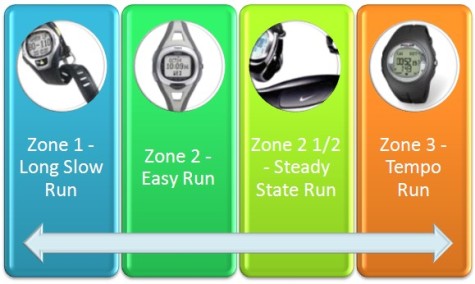
The chart below gives you the visual version of the same breakdown.
Choosing Your Program: First 10K or First Half Marathon
I've built two schedules for you, both structured to get a first-timer to the finish line — not to a specific time.- A "Run Your First 10K" Heart Rate Monitor Training Schedule. See 10K Running Program - in 12 weeks to your first 10K. Assumes you are able to run 30 minutes non-stop.
- A "First Half Marathon" Heart Rate Monitor Training Schedule. See the Half Marathon Running Schedule - in 12 weeks to your first half marathon. Assumes you are able to run a 10K.
Not Ready Yet? Start With a Beginner Program
Not quite at that level yet? Check out the run/walk beginner running programs. Work your way up to running 30 minutes non-stop, e.g. by using Beginners Running Program 3 (from 0 to 30 minutes of non-stop running in only 12 weeks), then move on to the 10K schedule above.Finish First, Race Later
These programs are built to get you to the finish — not to race the distance. Notice that subtle difference?By all means, enter a race. I encourage it. When you've got a race on the calendar, your motivation to stick to the plan is definitely higher.
But do not race your race. "Only" finish it... enjoy it... after your first, hopefully successful attempt at the distance, you'll have plenty of opportunities to improve.
When you're relatively new to running, it really is best to take things one step at a time. You've got a lifetime of running ahead of you. So first focus on being able to cover the distance, being able to run that far.
Then next time, try to improve your running with a training schedule focused on improvement.
That's why you won't find any real speedy stuff in these programs. Pretty much every run is aimed at building your aerobic engine — getting you used to the time on your feet and the distance you'll cover on race day.

Frequently Asked Questions
What heart rate zone should I train in for a 10K or half marathon?
Mostly the easy/aerobic zone (roughly 60-75% of max heart rate (HR)), with occasional harder efforts depending on the specific week of the schedule — see the pillar's reliability table for the full session-by-session breakdown.
Do I need a heart rate monitor to follow a 10K or half marathon training program?
No — both schedules can be run by pace or effort; a monitor just gives you an objective check that your easy days are genuinely easy.
How do I find my heart rate zones before starting a program?
Use the Karvonen or Zoladz method to calculate your training zones from your max heart rate (and, for Karvonen, your rest heart rate too).
What if I can't run 30 minutes non-stop yet?
Start with a beginner run/walk program first (Beginners Running Program 3 takes you from 0 to 30 minutes non-stop in 12 weeks), then move on to the 10K schedule.
For the full picture on when heart rate training helps — and when it doesn't — head back to the heart rate training anchor page. Ready to set your own zones before you start either schedule? Use the Karvonen Method calculator or the Zoladz Method calculator to work out your numbers first.
Some Other Pages You May Like
About the author

Dominique de Rooij (Dom)
Advanced Running Coach certified by Athletics Australia with 20 years of writing about running and over a decade coaching runners — from first-timers to marathoners. Dom's beginner programs have guided thousands of runners and been praised above plans from Jeff Galloway, Hal Higdon, and Runner's World. Now over 50, Dom still loves trail running, parkrun, and the coffee after.
Free weekly coaching • Join 3,500+ runners
Train Smarter, Not Just Harder
Get your free guide when you join the BRT Coaching Letter
No spam, ever. Unsubscribe in one click, any time.
What's New?
-
Personalized Running Coaching - BRT | Run Smarter, Race Better
 Get a personalized running program built around your current fitness, goals, and schedule - not a generic app template. Choose from BRT Silver, Gold, or Platinum coaching with Dom, accredited running…
 -
Sample 4-Day Marathon Training Week: Base to Taper
A full 4-day-a-week marathon training schedule, phase by phase - base, build, peak, and taper - with named workouts and weekly mileage. -
Marathon Taper for a 10-12 Week Training Cycle
How to taper correctly on a compressed 10-12 week marathon plan - the right taper length, why standard advice doesn't fit, and the week-by-week structure.
