Does Altitude Raise Your Heart Rate When Running? Here's What's Normal
"I live in Quito, Ecuador, at 9,300 ft. I played soccer all my life and have been climbing mountains — up to 19,600 ft — since I was 15, but I only started running systematically about a year ago. I'm currently running roughly 35 km (about 20 miles) a week, and my routes involve steep hills I simply can't avoid. I recently started using a heart rate monitor, and after my long runs (10–12 km) — where I don't feel wasted and I'm not in pain — I'm averaging 166 beats per minute (bpm). I'm 38, and my field-tested maximum heart rate (HRmax) is 188. Is this too high? Does altitude have anything to do with it?
– Esteban, Quito, Ecuador
Answer by Dominique: Hi Esteban,
Thanks for writing in. Altitude explains part of this, and the hills are stacking on top of it.
Yes — running at altitude raises both your resting and your exercise heart rate, while your true maximum heart rate actually goes down. There's less oxygen available in the air up there, so your heart works harder to deliver what it can get. On its own, that's expected — not a warning sign.
I'll break my response down as follows:
1. Why Altitude Raises Your Heart Rate
2. How Long Until You Acclimatise
3. Hill Running Adds Its Own Heart Rate Load
4. Should You Trust Your Heart Rate Monitor Here?
5. When to Actually Be Concerned

1. Why Altitude Raises Your Heart Rate
At altitude, air pressure is lower, so there's less oxygen in every breath you take. Your heart compensates by beating faster and harder to deliver the oxygen your muscles need — at a given effort, that means a higher heart rate than the same run at sea level. Your true maximum heart rate actually trends the other way: it falls, not rises, at altitude.This isn't unique to your situation, Esteban — it's well-established exercise physiology, not something specific to running in Quito. What does vary is the size of the effect. Altitude tolerance differs by roughly 20–30% between individuals, so two runners at the exact same elevation can see meaningfully different heart rate shifts. Some of that gap is genetics, some is how long you've lived there, and some is simply how fit you already are — the same variability shows up in how altitude affects your easy pace, if you want the pacing side of this too.
Since your max heart rate genuinely shifts at altitude, how to find your true max heart rate is worth a read before you set any new training zones from it.
2. How Long Until You Acclimatise
Substantial acclimatisation takes roughly 3–4 weeks of consistent exposure to a new altitude — not the two weeks you might have heard elsewhere. You'll get some early, partial adaptation within the first few days, then, for most people, a rough patch around days 2–5 where your body is adjusting but hasn't caught up yet. Push through that rather than reading it as a bad sign.But that timeline is for a visiting runner. You're not visiting, Esteban — you live at 9,300 ft year-round. For someone in your position, I stop treating their numbers as something to fix against a sea-level baseline. The useful comparison is your own history at your own elevation, not a formula built for a two-week training camp. Your exercise heart rate may simply run higher than sea-level norms indefinitely — and that's a baseline to train around, not a problem to solve.
3. Hill Running Adds Its Own Heart Rate Load
Altitude is only half of your question — the hills are doing their own work on top of it. Hill running is strength training in disguise. You'll work harder, and your heart rate will climb, no matter how easy the effort feels.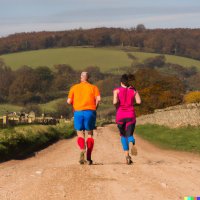
For you, altitude and hills are stacking — that's exactly why your average looks high even though nothing about the run itself feels hard. It would be worth looking at your heart rate spread across a run, not just the average, to see whether the number is really being driven by the climbs specifically. See hill training and effort for more on training with hills deliberately, rather than just enduring them.
4. Should You Trust Your Heart Rate Monitor Here?
Given your terrain and altitude, I wouldn't go by the heart rate monitor alone. Run by feel first — make sure an easy run feels like an easy run, and worry less about matching a number that was never built for your conditions. Easier said than done when hills are involved, I know.A power meter like Stryd is a genuinely useful alternative here — it accounts for terrain and elevation change directly, rather than inferring effort from a heart rate that altitude and hills are already distorting.
One more thing worth knowing: your global positioning system (GPS) watch's own auto-calculated training zones are built from a generic formula. They won't reflect your actual, altitude-adjusted baseline. If you're training long-term at elevation, treat your own historical data — not a formula-derived zone — as your real reference point. Once you're ready to build proper zones from that data, calculating your training zones (or the Zoladz Method) is the next step.
5. When to Actually Be Concerned
None of this is diagnosis — it's triage. Here's how I'd tell the difference:Normal — Keep Going
- The number tracks with the elevation and the hills you're running.
- It comes back down within a few minutes of easing off.
- No chest pain, dizziness, or breathlessness out of proportion to the effort — which matches exactly what you've described, Esteban.
Worth Checking With a Doctor
- Chest pain or pressure.
- Dizziness or fainting.
- A fluttering or skipped-beat sensation.
- Breathlessness that feels disproportionate — especially before you keep training hard at elevation.
It might not feel like the most optimal environment for building clean heart-rate data, Esteban, but there's no question it's building serious fitness. All that altitude and hill running is putting real strength into your legs and your engine — keep at it.
For the full picture on training by heart rate, see the full guide to heart rate monitor training.
All the best.
Kind regards,
Dominique
Some Other Pages You May Like
About the author

Dominique de Rooij (Dom)
Advanced Running Coach certified by Athletics Australia with 20 years of writing about running and over a decade coaching runners — from first-timers to marathoners. Dom's beginner programs have guided thousands of runners and been praised above plans from Jeff Galloway, Hal Higdon, and Runner's World. Now over 50, Dom still loves trail running, parkrun, and the coffee after.
Free weekly coaching • Join 3,500+ runners
Train Smarter, Not Just Harder
Get your free guide when you join the BRT Coaching Letter
No spam, ever. Unsubscribe in one click, any time.
What's New?
-
Personalized Running Coaching - BRT | Run Smarter, Race Better
 Get a personalized running program built around your current fitness, goals, and schedule - not a generic app template. Choose from BRT Silver, Gold, or Platinum coaching with Dom, accredited running…
 -
Sample 4-Day Marathon Training Week: Base to Taper
A full 4-day-a-week marathon training schedule, phase by phase - base, build, peak, and taper - with named workouts and weekly mileage. -
Marathon Taper for a 10-12 Week Training Cycle
How to taper correctly on a compressed 10-12 week marathon plan - the right taper length, why standard advice doesn't fit, and the week-by-week structure.
