Pain vs. Soreness in Couch to 5K: When to Stop and When to Keep Going
Soreness is dull, general, felt on both sides, and fades within a day or two. Pain is sharp, one-sided, sits in a specific joint or spot, and doesn't ease as you warm up. If what you're feeling matches that second description, stop and read the rest of this page properly — don't just skim it.That's the headline rule, and it's specific to Couch to 5K's walk/run structure. If you've got a wider "is this an injury" question that isn't tied to this programme, head to the general soreness-vs-injury framework for any stage of running instead.
Prefer the full plan first? Head back to the full Couch to 5K plan — otherwise, keep reading below for the pain-vs-soreness breakdown.
Why Shins and Calves Ache So Often in the Early Weeks
Let's face it — if you've picked up a new ache in the first few weeks of Couch to 5K, there's a good chance it's in your shins or calves. That's the single most common complaint I see from beginners on this programme, and it's not a coincidence.Early intervals ask your lower legs to absorb repeated impact in short, frequent bursts — something your shins and calves haven't had to handle before. The connective tissue and muscles down there take the brunt of that adaptation while the rest of your body catches up.
Expect this in weeks 1 to 3. It's part of base building, not a reason to stop the programme on its own, and it should ease as your tissue adapts to the new load.
How Normal Soreness Should Change as Your Intervals Get Longer
Soreness shouldn't stay the same from week 1 to week 7 — it should trend down, even as your intervals get harder. Here's what normal looks like at each stage:| Programme stage | Expected soreness pattern | When it's a flag |
|---|---|---|
| Weeks 1–2 (short run intervals) | Mild, generalised soreness after most sessions, easing within 24–48 hours | Soreness that doesn't ease within 48 hours |
| Weeks 3–6 (intervals lengthening) | Trending down, even as intervals get harder — your tissue is adapting | Soreness holding steady or getting worse as the weeks go on |
| Week 7+ (mostly continuous running) | Occasional, not routine | Soreness showing up after most runs at this stage |
One rule matters more than any single row in that table: soreness trending the wrong direction — worse in week 5 than it was in week 2 — is itself a warning sign. That's true even if any one instance, taken on its own, still looks like normal soreness.
The Stride-Change Self-Check: A Step-by-Step Test
There's one test I rely on more than pain intensity alone, and it's worth knowing how to use it. Here it is, broken into three steps you can run mid-interval.- Notice the ache, and consciously check: am I favouring that side, shortening my stride, or changing my footstrike to avoid it?
- If your stride is unchanged, and the ache stays flat or fades, finish the interval as planned.
- If you catch yourself limping, favouring, or altering your gait even slightly to manage the ache, stop the run and walk the rest of that session.
Could It Be Your Shoes or Surface, Not Your Fitness?
Before you conclude something's wrong with your training, check two things that are far easier to fix.Your shoes. Worn-out cushioning, or non-running shoes like cross-trainers or casual trainers, is a common — and fixable — cause of aches around the knees, ankles, and hips. If yours are old, non-running, or both, rule that out first.
Your surface. Running consistently on hard tarmac or pavement adds impact load that a softer surface reduces. You don't need to abandon the road entirely — rotating in one session a week on a park path, trail, or track is often enough to take the edge off.
Neither of these replaces the stride-change test above. Treat them as your first-pass check, not a substitute for it.
Next-Day Soreness vs. Pain That Lingers
Soreness the morning after a session is normal — but not all next-day discomfort is the same, and the difference tells you what to do next.Normal next-day soreness is dull, symmetric, present the morning after, and eases with light movement. It's gone within 48 hours. If that's what you've got, proceed with your next scheduled session as planned — light walking in between is fine, and often helps.
Pain that lingers is different. It's still sharp or localised on day 2 or 3, or it returns as soon as you start your next run rather than warming out of it. If that's what you're dealing with, take an extra rest day before your next session, and reassess with the stride-change test above rather than pushing through on schedule.
What to Do If the Same Pain Keeps Coming Back
One ache in one session is rarely a problem. The same ache, in the same spot, across two sessions in a row is where I want you to change something.Don't repeat the same interval load a third time. Either repeat that week at a slightly easier effort, or add an extra rest day before trying again.
If it comes back a third time in the same spot, that's not routine Couch to 5K soreness any more — pause the programme and treat it as a warning sign rather than pushing on. As a coach, a third recurrence in the same spot is the point where I tell my own clients to stop self-managing it and get it properly assessed. For what specific injuries look like by location, see what specific injuries look like by location, and for the general decision framework, see the general soreness-vs-injury framework for any stage of running.
One more distinction worth making: if it's not a specific recurring ache but a hard week generally — sessions that just feel too tough across the board — that's a different problem with a different fix. Head to struggling with a hard week, not a specific ache instead.
Frequently Asked Questions
Is it normal to feel sore after Couch to 5K sessions?
Yes, especially in weeks 1 to 3. The key is whether it's general, dull soreness on both sides rather than something sharp or localised to one spot — see the headline rule at the top of this page.
Is it normal to hurt more after week 1, run 2, than run 1?
Usually yes, briefly. Your second session compounds fresh soreness on top of what hasn't cleared yet, before your body starts adapting. It should ease by run 3 or 4.
Does soreness get worse or better as the weeks progress?
It should trend down, even as your intervals get harder. Soreness that's worsening over time is itself a warning sign, not routine Couch to 5K discomfort.
Could my shoes or running surface be causing pain I'm blaming on my fitness?
Yes. Worn-out or non-running shoes and consistently hard surfaces are common, fixable first causes of joint-adjacent aches — check these before assuming a fitness or injury problem.
When is it okay to keep running through discomfort during Couch to 5K specifically?
Only when it's general, symmetric soreness that fades as you warm up and doesn't change your stride. Anything localised, sharp, or recurring is a stop signal.
Most Couch to 5K pain confusion comes down to not knowing where the line sits — now you do. Use the headline rule, run the stride-change test when you're not sure, and don't be afraid to repeat a week if that's what it takes to keep going. Listen to your body, and it will tell you which one you're dealing with. :)
Some Other Pages You May Like
About the author

Dominique de Rooij (Dom)
Advanced Running Coach certified by Athletics Australia with 20 years of writing about running and over a decade coaching runners — from first-timers to marathoners. Dom's beginner programs have guided thousands of runners and been praised above plans from Jeff Galloway, Hal Higdon, and Runner's World. Now over 50, Dom still loves trail running, parkrun, and the coffee after.
Free beginner guide • From Coach Dom
Start Running This Week, Even If Your Week Is Already Full
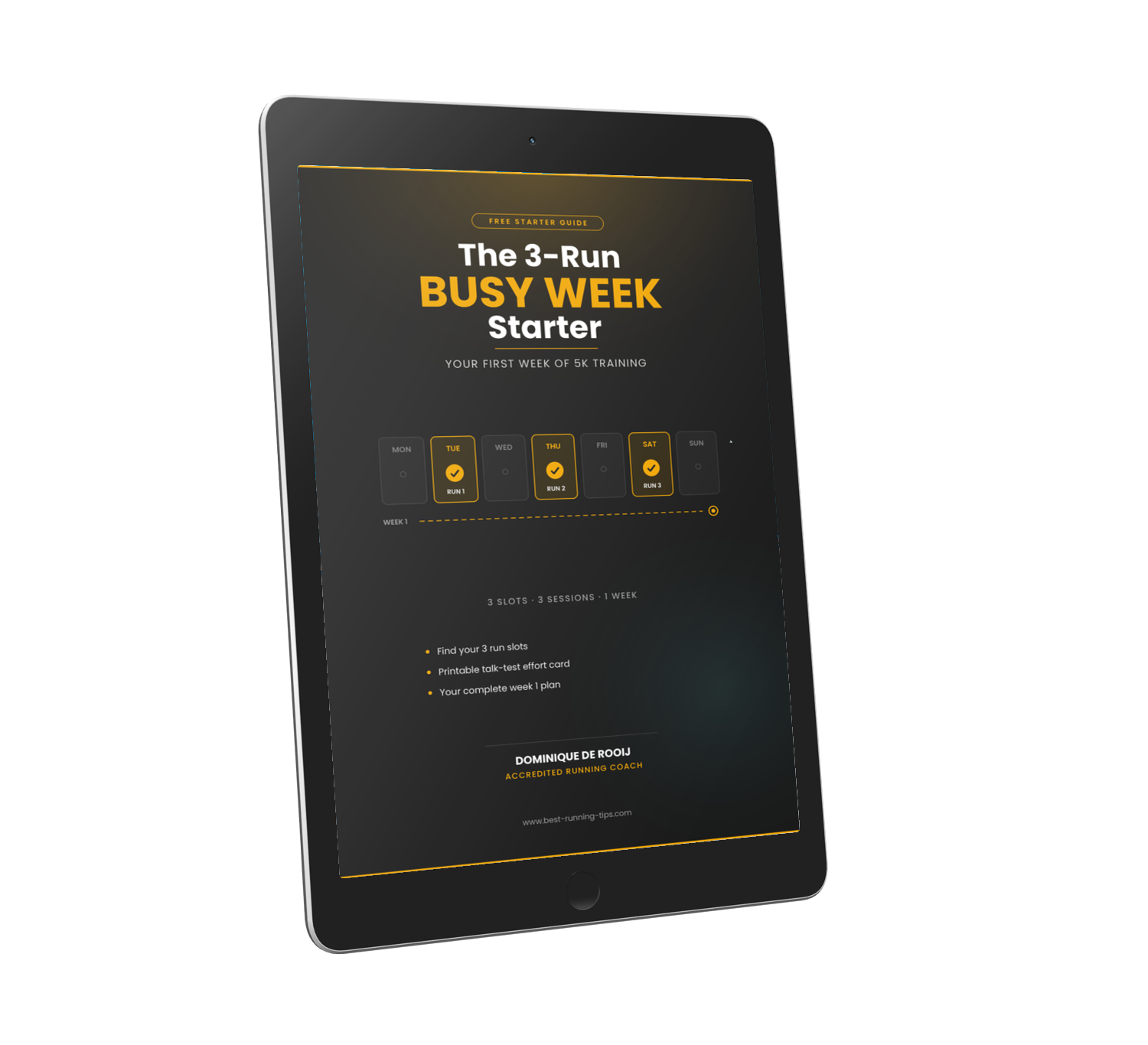
Most beginners don't quit for lack of motivation. They quit because their plan doesn't fit their life. The 3-Run Busy Week Starter plans your first week around the week you actually have.
- Find 3 run slots you can actually keep
- The talk test: the simple way to stop running too fast
- Your complete week 1 plan: 3 run/walk sessions, about 20 minutes each
You'll get the guide plus a short email every few days to help you through week 1. Unsubscribe any time. Privacy policy.
What's New?
-
Personalized Running Coaching - BRT | Run Smarter, Race Better
 Get a personalized running program built around your current fitness, goals, and schedule - not a generic app template. Choose from BRT Silver, Gold, or Platinum coaching with Dom, accredited running…
 -
Sample 4-Day Marathon Training Week: Base to Taper
A full 4-day-a-week marathon training schedule, phase by phase - base, build, peak, and taper - with named workouts and weekly mileage. -
Marathon Taper for a 10-12 Week Training Cycle
How to taper correctly on a compressed 10-12 week marathon plan - the right taper length, why standard advice doesn't fit, and the week-by-week structure.
