Sore or Injured? A Beginner's Self-Triage Guide for Running Pain
Soreness is usually bilateral — both legs, roughly evenly — eases within the first 5 to 10 minutes of a run, and fades within 24 to 72 hours. Injury pain is usually one-sided, gets worse the longer you run, and barely improves day to day. If your pain fits that second pattern, treat it as a possible injury, not soreness.That's the headline rule. Here's how to use it properly, plus exactly what to do next.
Prefer the wider picture first? Head back to the full guide to common beginner running injuries — otherwise, keep reading below for the full self-triage breakdown.
Why This Distinction Matters More in Your First Few Weeks
Let's face it — your soreness right now is probably worse than anything an experienced runner feels after a hard session. That's not a bad sign. It's simply DOMS — delayed-onset muscle soreness — and it peaks 24 to 72 hours after unfamiliar exertion, hitting hardest the first one or two times a muscle group gets loaded this way.You're loading tissue that's never done this job before. Calves, shins, quads — none of them have been asked to run before, and many of us forget that fitness and tissue readiness run on two different clocks. Expect it as normal. It's not a red flag, and the rest of this page is calibrated against that baseline — not against how an experienced runner's body responds.
The Core Signals: Bilateral vs. Unilateral, Sharp vs. Achy, Timing
Here's the evidence, side by side, so you're not left guessing. Four criteria decide almost every case.| Criteria | Soreness | Injury |
|---|---|---|
| Location | Both sides, or a general area of a muscle | One specific spot |
| Quality | Dull, achy, tight | Sharp, stabbing, or a distinct "catch" |
| Behaviour during activity | Eases as you warm up | Stays the same, or worsens as you run |
| Timeline | Peaks at 24–72 hours, then steadily improves | Persists or worsens day to day |
One quirk trips up a lot of beginners. Soreness can feel briefly sharp the moment you stand up from a chair, or take your first strides after sitting still — that doesn't mean it's an injury. The tell is whether it fades within a minute of moving, not whether it was sharp to begin with.
A Quick Self-Triage Checklist You Can Use Mid-Run or the Next Morning
This is the exact four-question sequence I walk new clients through when they message me mid-run asking "is this normal?" It takes under 30 seconds, and you can run it two ways — mid-run, by dropping to a walk and asking yourself these, or the next morning, before deciding whether to run at all.- Is it in roughly the same spot on both sides, or spread across a muscle rather than pinpoint?
- Does it ease off in the first 5–10 minutes of running, rather than staying constant or building?
- Is it dull, achy, or tight — rather than sharp, stabbing, or paired with swelling, clicking, or a give-way feeling?
- Is today noticeably better than yesterday?
Any "no," especially on sharpness or one-sidedness — treat it as a caution flag, and move to "What to Do Next" below.
Common Beginner Pain Spots and What to Watch For (Shins, Knees, Feet)
Three spots generate almost all the anxious messages I get from new runners — shins, knees, and feet. Each has its own tell, and the pinpoint-vs-diffuse distinction is the filter I actually use.Shins. A diffuse, dull ache along the inner shin bone that's worse at the start of a run and eases off is likely shin splints developing — manageable, not an emergency. Pinpoint tenderness right on the bone that doesn't ease, and hurts to hop on one leg, is a different story. Treat that as a possible stress reaction, and back off immediately.
Knees. General, achy soreness around or below the kneecap that's worse going downstairs is a common beginner knee strain from new load — expected, not alarming. Sharp pain with swelling, locking, or instability is not soreness. Escalate that one.
Feet and arches. A mild, diffuse ache across the arch after a run is normal adaptation to new impact. Sharp, localised pain at the heel or arch first thing in the morning that improves as you walk it off is a plantar fasciitis pattern — worth monitoring, not ignoring.
What to Do Next: Run as Planned, Modify, or Rest
Your checklist result points to one of three moves. Here's what each actually looks like in practice.Proceed. Soreness pattern, all clear — run as planned, and expect it to fade further as you go.
Modify. One or two caution flags, but nothing sharp or one-sided — cut today's run 20 to 30% shorter or easier, then reassess afterwards.
Rest 2 to 3 days, then re-check. Sharp, one-sided, worsening, or paired with swelling or instability — stop. Take 2 to 3 full rest days, then run through this checklist again rather than testing it mid-run a second time.
If the same pain comes back at the same intensity after your rest period, don't repeat the cycle. Go to realistic recovery timelines for common running injuries or clear red-flag criteria for when to see a doctor instead.
When Caution Becomes Avoidance: Not Letting Normal Soreness Stop You
There's a second failure mode that gets far less attention than pushing through real pain — and in my coaching practice, it derails just as many beginners. It's stopping running altogether over ordinary soreness, out of pure unfamiliarity with how DOMS feels.Here's the thing — three weeks off for normal soreness isn't "staying safe." It's starting over. If your checklist above says "likely soreness," running through it is not just safe — it's often what makes your next session feel easier, since staying moving, even easy, aids recovery more than total rest does.
That's not permission to override a sharp or one-sided signal. It's permission to proceed when the signals genuinely say soreness, rather than second-guessing yourself into weeks of unnecessary rest.
When to Escalate Beyond Self-Triage
Two clean handoffs from here. If your checklist consistently lands on "rest and re-check," and the pain returns at the same intensity, your next stop is realistic recovery timelines for common running injuries. If there's swelling, you can't bear weight, you've lost feeling, or the pain simply doesn't fit any pattern above, go straight to clear red-flag criteria for when to see a doctor — not more self-triage.Frequently Asked Questions
Is sharp pain always a sign of injury, or can soreness feel sharp too?
Soreness can feel briefly sharp in the first steps after being still — standing up, or the first strides of a run — without meaning injury. The tell is whether it fades within a minute of moving, not whether it was sharp to begin with.
What's different about soreness in your shins versus soreness in a joint like your knee?
Shin soreness is typically a diffuse ache along the bone that eases into the run. Knee soreness is typically a general ache around the kneecap, worse on stairs. Sharp, swollen, or unstable versions of either mean backing off, not running through.
Can I tell the difference between soreness and injury by pressing on the area?
Diffuse tenderness across a muscle when you press it is consistent with soreness. One specific point that's sharply tender to press — especially on a bone, like the shin — is more consistent with a developing stress injury, and worth backing off from.
Is it possible to be "too cautious" and stop running for normal soreness?
Yes — stopping for weeks over ordinary DOMS is a common beginner mistake, and it costs more fitness than it protects. If the checklist says soreness, running easy is generally fine, and it often helps recovery.
What pain scale number should make me stop a run immediately?
There's no single number that works alone, but as a guide: pain above a 5 or 6 out of 10, or anything sharp enough to change your stride or gait, is a stop-and-reassess signal regardless of the number.
Most of the anxiety around beginner soreness comes down to not having a framework — you feel something, you don't know if it's dangerous, and the not-knowing is worse than the ache itself. Now you've got one. Use it, keep listening to your body, and get in touch with a professional the moment it tells you to. :)
Some Other Pages You May Like
About the author

Dominique de Rooij (Dom)
Advanced Running Coach certified by Athletics Australia with 20 years of writing about running and over a decade coaching runners — from first-timers to marathoners. Dom's beginner programs have guided thousands of runners and been praised above plans from Jeff Galloway, Hal Higdon, and Runner's World. Now over 50, Dom still loves trail running, parkrun, and the coffee after.
Free beginner guide • From Coach Dom
Start Running This Week, Even If Your Week Is Already Full
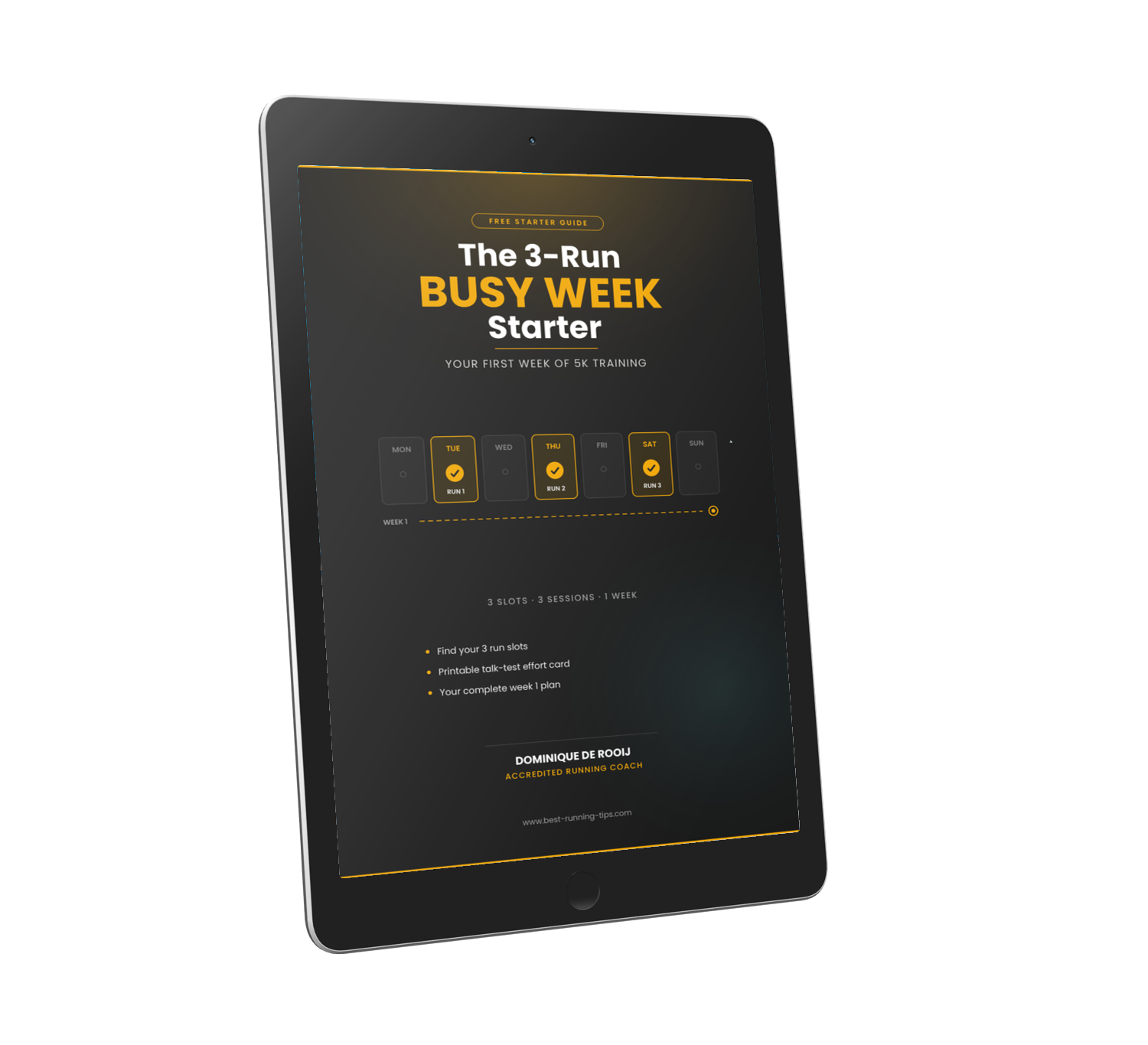
Most beginners don't quit for lack of motivation. They quit because their plan doesn't fit their life. The 3-Run Busy Week Starter plans your first week around the week you actually have.
- Find 3 run slots you can actually keep
- The talk test: the simple way to stop running too fast
- Your complete week 1 plan: 3 run/walk sessions, about 20 minutes each
You'll get the guide plus a short email every few days to help you through week 1. Unsubscribe any time. Privacy policy.
What's New?
-
Personalized Running Coaching - BRT | Run Smarter, Race Better
 Get a personalized running program built around your current fitness, goals, and schedule - not a generic app template. Choose from BRT Silver, Gold, or Platinum coaching with Dom, accredited running…
 -
Sample 4-Day Marathon Training Week: Base to Taper
A full 4-day-a-week marathon training schedule, phase by phase - base, build, peak, and taper - with named workouts and weekly mileage. -
Marathon Taper for a 10-12 Week Training Cycle
How to taper correctly on a compressed 10-12 week marathon plan - the right taper length, why standard advice doesn't fit, and the week-by-week structure.
