Building Confidence as a New Runner
You build running confidence the same way you build running fitness: through small, repeated, verifiable proof points, not through motivation, willpower, or waiting to "feel ready." A finished run, a completed week, a pace held for the distance you set out to cover. Each one is evidence. Below you'll find how to handle self-consciousness running in public, how to stop comparing yourself with other runners, rebuilding confidence after a setback, milestones for your first three months, simple sports psychology techniques explained step by step, and how to tell when confidence isn't the real problem.Two things undo new runners faster than anything else: being seen while they run, and measuring themselves against everyone else. Leave either one alone and confidence stalls however many runs you log, so we'll deal with both head-on.
Overcoming Self-Consciousness Running in Public

How to Stop Comparing Yourself to Other Runners
In-person comparison is old news. The modern version is Strava and Instagram feed comparison, where every runner you follow appears to be faster, further, and more consistent than you. It's a distorted sample, not a fair one. For the full reframe, and concrete practices for what to focus on instead of someone else's pace or mileage, see how to stop comparing yourself to other runners.Rebuilding Confidence After a Setback

Confidence-Building Milestones for Your First Three Months

| Situation | Small evidence-building action | What it proves |
|---|---|---|
| Feeling shaky before a run/walk session | Complete the session exactly as planned, even if slower than hoped | You can follow through, not just start |
| Unsure you can run without stopping | Run a set distance non-stop for the first time, at any pace | Your body can do more than your doubts assumed |
| Worried this week won't stick | Complete every planned session in the week, rest days included | Consistency is achievable, not just a one-off |
Simple Sports Psychology Techniques, Explained Step by Step
Even the more credentialed advice on this topic tends to name a technique and move straight on, without ever explaining how to actually use it. Two worth knowing by name: implementation intentions — deciding in advance exactly when and where you'll run, so the decision is already made before motivation has to show up — and brief pre-run visualisation, used properly, as a rehearsal of the run itself rather than a wish. For the full step-by-step walkthrough of both, see simple sports psychology techniques, explained step by step.When Confidence Isn't the Real Problem
One honest boundary before you go further: this page is about confidence, not about the acute urge to quit in your first few weeks, which is a motivation problem and is covered separately — see dealing with motivation loss in the first weeks. If weight loss is part of why you started and you're worried your motivation won't last?, that's the same kind of question — sort your weekly schedule first, then come back to confidence. And if what's actually stopping you is pain, breathlessness, or genuine overtraining, that's a training-plan or medical question, not a confidence one. Sort the physical issue first. Confidence-building works on top of a body that's able to run, not instead of one.Frequently Asked Questions
How long does it take to feel confident as a runner?There's no fixed timeline. Confidence tracks the number of runs you've completed, not the number of weeks on a calendar — more proof points, more belief.
How do I get back on track after missing a week of running?
Restart at an easier level than where you left off and rebuild from there. See rebuilding confidence after a setback for the full framework.
Does running with a group help build confidence?
Yes, through social proof and normalised pacing — provided you choose a group at the right level for you, not one that leaves you gasping to keep up.
What's a realistic first goal to build early confidence?
Something small and checkable — completing a set run/walk session three times in a week, for example — not a race and not a pace target.
Why do I feel like I don't belong when I run?
Impostor-style feelings are very common in the first few months of running. They fade as your evidence of having done it before builds up.
More Pages on This Topic
Some Other Pages You May Like
About the author

Dominique de Rooij (Dom)
Advanced Running Coach certified by Athletics Australia with 20 years of writing about running and over a decade coaching runners — from first-timers to marathoners. Dom's beginner programs have guided thousands of runners and been praised above plans from Jeff Galloway, Hal Higdon, and Runner's World. Now over 50, Dom still loves trail running, parkrun, and the coffee after.
Free beginner guide • From Coach Dom
Start Running This Week, Even If Your Week Is Already Full
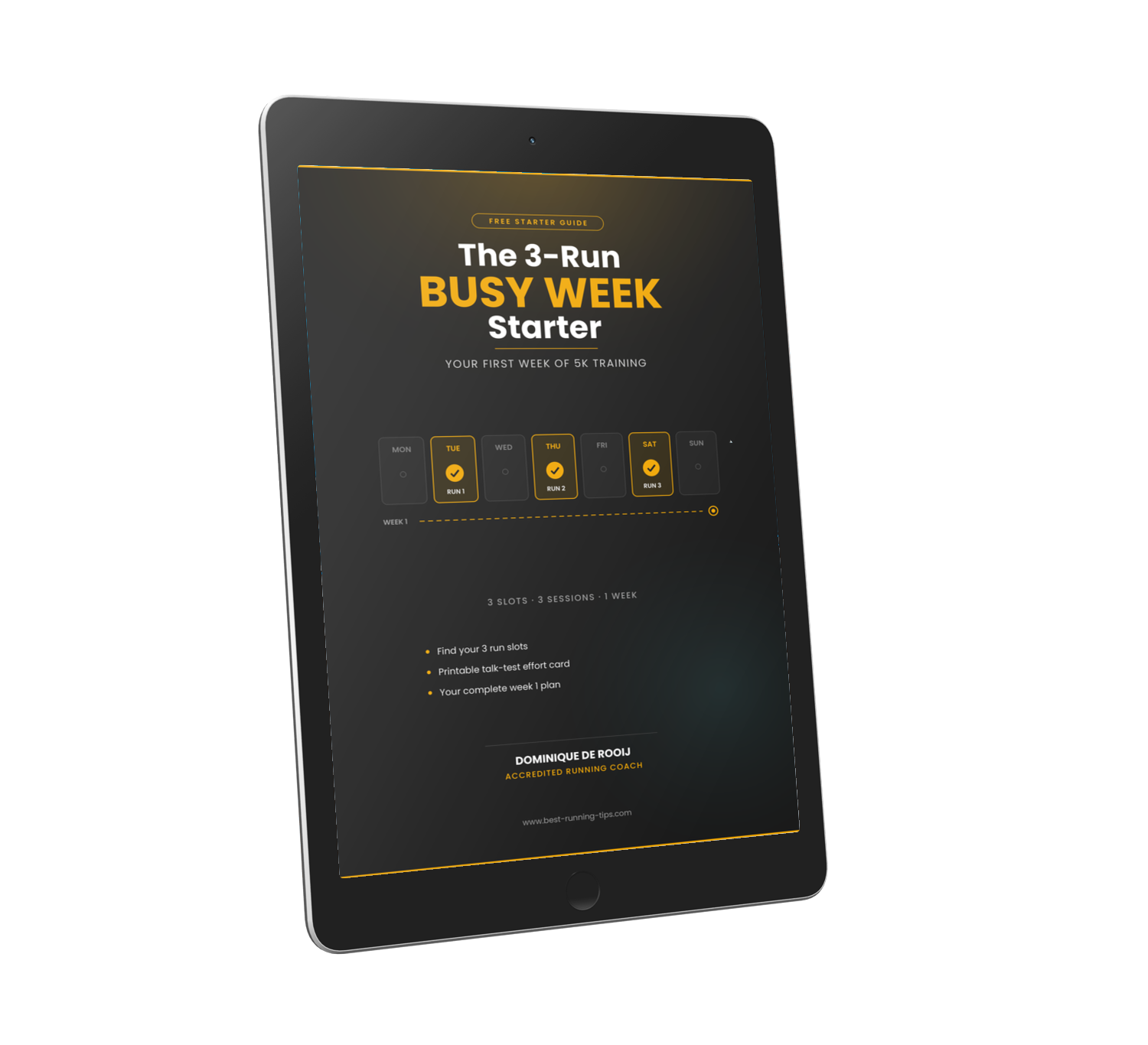
Most beginners don't quit for lack of motivation. They quit because their plan doesn't fit their life. The 3-Run Busy Week Starter plans your first week around the week you actually have.
- Find 3 run slots you can actually keep
- The talk test: the simple way to stop running too fast
- Your complete week 1 plan: 3 run/walk sessions, about 20 minutes each
I'll email you a link to confirm your address, then send the guide plus a short email every few days to help you through week 1. Unsubscribe any time. Privacy policy.
What's New?
-
Cut 90 Seconds Off Your 1.5 Mile Run for the Army Test
Cutting 90 seconds off a 1.5 mile run in 3-4 weeks for the Army test: Dom breaks down realistic pacing to reduce 10:32 toward sub-9:00 for Paras selection. -
Training for a 1.5 Mile Run - How to Qualify For Your Test
Coach Dom's 3-step plan for 1.5 mile run training: build aerobic base, add strides, then tempo and pace work to hit your test time. -
Improve Your 1.5 Mile Running Time to 10:30: Shin Splints
From 12:59 to 10:30 for 1.5 miles: Coach Dom's shin-splint fix and training plan to improve your running time in 2-3 months.