How to Stop Comparing Yourself to Other Runners
Willpower isn't the fix here, and neither is the well-meaning advice to just focus on your own journey. What actually works is more concrete: swap the comparison target from other runners to your own trend data — pace, consistency, effort over time — and adjust the apps that put other people's numbers in front of you by default. I see this exact spiral in new runners I coach every month, and the swap above is what breaks it.Why Comparison Feels So Automatic for Runners
Running is almost uniquely set up to make you compare yourself to others. Your performance is numeric and instantly visible — pace, distance, splits, all sitting right there on a screen the moment you finish. And running is social by default, too: group runs, races, and apps that show you everyone else's numbers alongside your own.Put a numeric hobby and a social one together, and near-universal comparison is the result. Not a personal failing. Not a sign you're doing this wrong. That's a different problem from feeling self-conscious running in public — this page is about the numbers, not who might be watching you run.
The Modern Trigger: Strava, Instagram, and Social Comparison
In-person comparison is old news. Someone finishes ahead of you in a group run, you notice, and it fades by the next session. The modern version is a different mechanism entirely.Strava's kudos and leaderboards, and Instagram running content, are curated highlight reels — the best pace, the best photo, the best day, posted on purpose. In-person comparison is one visible moment. A feed is a constant, edited stream of other people's peaks.
The damage isn't just what you see — it's how often. You check a feed several times a day, not once at the end of a group run. That repetition is what makes passive, feed-based comparison harder on your motivation than the in-person version ever was. Name the mechanism, and it loses some of its grip.
What to Track Instead: Metrics That Actually Serve You
Every generic answer to this problem tells you to "focus on yourself" without ever naming what that means in practice. Here's the actual list.Track your consistency streak — runs completed against runs planned — because showing up is the one thing that's entirely within your control. Track your effort, or rate of perceived effort (RPE, a 1 to 10 scale of how hard you are working), at a fixed easy pace, since a lower effort for the same pace over time is real, measurable progress. Track your longest continuous run without walking, a number that only moves in one direction as you build up. And track your week-over-week mileage, because a steady, sensible increase tells you far more about your progress than anyone else's pace ever could.
Four numbers, all yours, all improving even on weeks your pace doesn't. When I'm coaching a brand-new runner, I only ever ask them to log one or two of these at a time — usually the consistency streak first, sometimes effort at easy pace — because handing someone four new things to track at once is how tracking itself becomes another thing to quit.
| Stop tracking this | Track this instead |
|---|---|
| Other runners' pace on Strava | Your effort (RPE) at a fixed easy pace |
| Other runners' mileage or splits | Your own week-over-week mileage |
| Leaderboard position on a segment | Your consistency streak (planned vs. completed) |
| Someone else's personal best | Your longest continuous run without walking |
These are exactly the sort of numbers that build real confidence over time — for the fuller picture of what progress looks like in your first few months, see confidence-building milestones for your first three months.
Adjusting Your Apps to Reduce Comparison Triggers
The trick is reducing the trigger, not fighting the reaction once it's already there. You can't will yourself out of feeling discouraged by a feed that's designed to be scrolled. But you can change what that feed shows you.On most running apps, you can hide your own pace and splits from public view, mute specific segments or leaderboards so they stop appearing altogether, turn off kudos notifications so a quiet run doesn't feel like a public event, and unfollow — or simply mute — accounts that reliably trigger comparison rather than motivate you.
Start with muting leaderboards and segments, not unfollowing people outright. It's a smaller, lower-friction change, it's reversible, and in my experience it's the one that actually sticks — unfollowing feels like a bigger social step, and beginners are far more likely to talk themselves out of it and quietly re-follow within a week.
Comparing Yourself to Your Past Self, Made Concrete
"Compare yourself to your past self" is the classic advice, so here's how to actually do it. Here's the method.Pick one metric — your pace at a fixed easy effort, or your time on a known route you run regularly. Log it every two to four weeks. Compare it only against your own most recent entry, not against where you started or where you'd like to be.
That gives you an actual number to feel good about. Not a vague mindset shift you're supposed to will into existence — a real one. Two months of easy-pace numbers sitting side by side is worth more than any pep talk.
When Comparison Can Actually Help You
Not all comparison is harmful. The difference isn't who you're comparing yourself to — it's whether the comparison is chosen and actionable, or passive and constant.Pacing off a training partner who's slightly faster than you, or using a group's average pace as a stretch target for one session, is comparison you've chosen, for a specific reason, on a specific day. I coached a runner who used exactly this — pacing off a training partner roughly 30 seconds per kilometre quicker than her — for her last few long runs before a half marathon, and it took real time off her finish without ever feeling like pressure, because she'd chosen it and could opt out any run she liked.
Scrolling a stranger's personal best with no relationship to your own training is the opposite. Passive. Constant. Entirely outside your control. Same word, comparison — two completely different effects.
Building a Mindset That Sticks Long-Term
None of this is about eliminating comparison altogether — that's neither realistic nor necessary. It's about changing what gets compared, and how often you're exposed to what doesn't serve you.Compare your own trend data, not other people's. Choose your comparisons — a training partner, a pace group — rather than letting a feed choose them for you. And adjust your app settings so the numbers you don't need stop showing up by default.
This gets easier with time, mostly because you'll have more of your own data to look at instead of everyone else's. It's part of the same process as building confidence as a new runner more broadly :)
Frequently Asked Questions
Is it normal to compare my pace to people who've been running much longer?Yes, it's close to universal among new runners. The reframe isn't to stop noticing other people entirely — it's to track your own consistency, effort and mileage instead, so you have something of your own worth watching.
How do I stop checking other runners' splits and paces during a race?
Hide your own pace display and turn off the leaderboard view before the race starts, and go in with a plan for your own effort rather than a plan to react to whoever's ahead of you.
Can comparing myself to a training partner ever be a good thing?
Yes — when it's chosen and actionable, like pacing off a partner who's slightly faster than you, it can push you on productively. That's a different mechanism from passively scrolling strangers' personal bests.
How do I handle a friend or family member who keeps comparing my times to theirs?
Redirect the conversation to your own consistency and effort rather than defending your pace. You don't owe anyone a comparison you didn't ask for.
Why does comparison feel worse on race day than during training?
The stakes are higher and the comparison points are far more visible — start corrals, live results, runners streaming past you — so the same feed-comparison mechanism above gets amplified on the day.
Some Other Pages You May Like
About the author

Dominique de Rooij (Dom)
Advanced Running Coach certified by Athletics Australia with 20 years of writing about running and over a decade coaching runners — from first-timers to marathoners. Dom's beginner programs have guided thousands of runners and been praised above plans from Jeff Galloway, Hal Higdon, and Runner's World. Now over 50, Dom still loves trail running, parkrun, and the coffee after.
Free beginner guide • From Coach Dom
Start Running This Week, Even If Your Week Is Already Full
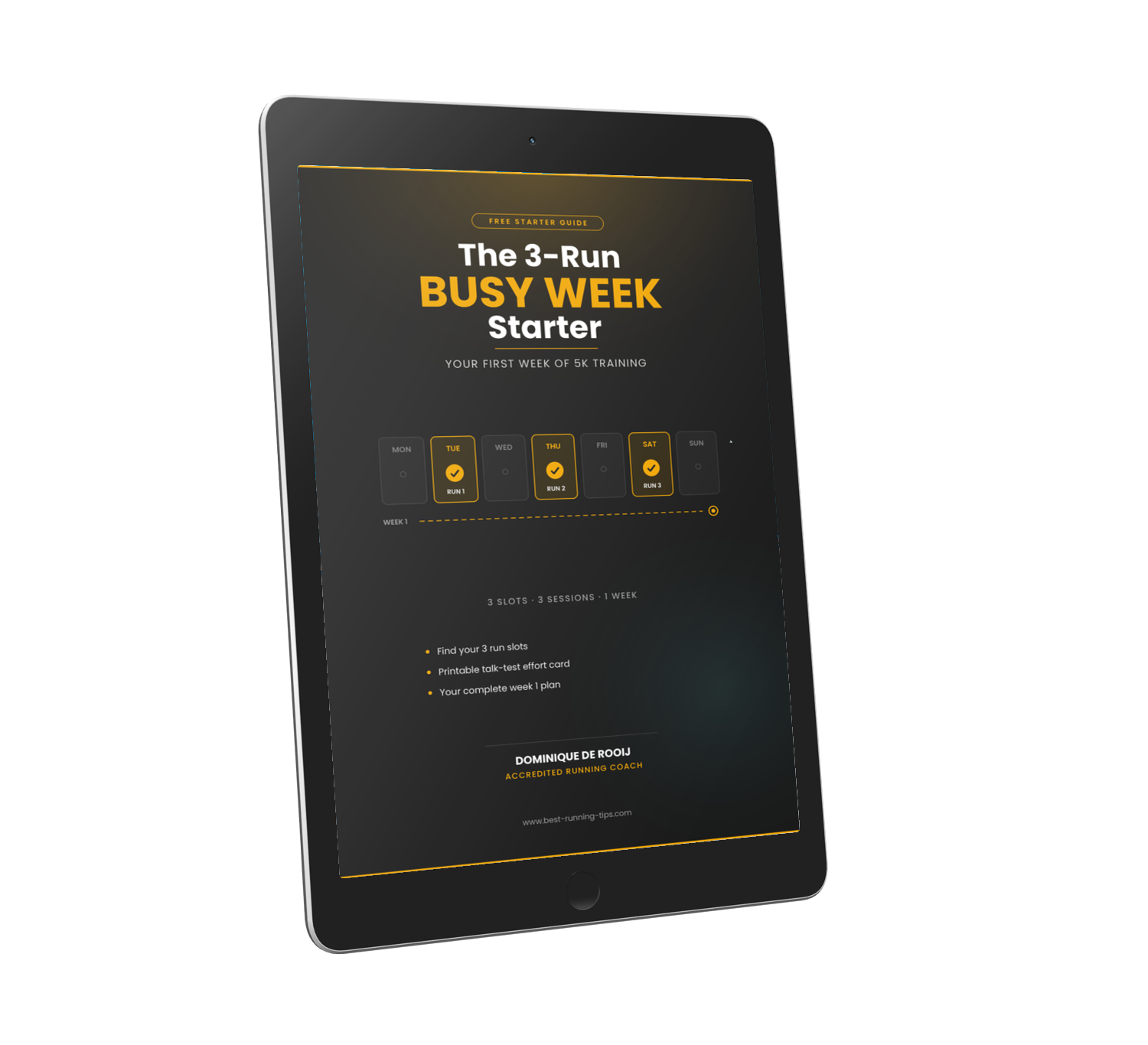
Most beginners don't quit for lack of motivation. They quit because their plan doesn't fit their life. The 3-Run Busy Week Starter plans your first week around the week you actually have.
- Find 3 run slots you can actually keep
- The talk test: the simple way to stop running too fast
- Your complete week 1 plan: 3 run/walk sessions, about 20 minutes each
You'll get the guide plus a short email every few days to help you through week 1. Unsubscribe any time. Privacy policy.
What's New?
-
Personalized Running Coaching - BRT | Run Smarter, Race Better
 Get a personalized running program built around your current fitness, goals, and schedule - not a generic app template. Choose from BRT Silver, Gold, or Platinum coaching with Dom, accredited running…
 -
Sample 4-Day Marathon Training Week: Base to Taper
A full 4-day-a-week marathon training schedule, phase by phase - base, build, peak, and taper - with named workouts and weekly mileage. -
Marathon Taper for a 10-12 Week Training Cycle
How to taper correctly on a compressed 10-12 week marathon plan - the right taper length, why standard advice doesn't fit, and the week-by-week structure.
