Base Training for Runners: Build Your Aerobic Foundation

What Base Training Actually Builds

Here's the mechanism behind it. Every heartbeat pumps blood through your body, and that blood carries the oxygen your muscles need to function. Base running trains your heart to pump more blood with every single beat.
More base running → stronger heart → more blood pumped → more oxygen delivered to your working muscles.
But base running does more than strengthen your heart. Easy running transforms your muscles at the cellular level. Your muscles learn to:
- Increase mitochondria that process oxygen
- Burn fat efficiently as fuel
- Receive oxygen better
- Handle lactic acid more effectively
The Five Base Training Sessions

1. Long Slow Run
A weekly long run works well for most serious runners — usually fairly slow, sometimes with a little quality mixed in. Depending on where you are in your programme, this runs anywhere from 30 minutes to roughly three hours. If that's 10 minutes for you right now, that's fine — you build it up over time.
Your pace can sit markedly slower than easy running, or right at easy pace. On a heart rate monitor, that's Zone 1 (about 50 beats below max) up to Zone 2 (about 40 beats below max). The key isn't speed — it's time on your feet.
2. Easy Running

Most runners mess this up by going too fast. If you can't talk comfortably, slow down. Your ego takes a small hit. Your fitness soars.
That's not just a rule of thumb — it's why easy runs stay easy in the first place. For the physiology behind training at or below your aerobic threshold, see Hadd's Approach to aerobic base building.
3. Recovery Running
When your legs feel heavy from yesterday's harder session, get out and log some easy miles anyway. Recovery running eases muscle soreness and quietly adds to your weekly mileage. Speed matters far less than simply getting out the door for a few slow miles — and cross-training works well here too.
4. Steady State Running
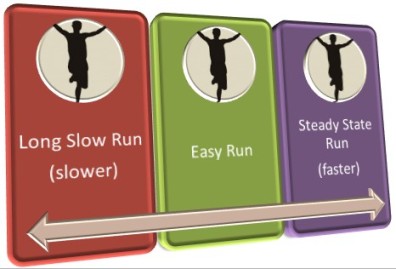
Where does it fit if you're already juggling tempo and interval sessions? Rotate steady state in place of a tempo or interval session on alternating weeks, rather than adding it on top — it's not a replacement for either one, it's a third gear.
5. Progressive Long Runs
Sometimes it pays to combine session types in one run. A progressive long run does exactly that — you gradually increase your speed as the run goes on. It's not technically pure base running, but it blends easy, steady-state and faster running, and it teaches you to run well on tired legs — useful for every race, especially half marathons and marathons. A typical session: 90 minutes, increasing pace every 15 minutes, from very easy to moderately hard.
An alternative is the long run with a fast finish — easy for most of the distance, then 2-4 miles at faster pace (e.g. a 2-hour run finishing with 15 minutes at marathon pace). Or a long run with faster steady-state intervals threaded through it, e.g. a 12-mile run with 4 x 1 mile at sub-threshold pace.
Progression by Experience Level

Beginner Runners (0-1 years of consistent running)
Weekly Structure:
- Long runs: 45-75 minutes, very conversational pace
- Easy runs: 20-40 minutes, 3-4 times per week
- Recovery runs: 15-25 minutes after any harder efforts
- Steady state: start with something like 3 x 5 minutes steady state, 1 minute recovery
- Progressive runs: save these for later in your development
Intermediate Runners (1-3 years of consistent running)
Weekly Structure:
- Long runs: 75-120 minutes, mix of easy and steady-state pace
- Easy runs / recovery runs: 30-60 minutes, 2-4 times per week
- Steady state: 2-3 sessions ranging 25-30 minutes of intervals (5 x 5 min, 3 x 8 min, 3 x 10 min, etc.)
- Progressive runs: monthly, starting with 60-minute progressions
Advanced Base Runners (3+ years of consistent running)
Weekly Structure:
- Long runs: 90-180+ minutes, incorporating various paces and efforts
- Easy runs / recovery runs: 45-75 minutes, 2-4 times per week
- Steady state: 2-3 sessions ranging 30-45 minutes of intervals
- Progressive runs: bi-weekly, up to 2+ hour progressions
The progression isn't about doing more — it's about doing it smarter. Advanced runners can handle more complexity. Beginners need to focus on consistency above all else.
How Long Should Your Base Phase Last?
Most runners need 8-16 weeks in base training, depending on experience and race goal. A fixed number is the wrong frame to fully rely on though — your starting fitness and your goal race both shift that range considerably.Here's a worked example. One runner I coach was rebuilding for a spring marathon off just six weeks in the off-season. Given that short run-in, I sized her base phase at 12 weeks rather than the 8 she'd hoped for — enough time to rebuild the aerobic floor properly before any marathon-specific work began. For the full sizing logic mapped to your own starting point and goal, see how to size your base phase to your fitness and goal.
Mileage Progression and the 10% Rule
Once you're in base training, the 10% rule is your safe-progression starting point: increase your weekly mileage by no more than 10% from one week to the next. Go slower than that when niggles appear, or when you're returning from a break. For the full mileage-progression rules, including consolidation weeks and when to hold steady, see the dedicated page.Common Mistakes During Base Training
Mistake #1: Running Your Easy Days Too Hard. This is the single most common fault I see across the runners I coach. Easy means easy — if you can't hold a conversation, you're going too fast. The fix: run by effort, not by pace. Leave your watch at home occasionally.Mistake #2: Skipping Recovery Runs Completely. A 20-30 minute shuffle often does more good than the couch. The fix: make recovery runs stupidly easy — the goal is movement, not training stimulus.
Mistake #3: Making Every Long Run a Grind. Most long runs should feel comfortable, not like a weekly sufferfest. The fix: run at a pace where you could theoretically keep going for another 30-60 minutes.
Mistake #4: Ignoring the Steady-State Gap. Easy running and tempo running alone leave a gap in your aerobic development. The fix: add one steady-state session a week, starting at 20 minutes and building up — it should feel comfortably hard, not straining.
Mistake #5: Rushing Through Base Building. Real base building takes months and years, not weeks. The fix: if you're used to 6 weeks of base work, try 12-16 weeks instead — your eventual speed work will be far more effective for it.
Mistake #6: Jumping Mileage Too Fast. The 10% rule exists for a reason — your connective tissue, bones and aerobic system all adapt on their own timeline. The fix: increase weekly mileage by no more than 10%, and go lower still if niggles show up.
Mistake #7: Chasing Perfection Over Consistency. Missing a run and then trying to "make up" for it with an extra-hard session breaks the steady stimulus base building needs. The fix: prioritise showing up. A consistent 80% effort beats sporadic 100% efforts every time.
Base Training by Race Distance and Cross-Training
Base building isn't identical for every race. A 5K base leans more on the endurance argument made above, but with less emphasis on sheer time on feet than a marathon base needs — see how a 5K base differs from a marathon base for the full comparison.Cross-training deserves its own answer too — which modality, how much, and on which days all matter more than most runners assume. I cover that in full on cross-training during base building.
Are You Ready to Move to Speed Work?
A few signals tell you your base phase has done its job:- Consistent weekly volume held for several weeks running
- No lingering fatigue on your easy days
- Comfortable, controlled effort at steady-state pace
Advanced Base Training Strategies

Marathon Pace Integration. In marathon preparation, I recommend plenty of marathon-pace running during the base phase — start with 8-mile efforts early on, then gradually build to 16 miles. General rule of thumb: if you can handle a 16-mile marathon-pace run, and you've done the rest of the training, you should be able to run the full marathon at that pace.
Combination Workouts. Two favourites for experienced base builders: TLT (Tempo-Long-Tempo) — a 15-minute tempo run, a 60-90 minute long run, then another 15-minute tempo run to finish (that last 15 minutes seems to last forever); and Long Run with Inserts — a long run with 3 x 3-6 minutes of faster running inserted, with plenty of easy running either side so it doesn't tip into a full interval session.
Terrain Variation. Don't do all your base running on flat roads. Hills build strength while keeping the aerobic emphasis, and trail running adds a proprioceptive challenge that keeps your mind engaged on long efforts. I recommend at least 20% of your base running on varied terrain.
Building your base forms the foundation of every successful training programme. Master it, keep at it, avoid the mistakes above, and your racing improves as a natural consequence of better aerobic development.
For a book that explains how to move from base training into harder sessions, I recommend Daniels Running Formula by coach Jack Daniels.
Frequently Asked Questions
How much should I increase my mileage each week during base building?The 10% rule is a sensible starting point, lower when niggles appear. See the full mileage-progression rules for the complete brief.
Do I need a base phase if I'm not training for a specific race?
Yes — base training is the aerobic floor under all running, race or not, and it's where most of a runner's long-term improvement actually comes from.
What's the difference between base training and general easy running?
Base training is the deliberate, phase-level application of easy running — plus steady-state and long runs — toward a fitness goal. Easy running is just one of its ingredients.
How do I know when my base phase is finished?
When you're hitting your target weekly volume consistently, recovering well, and comfortable at steady-state pace. Full checklist: the full readiness checklist.
Where does steady-state running fit into my weekly training if I'm juggling it with tempo and interval work?
Rotate it in place of a tempo or interval session on alternating weeks, rather than adding it on top. It's not a replacement for either one — it's a third gear.
Connecting Base Running to Your Complete Training System
Base running doesn't exist in isolation — it's the foundation everything else in your programme sits on. Your steady-state runs prepare you for quality sessions. The aerobic capacity you build through long runs becomes the platform for effective interval running later.That shift, from pure base work into quality sessions, is exactly what periodization maps out across a full training year. See how periodization structures your training year, block by block, for the bigger picture.
When you're ready to add variety, fartlek sessions bridge pure aerobic work and structured speed work. And once tempo running and interval work enter your programme, base running doesn't disappear — it just takes up a smaller share of a bigger week. The base phase is also a sensible time to build supporting strength through cross-training, since lower running intensity leaves energy for resistance work that pays off later.
The time you invest in base running now determines how well you'll handle every other part of training. It isn't the glamorous part of the sport. It's the most important part.

More Pages on This Topic
Increasing Mileage Safely
Hadd's Approach to Distance Training
Periodization: The Principles
Having Difficulty with Zone 2 Running
How to Spread Out Your Weekly Running Mileage
Running in Cold Weather and Base Running Phase
A Running Schedule to Run 16 Miles in 14 Weeks
Increasing Pace and Distance
Can't Run Past Two Miles? How to Build Endurance to Go Further
How to Increase Running Stamina: A Run/Walk Plan
How Long Should Your Base Phase Be?
Base to Speed Training: A Transition Checklist
Base Training for 5K vs. Marathon
Cross-Training During Base Training: What to Do and How Often
How Many Kilometers Can Running Shoes Last?
Going from Gymnastics to Running
Some Other Pages You May Like
Home > Running Training > Base Training for Runners

About the author

Dominique de Rooij (Dom)
Advanced Running Coach certified by Athletics Australia with 20 years of writing about running and over a decade coaching runners — from first-timers to marathoners. Dom's beginner programs have guided thousands of runners and been praised above plans from Jeff Galloway, Hal Higdon, and Runner's World. Now over 50, Dom still loves trail running, parkrun, and the coffee after.
Free weekly coaching • Join 3,500+ runners
Train Smarter, Not Just Harder
Get your free guide when you join the BRT Coaching Letter
No spam, ever. Unsubscribe in one click, any time.
What's New?
-
Personalized Running Coaching - BRT | Run Smarter, Race Better
 Get a personalized running program built around your current fitness, goals, and schedule - not a generic app template. Choose from BRT Silver, Gold, or Platinum coaching with Dom, accredited running…
 -
Sample 4-Day Marathon Training Week: Base to Taper
A full 4-day-a-week marathon training schedule, phase by phase - base, build, peak, and taper - with named workouts and weekly mileage. -
Marathon Taper for a 10-12 Week Training Cycle
How to taper correctly on a compressed 10-12 week marathon plan - the right taper length, why standard advice doesn't fit, and the week-by-week structure.
