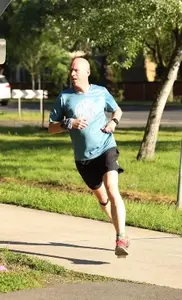
Why Am I So Much Slower Since Coming Back to Running?

"I am now fifty years old and have been back in training for almost a year. I ran regularly in my early thirties, then suffered tendinitis in my left foot that, along with some non-running issues, caused me to stop. Progress with the injury has been slow, but it's improving — it hurts less than it did. I've run two 10K races and two half marathons since getting back into it. But my cadence and pace are slow. I looked up my half marathon time from twenty years ago, and I'm now over an hour slower. I know that as my weight drops — I'm currently 220lbs — I might speed up, but I think I need to work on my cadence and pace too. What do you think?
– Ron, USA
Answer by Dominique: Hi Ron,
Thanks for writing in, and well done on the two 10Ks and two half marathons this year. That's a proper comeback by any measure.
If your pace has fallen off a cliff since you came back to running, you're not looking at one problem. You're looking at three, stacked together: normal age-related decline, twenty years of detraining, and an old tendon injury that was never properly rehabbed. Treat those three separately, not as one big "I've gotten slow" problem.
Let's take your three factors one at a time: your age, your twenty years away, and that old tendinitis. Here's how each one plays into your pace, and what to do about each.
I'll break my response down as follows:
1. Returning to Running — Establishing Your Base
2. Running with Injury Problems and Injury Prevention
3. Is it age? Is it cadence? Is it pace?
1. Returning to Running — Establishing Your Base

The starting point is always the same: a consistent routine, not a heroic one. Three to four runs a week, all at easy pace, holding your mileage flat for two to three weeks before you even think about adding more. Once you've held steady there, apply the 10% rule to build your mileage back up. Increase no more than 10% at a time, and your base grows without breaking down.
Here's the thing, though: you're not actually at this stage any more. A year into your comeback, with two 10Ks and two half marathons already banked, you've done the base-building work. Your real issue now isn't building a base. It's the two things below.
2. Running with Injury Problems and Injury Prevention

Beyond diagnosis, there's a specific approach for exactly your situation — a chronic tendon issue that's improved but never fully resolved: eccentric and isometric loading of the tendon. Two exercises do the job: slow eccentric heel raises — lowering off a step over three to four seconds, for three sets of 10-15 — and isometric holds, where you hold a loaded calf raise for 30-45 seconds. That's the loading protocol physios reach for in a long-running, low-grade case like yours. As a coach, I'd frame this as a supplement to your medical treatment, not a replacement for it. Your physio or doctor should still be steering the diagnosis.
General strength work still matters too, and it matters more as we age. Strong muscles support your joints better and lower your risk of niggles like tendinitis in the first place. Here are some simple exercises to build in:
- Squats - strengthen your legs and core.
- Lunges - great for balance and building your leg muscles.
- Planks - strengthen your core, which helps maintain proper running form.
- Push-ups - good for overall upper body strength and core.
3. Is it age? Is it cadence? Is it pace?

You mentioned you've got weight to lose, and that's a real lever. Lighter on your feet at the same effort means faster. A sensible diet alongside your running and strength work should get you there.
As for cadence, it's easy to get fixated on it. Unless yours is genuinely very low, I wouldn't chase it consciously. It's hard to change through drills alone. As you run more, your body tends to find its own efficient rhythm — with cadence improving as a byproduct, not a target.
A year into your comeback, with your base built and two 10Ks and two half marathons already run, you're well placed to start adding some faster running. But here's the training-load piece that matters given your tendon: increase your intensity and your volume separately, not both at once. Add pace, or add mileage. Not both in the same week.
Here are two beginner-friendly ways to add faster running once you're ready:
Strides
At the end of an easy run, run four to six strides — fast but controlled for about 100 metres, then walk back to your start point. Short, controlled, low-stress: a good way to sharpen leg turnover without loading the tendon hard. My running strides page has the full how-to.
Fartlek
Fartlek is Swedish for "speedplay" — unstructured bursts of faster running mixed with slower running. Run a block fast, then a block easy, using lamp posts or street corners as your markers. If unstructured feels too loose for an organised mind, check out the fartlek workouts page for some well-known structured versions.
As you progress, my running workouts page has further ideas for running fast in different ways. If fatigue or pain start creeping up as you add any of this in, that's your cue. Check whether this is a training-load issue, not just age.
Ron, yours is about as long a layoff as they come. If you want the bigger picture beyond just age and injury, here's the full framework for coming back after a long layoff. And if progress stalls again down the track, my running plateau diagnosis page has the full plateau, overtraining and undertraining framework for working out why.
You've already done the hard part, Ron — getting back out there and staying consistent for a year, plus two 10Ks and two halves along the way. Sort the tendon properly, keep building sensibly, and let your pace come back on its own timeline rather than the one you set twenty years ago.
Kind regards,
Dominique
Some Other Pages You May Like
About the author
Dominique de Rooij (Dom)
Advanced Running Coach certified by Athletics Australia with 20 years of writing about running and over a decade coaching runners — from first-timers to marathoners. Dom's beginner programs have guided thousands of runners and been praised above plans from Jeff Galloway, Hal Higdon, and Runner's World. Now over 50, Dom still loves trail running, parkrun, and the coffee after.
Free weekly coaching • Join 3,500+ runners
Train Smarter, Not Just Harder
Get your free guide when you join the BRT Coaching Letter
No spam, ever. Unsubscribe in one click, any time.
What's New?
-
Personalized Running Coaching - BRT | Run Smarter, Race Better
 Get a personalized running program built around your current fitness, goals, and schedule - not a generic app template. Choose from BRT Silver, Gold, or Platinum coaching with Dom, accredited running…
 -
Sample 4-Day Marathon Training Week: Base to Taper
A full 4-day-a-week marathon training schedule, phase by phase - base, build, peak, and taper - with named workouts and weekly mileage. -
Marathon Taper for a 10-12 Week Training Cycle
How to taper correctly on a compressed 10-12 week marathon plan - the right taper length, why standard advice doesn't fit, and the week-by-week structure.