What to Do After Couch to 5K: Your Next 4 Weeks
Finished Couch to 5K? You now have three legitimate paths forward — and no program is telling you which one to take. Build toward a 10K to run farther, sharpen your speed to run faster at your current distance, or hold steady as a maintenance runner. Below is a real 4-week bridge plan for whichever path you choose, not just vague advice.
I've coached runners through exactly this transition for over 20 years. I've watched strong finishers quietly stop running in the weeks right after graduating — not from a lack of fitness, but from a lack of a plan. Here's what actually works next.
Why Weeks 10–14 Are a High-Risk Window for Quitting
Let's name the real risk here. Finishing a structured program removes the accountability that got you this far — the daily instructions, the built-in progression, the sense that someone else has already planned today's session for you. Once that structure disappears, so does the routine that carried you through it.This transition period — not the program itself — is where I see many new runners quietly stop, often within a few weeks of finishing. That's not a scare tactic. It's the reason this page gives you a specific plan for your next 4 weeks, rather than a vague "keep it up."
Two Paths Forward: Running Faster vs. Running Farther
From here, the fork in the road has two real options. "Faster" means speed-focused sessions at your current distance — roughly 30 minutes, or about 5K — designed to make that same distance feel easier. "Farther" means progressively building your mileage toward a 10K, using the same run/walk foundation that got you through Couch to 5K.Runners who already have a race or distance goal tend to prefer farther. Runners who are happy at their current distance, but want it to stop feeling hard, tend to prefer faster — see effort-based pacing guidance for how to judge that effort without a watch.
How to Choose Based on Your Own Goals and Constraints
The right answer depends on you, not on what's trending in running content. Ask yourself three questions. Do you already have a race or distance goal in mind, like a half marathon somewhere down the line? Do you have an injury history that argues for staying at your current volume a while longer before adding more? And realistically, how much weekly time do you actually have to give this?A distance goal points you toward farther. An injury history or limited time points you toward faster, or toward maintenance. There's no wrong answer here — only the one that's sensible for your actual life.
A Real 4-Week Bridge Plan
This is the part most advice skips — a genuine bridge, not a full program dumped on you cold. Here's how I'd sequence your next 4 weeks, built on the same progressive logic behind Beginners Running Program 3 and the 10K Running Program.| Week | Focus | What to do |
|---|---|---|
| 1 | Hold steady | Keep running 30 minutes non-stop, 3 times a week — consolidate what you've built before adding anything. |
| 2 | Add length | Keep two 30-minute runs, extend the third to around 35–40 minutes. |
| 3 | Add faster or add distance | Choose one: swap a 30-minute run for a faster-effort session, or extend your longest run further, toward 45 minutes. |
| 4 | Reassess | Decide whether to formally start the 10K Running Program, keep building on your own, or settle into maintenance. |
This bridge is deliberately short — a genuine step, not week 1 of a 12-week program in disguise. Starting the 10K Running Program cold, straight off Couch to 5K, is a bigger jump than it looks. These 4 weeks close that gap first.
Maintenance Running: A Valid Third Option
Let's be direct about this: running 30 minutes, 3 to 5 times a week, with no further distance or speed goal, is a complete and sustainable outcome. You don't need a bigger running goal to justify the time you're already putting in.If you want to round out your training without chasing more mileage, cross-training or strength work is a sensible way to do it — not a consolation prize, but a genuine complement to the running you're already doing.
Moving From a Fixed Program to Planning Your Own Runs
No program telling you what to do each day doesn't have to mean no structure. For your first self-directed week, pick 3 fixed run days and treat the rest as flexible recovery days — walk, rest, or cross-train, whatever suits you.Easy to understand. Easy to stick to. That's the whole point.
Signs You're Ready for a Longer 10K-Specific Plan
You'll know you're ready to move on to a proper 10K program when a few things line up. You can comfortably run 30-plus minutes at an easy effort on 3 consecutive scheduled days. You don't have lingering soreness that lasts beyond 24 to 48 hours. And — this one matters most — you genuinely want a distance goal, rather than feeling like you should want one.Tick those three, and it's time for the 10K Running Program.
Frequently Asked Questions
A few quick answers to what readers ask most about this transition.Should I keep running the same distance/time or start increasing it right away?
Either is fine. If you'd rather progress, use this page's 4-week bridge plan rather than jumping straight into a full 10K program — you don't need 12 weeks of structure to take the next sensible step.
Is it true more people quit running shortly after finishing Couch to 5K than at any other point?
Yes. This transition window — roughly weeks 10 to 14 — is a known high-attrition point, because the built-in program structure that got you here disappears overnight.
Should I run faster or farther first?
It depends on your goals. Choose farther if you already have a distance goal in mind, like a 10K or half marathon down the line. Choose faster if you're content at your current distance and want it to feel easier.
Do I need a formal 10K plan right away, or can I just keep running casually?
No. A 4-week self-directed bridge, like the one above, is a sensible and recommended step before you commit to a full program.
Is it okay to just maintain my current fitness without a new goal?
Yes — this is a legitimate, sustainable choice, not a lesser one.
How do I structure my own runs now that I don't have a program telling me what to do each day?
Fix three run days a week and treat the rest as flexible recovery days. That's the whole system.
If I eventually want to run a half marathon, what's the realistic path from here?
The 10K Program next, then the Half Marathon Running Program after that. One BRT reader went from zero running to a half marathon in nine months following exactly this sequence.
Do I need to start drinking sports drinks or using gels now that I'm running regularly?
Not at this distance. I only drink during a run once I'm past 90 minutes, or on an extremely hot day — anything shorter than that and hydration during the run itself isn't worth the fuss.
What's a reasonable weekly mileage or frequency right after finishing?
Roughly 3 to 5 runs a week at your current ~30-minute distance is a solid baseline, whichever path you choose next.
So: pick your path honestly — faster, farther, or steady — and give yourself these 4 weeks before committing to anything longer. Back to the full Couch to 5K plan if you want to see where this fits into the bigger picture.
Some Other Pages You May Like
About the author

Dominique de Rooij (Dom)
Advanced Running Coach certified by Athletics Australia with 20 years of writing about running and over a decade coaching runners — from first-timers to marathoners. Dom's beginner programs have guided thousands of runners and been praised above plans from Jeff Galloway, Hal Higdon, and Runner's World. Now over 50, Dom still loves trail running, parkrun, and the coffee after.
Free beginner guide • From Coach Dom
Start Running This Week, Even If Your Week Is Already Full
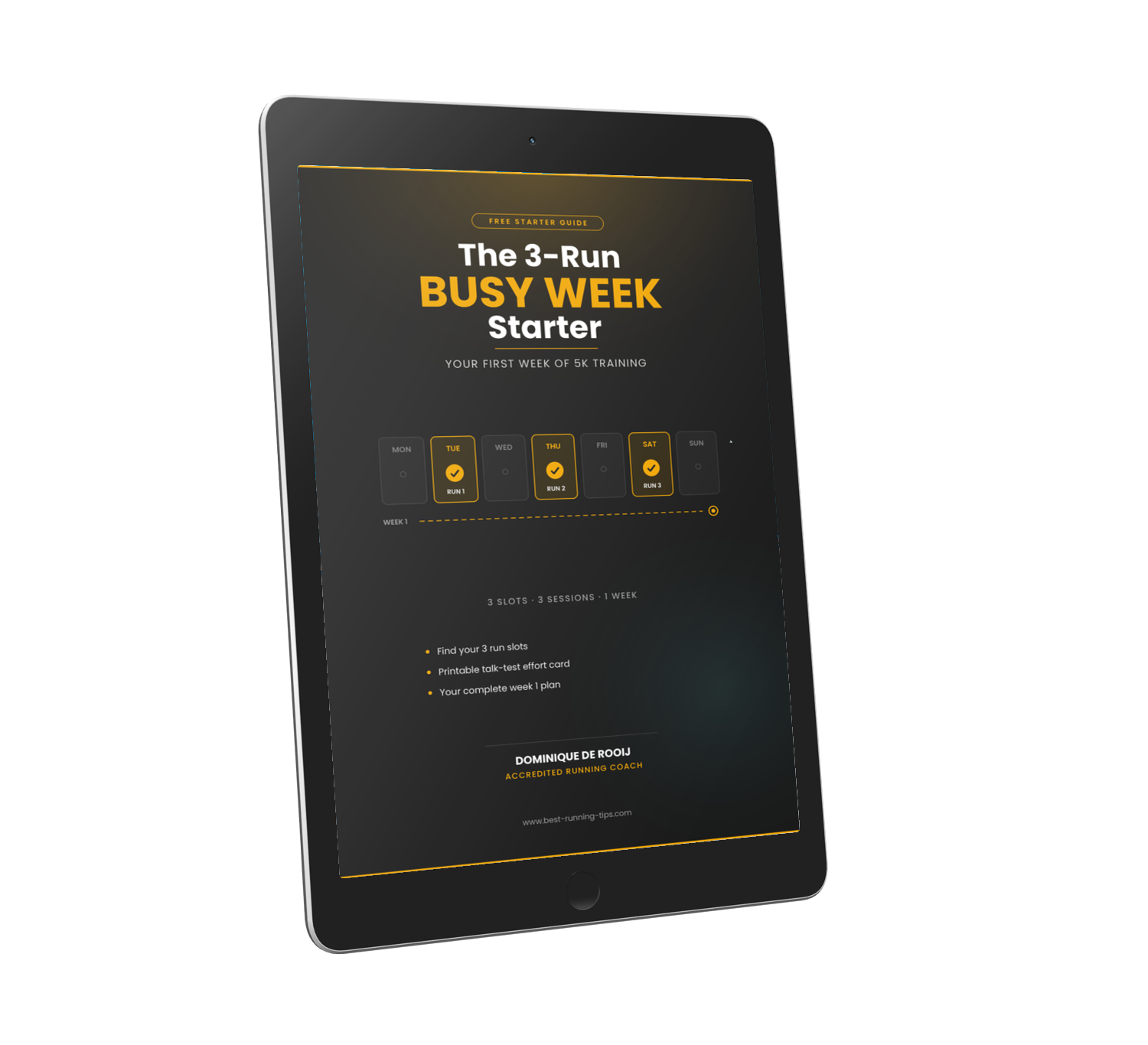
Most beginners don't quit for lack of motivation. They quit because their plan doesn't fit their life. The 3-Run Busy Week Starter plans your first week around the week you actually have.
- Find 3 run slots you can actually keep
- The talk test: the simple way to stop running too fast
- Your complete week 1 plan: 3 run/walk sessions, about 20 minutes each
You'll get the guide plus a short email every few days to help you through week 1. Unsubscribe any time. Privacy policy.
What's New?
-
Personalized Running Coaching - BRT | Run Smarter, Race Better
 Get a personalized running program built around your current fitness, goals, and schedule - not a generic app template. Choose from BRT Silver, Gold, or Platinum coaching with Dom, accredited running…
 -
Sample 4-Day Marathon Training Week: Base to Taper
A full 4-day-a-week marathon training schedule, phase by phase - base, build, peak, and taper - with named workouts and weekly mileage. -
Marathon Taper for a 10-12 Week Training Cycle
How to taper correctly on a compressed 10-12 week marathon plan - the right taper length, why standard advice doesn't fit, and the week-by-week structure.
